
The short answer
Answer engine optimization (AEO) is the practice of making your content easy for AI answer engines, such as Google AI Overviews, ChatGPT search and Perplexity, to find, trust and quote. It builds on SEO: crawlable pages, direct answers to real questions, first-hand evidence and consistent brand facts make a page more likely to be cited.
Key takeaways
- AEO aims for your page to be the source quoted inside the AI answer.
- Google's July 2026 guide says AEO and GEO are still SEO, so the foundations do not change.
- llms.txt files and special schema do not help Google Search, according to Google.
- Blocking AI training crawlers is a separate choice from blocking AI search crawlers.
- Measure with Search Console and a monthly panel of real customer questions.
In this article
- What is AEO?
- How does answer engine optimization work?
- What is the difference between AEO and SEO?
- Why does AEO matter for your business now?
- What are examples of answer engine optimization?
- How do you build an AEO strategy?
- What does AEO cost, and which tools do you need?
- What are the most common AEO myths?
- What to do next with answer engine optimization
Ask an AI assistant which dentist in your town does same-day crowns, or how much a tummy tuck costs in Phoenix, and you get a paragraph, not ten blue links. Somewhere in that paragraph are two or three sources. The businesses behind those sources got the click. Everyone else got nothing, including the ones ranking third on Google.
That shift is what answer engine optimization is about. Every few years the industry renames SEO, adds a letter and sells it back to you. AEO is partly that, and partly a real shift in how people get answers. In the keyword data we use for our clients (SEMrush US, September 2026), aeo meaning alone gets about 2,400 searches a month, so plenty of people are asking.
This explainer covers what AEO means, how answer engines choose what to quote, how AEO relates to SEO and GEO, and the steps worth taking first. It is the plain-English version of the AI search optimization work we do for healthcare, local service, e-commerce and B2B clients.
What is AEO?
AEO, or answer engine optimization, is the work of making your content the source an AI answer engine quotes when it answers a question. Answer engines include Google AI Overviews and AI Mode, ChatGPT search, Perplexity and Gemini. The aeo meaning in marketing is the same: earn a place inside the answer itself.
A search engine hands you a stack of library cards. An answer engine reads the books and tells you what they say, with a few page numbers in the margin if you are lucky. AEO is about being one of those page numbers, and about the book saying the right thing about you.
The term overlaps with older ideas. Featured snippets were an early answer engine: Google lifted a paragraph from one page and showed it above the results. Our glossary entry for AEO keeps the short definition, and the rest of this post covers how it works in 2026.
How does answer engine optimization work?
Answer engine optimization makes your pages easy to find, retrieve and quote when an AI system writes an answer. Google says its AI features use grounding, which means pulling pages from the search index. They also use query fan-out, which means running several related searches at once. Pages that clearly answer those related questions are easier to cite.
Google's guide to optimizing for generative AI features (last updated July 10, 2026 when we checked) describes query fan-out as "a set of concurrent, related queries generated by the model to request more information." A question about fixing a weedy lawn, for example, fans out into questions about weed types, timing and products.
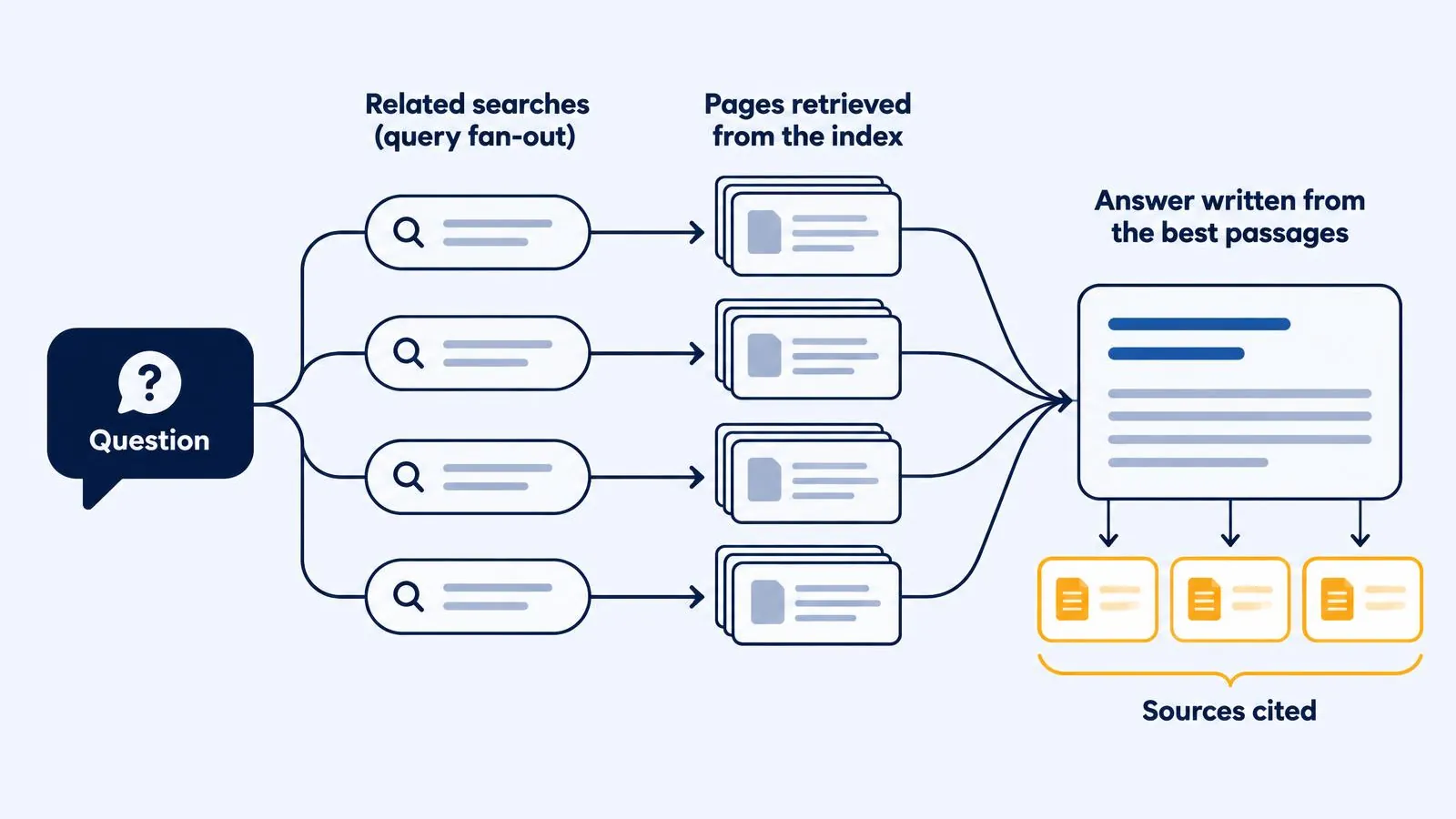
Google calls the related searches query fan-out. Pages that answer the fan-out questions clearly are easier to cite.
Other answer engines work in a similar way, with their own crawlers and indexes. OpenAI says its OAI-SearchBot crawler is used to surface websites in ChatGPT's search features, and that sites which block it will not be shown in ChatGPT search answers. The practical steps are the same everywhere: let the right crawlers in, write passages that stand on their own, and back claims with evidence.
Research supports the evidence part. A study on generative engine optimization by Aggarwal and colleagues found that methods such as adding citations, quotations and statistics could boost a source's visibility in generative engine responses by up to 40%. It was a research setting, not a promise, but the direction matches what we see.
What is the difference between AEO and SEO?
The difference between AEO and SEO is the goal, not the method. SEO aims to rank a page in search results so people click it. AEO aims to have the page quoted or cited inside an AI-written answer. Both rely on crawlable, useful pages, and Google's own guide says optimizing for generative AI search is still SEO.
GEO, or generative engine optimization, is a third name for nearly the same idea, used more often for assistants such as ChatGPT and Perplexity. The table compares all three on what they are judged by.
AEO vs SEO vs GEO
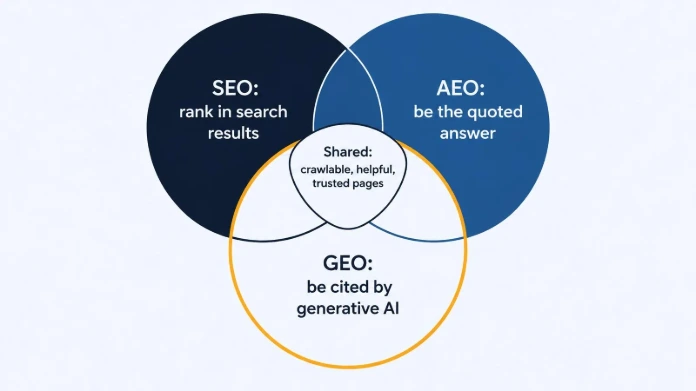
Three names, one foundation: crawlable, useful pages that answer real questions.
So aeo vs seo is a false choice. The sites that show up in AI answers are mostly sites that already do SEO well, with sharper answers and better evidence. Our SEO services and AI search work share the same audit for that reason.
Why does AEO matter for your business now?
AEO matters now because more questions end with an AI-written answer. The businesses cited in that answer collect the trust and the clicks. For healthcare practices, local services, e-commerce and B2B companies, the questions are often the same ones customers used to ask on the phone: cost, fit, timing and who to choose.
An answer engine will happily quote a competitor who explained your service better than you did. It has no loyalty, only reading comprehension. That makes three kinds of content more valuable than before: pages that state prices or price ranges, pages that explain a process step by step, and pages with first-hand detail no one else has.
The effect on traffic is real but uneven, which we covered in what AI Overviews mean for clicks. Fewer people may click for simple facts. The ones who do click tend to be further along in deciding.
Every example shares a pattern: the answer sits in the first sentence of a section, the evidence comes from the business itself, and the page covers the obvious next question. For healthcare, medical SEO uses the same pattern with extra care for claims; for telehealth brands, pricing and eligibility questions come first.
How do you build an AEO strategy?
An AEO strategy has seven steps: let answer engines crawl and quote your pages, answer questions first, cover follow-up questions, show experience and sources, keep brand facts identical everywhere, add structured data that matches the page, and measure monthly. Most sites can start on the first two this week.
- Make sure answer engines can crawl and quote your pages
- Answer the question first in every section
- Cover the follow-up questions people ask next
- Show first-hand experience and cite sources
- Keep your brand facts identical everywhere
- Add structured data that matches the page
- Measure AI visibility every month
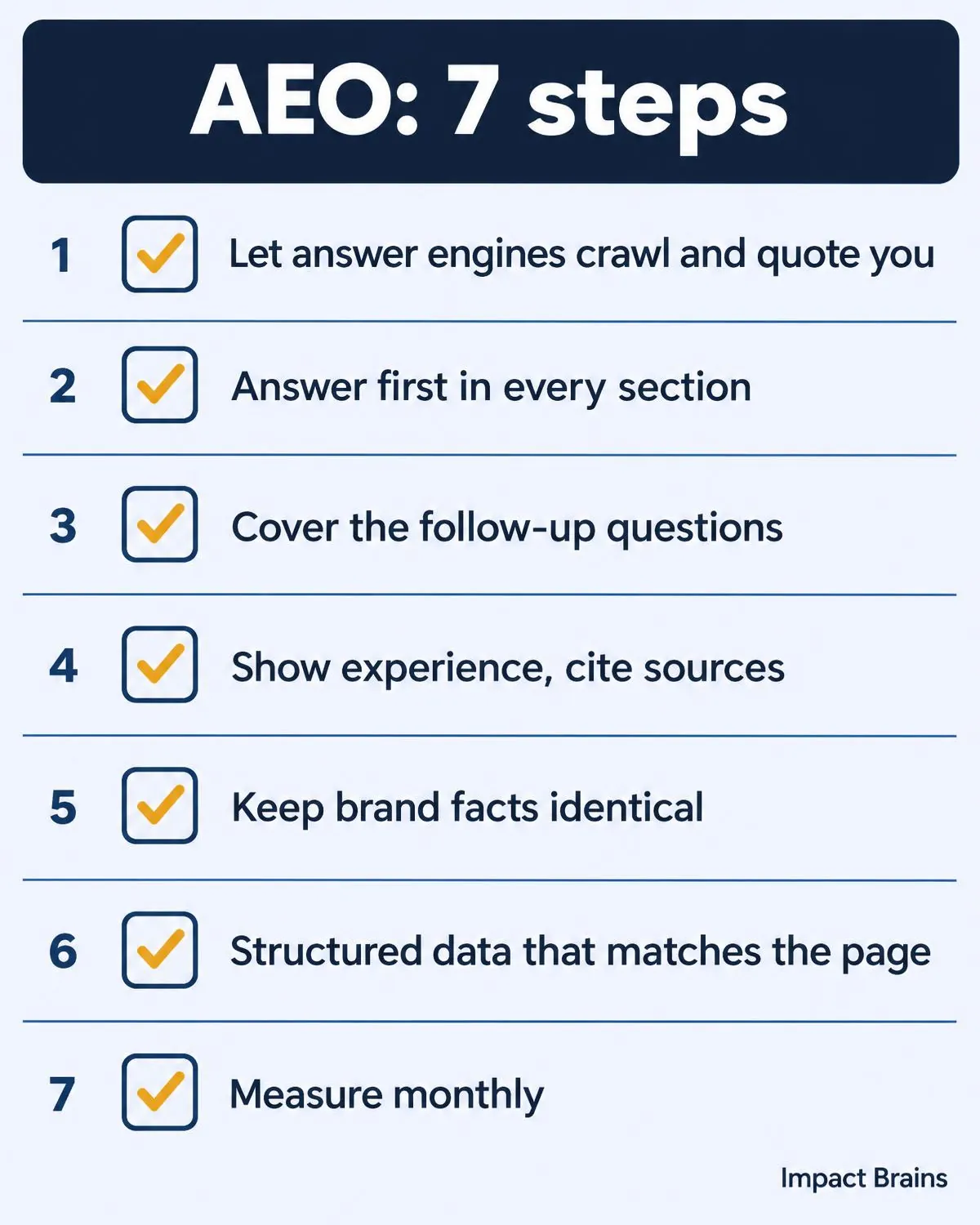
Steps 1 and 5 are the quickest wins for most sites.
1. Make sure answer engines can crawl and quote your pages
Google says a page must be indexed and eligible to show with a snippet to appear in AI Overviews or AI Mode. Check that important pages are not blocked in robots.txt, are not marked noindex and do not use nosnippet. Then decide, one crawler at a time, what you allow, because training and search crawlers are separate.
Crawler controls for answer engines (checked October 2026)
The Google-Extended row comes from Google's list of common crawlers, and the OpenAI rows from OpenAI's crawler page. Many businesses block training crawlers and allow search crawlers. That is a business decision; just make it on purpose.
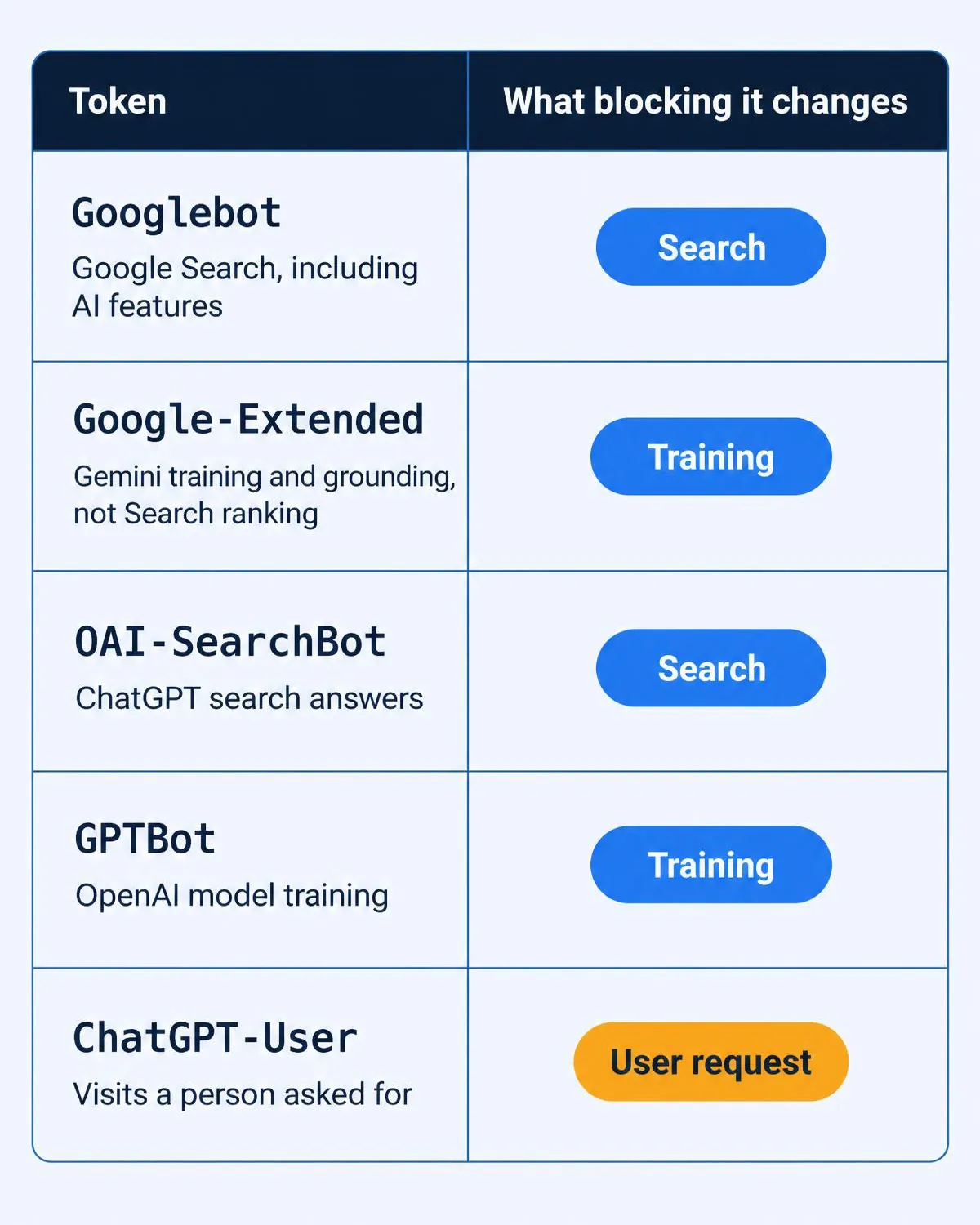
Blocking training crawlers and blocking search crawlers are different decisions. Checked October 2026.
2. Answer the question first in every section
Answer-first writing puts the direct answer in the first sentence under each question heading. Evidence and detail come next. Answer engines quote passages that make sense on their own, so a section that opens with background makes the answer harder to find. This also helps featured snippets and People Also Ask.
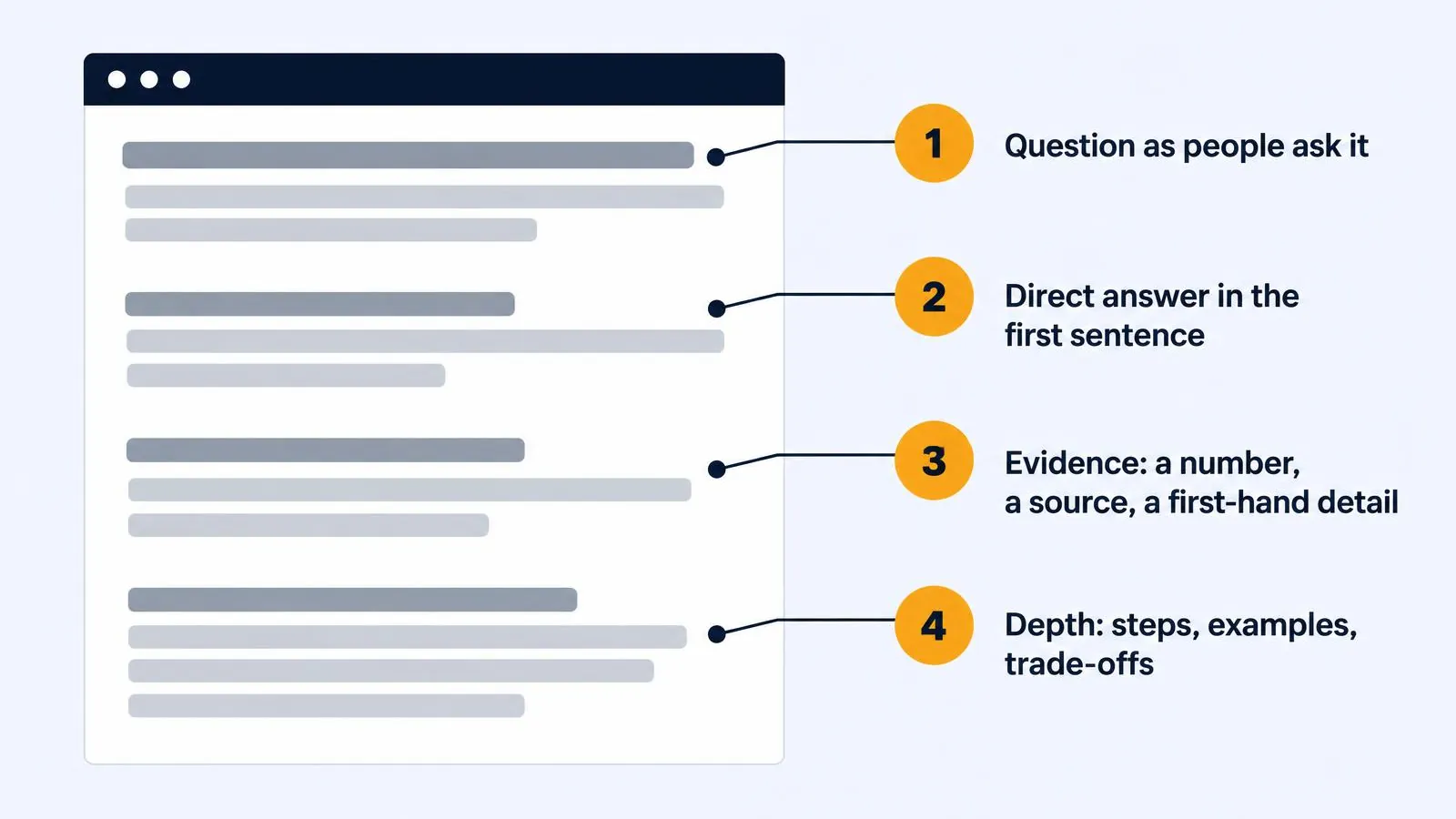
The first sentence answers. The next ones prove it. Everything after that is depth.
Name the subject in the sentence instead of saying it or this, keep the answer to 40 to 60 words, and save the nuance for the paragraphs that follow. Google's guide adds a useful limit: there is no need to break content into tiny pieces for AI. Write normal sections for people, just with the answer up front.
3. Cover the follow-up questions people ask next
Covering follow-up questions matches how query fan-out works. The engine searches for the next questions too, so a page that answers them is more useful to cite. For most services, the follow-ups are cost, time, risks, alternatives and how to choose. Answer them on the same page or link to a page that does.
Do not create a page for every phrasing. Google's guide warns that making content for every query variation to manipulate AI responses breaks its scaled content abuse policy. One strong page per topic, with clear sections, beats ten thin ones.
4. Show first-hand experience and cite sources
First-hand experience and cited sources give answer engines a reason to pick your page over a generic one. Google's guidance asks for non-commodity, people-first content, and its helpful content guidance explains what that looks like. Your process, your numbers and your named sources are the parts nobody else can copy.
In practice: name the author and their role, describe how you actually do the work, link the primary source next to each claim, and date anything that changes. A page that says what you have seen in your own work reads differently from a page that says what everyone says.
Architect's note
When we start AI search work for a client, I do not begin with new content. I begin with the facts. I list the 20 things an answer engine should say about the business: services, locations, prices or ranges, who leads it, who it serves. Then I check whether the website, the Business Profile and the main directories all say the same thing. They rarely do. Fixing those contradictions is the cheapest AEO work there is, and it makes every later page more believable.
Dr. Muhammad Abdullah, Founder & Chief Systems Architect
5. Keep your brand facts identical everywhere
Answer engines treat your business as an entity: one thing with a name, services and places. They read your site, your profiles and brand mentions on other sites together, so the facts need to agree. If your About page and your Business Profile disagree on what you do, the AI will split the difference, and nobody wants to be described as a dental HVAC company. Write one short brand description and reuse it.
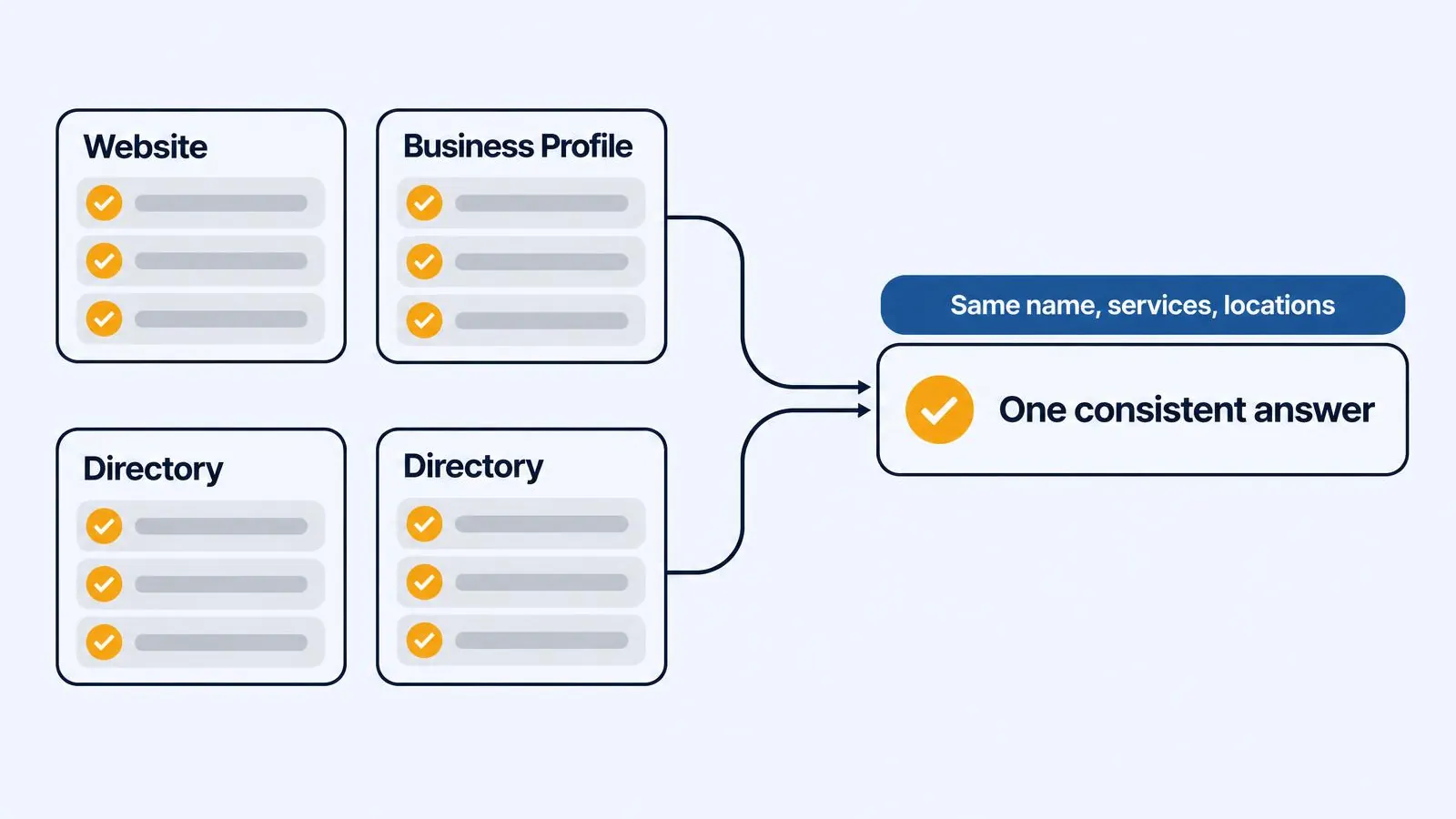
When every source says the same thing, the answer engine has nothing to guess.
Here is ours, as an example: Impact Brains is a marketing systems agency that builds the ads, conversion websites, server-side tracking and CRM automation behind growth, and measures all of it to booked patients, jobs and orders. Use the same name, services and locations on your site, profiles and directories, as we explain in what a marketing system is.
6. Add structured data that matches the page
Structured data is not required for AI features, Google says, and no special schema exists for them. It still helps search engines understand pages and keeps rich results possible, so add the standard types that fit, such as Organization, LocalBusiness, Article and Product, and make sure every value matches what the page shows.
Adding an llms.txt file and waiting for AI Overviews is the web version of putting a welcome mat outside a door Google does not use. Google says its Search does not use these files, and that creating them will neither harm nor help Search visibility. Other services may read them, so create one only if a tool you care about asks for it.
7. Measure AI visibility every month
Measuring AI visibility takes two sources: platform data, such as Google Search Console's generative AI performance report, and a monthly prompt panel you run yourself. Google's guide points to the Search Console report and warns that no third-party tool has access to its internal ranking or AI systems, so treat outside tools as estimates.
A prompt panel is simple: list about 20 real customer questions, ask them in each answer engine that matters to you once a month, and record whether your brand appears and which page is cited. Rank trackers for AI answers are like weather apps for a city that reshuffles its streets every hour: useful for trends, misleading for any single day.
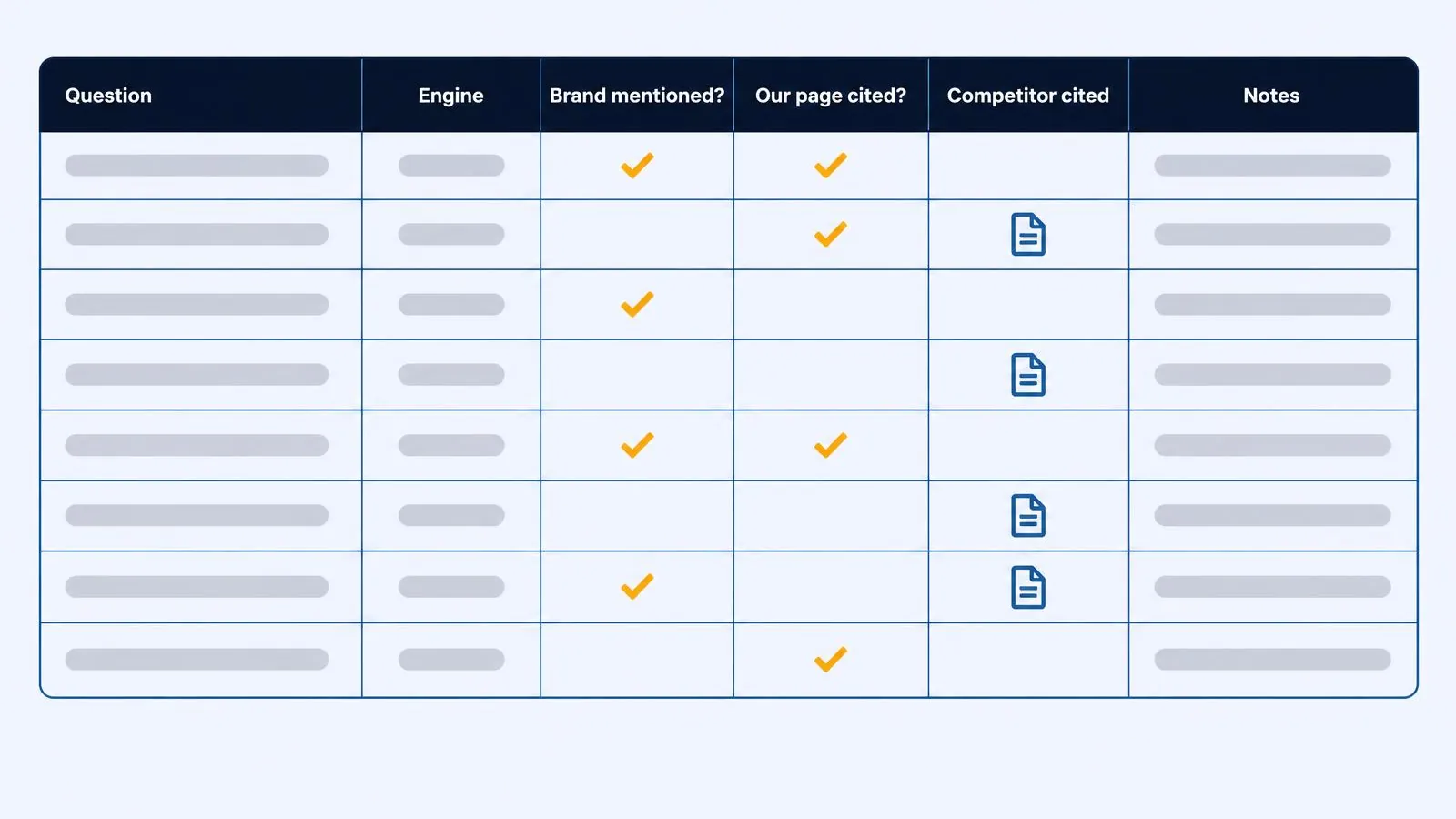
Twenty real customer questions, checked the same way every month, show the trend without paid tools.
Add referral traffic from AI tools in Google Analytics 4 and, most important, the leads and sales that follow. Our revenue attribution setup connects those visits to booked patients, jobs and orders.
Find out how answer engines describe your business
Get a free, recorded audit of your site's crawl access, answer-ready pages, brand facts and tracking, delivered within two business days.
Get my free growth audit →
What does AEO cost, and which tools do you need?
AEO costs mostly time. The core tools are free, and the work is writing, fixing facts and measuring. Google Search Console, Google Analytics 4 and Bing Webmaster Tools cost nothing. Paid prompt-tracking tools and agency help add cost, so start with the free stack and add paid tools only when the monthly panel becomes too slow to run by hand.
- Google Search Console: indexing, snippet eligibility and the generative AI performance report.
- Google Analytics 4: referral traffic from AI tools and the conversions that follow.
- Bing Webmaster Tools: indexing and crawl data for Bing.
- A spreadsheet: the monthly prompt panel.
- Optional paid tools: prompt tracking at scale, used for trends, not exact positions.
If you would rather hand it off, our marketing services run these steps alongside SEO, and our B2B AI marketing page shows how it works for software companies.
What are the most common AEO myths?
The most common AEO myths are that you need special files or markup, that content must be cut into tiny chunks, and that AEO replaces SEO. Google's July 2026 guide contradicts all three. The real work is the same as good SEO, done with sharper answers and better evidence.
AEO myths and what Google's guide says
Treat any AEO offer that leads with a secret file, a magic
schema type or hundreds of near-duplicate pages with care. The things that work
are slower and more ordinary, and they keep working when the engines change.
Frequently asked questions
What does AEO stand for?
AEO stands for answer engine optimization. It means making your content easy for AI answer engines, such as Google AI Overviews, ChatGPT search and Perplexity, to find, trust and quote. In AEO marketing, the term usually refers to earning citations inside AI-written answers.
Is AEO the same as GEO?
Nearly. GEO, or generative engine optimization, usually refers to generative AI tools such as ChatGPT and Perplexity, while AEO is the older and broader term that also covers featured snippets and voice answers. Both rely on the same foundations, and Google treats both as part of SEO.
Do I need llms.txt for answer engine optimization?
Not for Google. Google's AI optimization guide says Google Search does not use llms.txt and that creating one will neither harm nor help Search visibility. Some other services may read it, so add one only if a tool you rely on asks for it.
Can I block AI training and still appear in AI answers?
Often, yes, because training and search crawlers are separate. Google says Google-Extended does not affect Search inclusion or ranking, and OpenAI separates GPTBot for training from OAI-SearchBot for ChatGPT search. Check each engine's documentation before changing robots.txt.
How do I measure answer engine optimization?
Use Google Search Console's generative AI performance report, referral traffic from AI tools in Google Analytics 4, and a monthly prompt panel of about 20 real customer questions. Track whether your brand appears and which page is cited. Treat third-party AI rank trackers as estimates.
How long does AEO take to show results?
Fixes to crawl access and brand facts can show within weeks once pages are recrawled. New or rewritten pages take longer, because they need to be indexed and trusted like any SEO work. Measure monthly and judge by leads and sales from AI referrals, not by any single answer.
What to do next with answer engine optimization
Answer engine optimization is SEO with a sharper focus on being the quoted answer. You do not need new files or a new team to start. You need pages that answer real questions directly, facts that agree everywhere and a simple way to measure.
- Check robots.txt, noindex and snippet settings on your ten most important pages.
- Write your brand description once and make the site and your profiles match it.
- List 20 customer questions and run your first prompt panel this month.
Those three steps show where you stand. From there, rewrite the pages that should be cited but are not, and see how we have measured work like this for other clients in our case studies.
Talk it through with the architect
Book a call with Dr. Muhammad Abdullah to review how answer engines see your business today and which pages to fix first.
Book a call with Dr. Abdullah →

Keep reading
- Medical SEO in 2026: The Complete Guide for Practices
- SEO for Doctors: 15 Steps to Rank Your Practice Locally
- Server-Side Tracking Explained: sGTM, Stape and the Conversions API
Sources
- Google Search Central: Optimizing your website for generative AI features on Google Search (updated July 10, 2026) (accessed 2026-10-28)
- Google Search Central: Google's common crawlers (Google-Extended) (accessed 2026-10-28)
- OpenAI: Overview of OpenAI crawlers (accessed 2026-10-28)
- arXiv: GEO: Generative Engine Optimization (Aggarwal et al.) (accessed 2026-10-28)
- Google Search Central: Creating helpful, reliable, people-first content (accessed 2026-10-28)
This article is educational marketing guidance, not legal or medical advice. Confirm compliance decisions with qualified counsel.