
By Dr. Muhammad Abdullah, Pharm.D, MBA, Founder & Chief Systems Architect
Last updated: November 17, 2026 · 5 min read
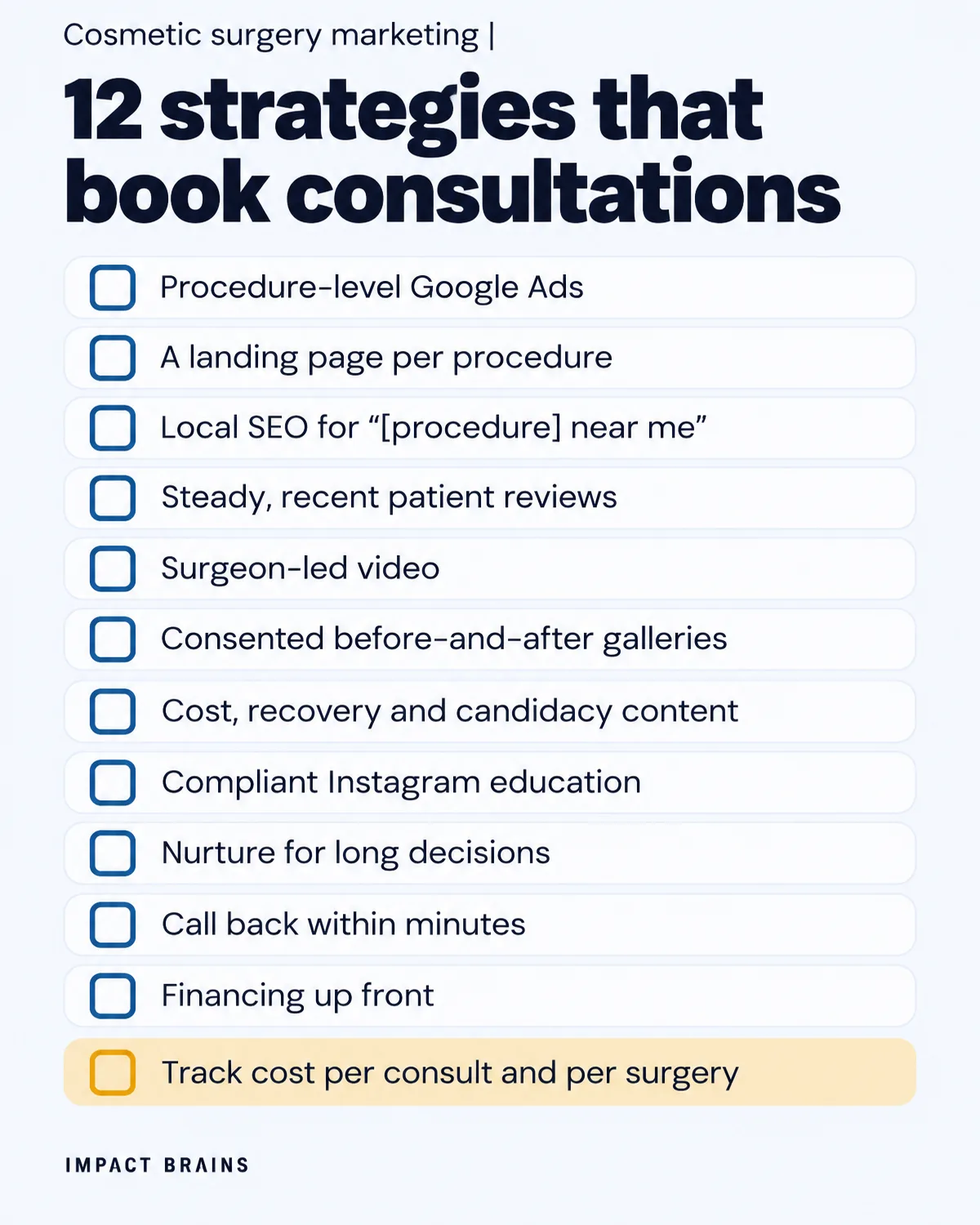
The cosmetic surgery marketing strategies that book the most consultations are: procedure-level Google Ads, a dedicated landing page per procedure, local SEO and reviews, surgeon-led video, compliant before-and-after galleries, nurture sequences for long decisions, fast follow-up, and tracking that measures cost per consultation and per surgery.
- Cosmetic patients research for weeks or months; marketing has to stay present for the whole decision.
- Every procedure deserves its own campaign, page and reporting line.
- Plastic and cosmetic surgery search leads average $102.51 in LocaliQ’s 2025 data; measure cost per surgery, not cost per lead.
- Ad platforms restrict before-and-after and body-image content, so plan compliant creative from the start.
In this article
Why is cosmetic surgery marketing different?
Cosmetic surgery is elective, expensive and personal. Patients compare surgeons for weeks or months, watch video, read reviews and talk to friends before they book. Our guide to how cosmetic surgery patients choose a surgeon maps that journey. The strategies below are ordered from capturing demand to converting it.
12 cosmetic surgery marketing strategies that book consultations
1. Run Google Ads by procedure
Separate campaigns for facelift, rhinoplasty, blepharoplasty, breast and body procedures, each with its own budget and ads. Searchers comparing “deep plane facelift cost” are close to booking; generic “plastic surgeon” campaigns waste money.
2. Build a dedicated landing page for each procedure
A consultation page that answers cost context, candidacy, recovery and surgeon credentials converts better than a services page. Read Why facelift patients rarely convert on service pages.
3. Win local search for “[procedure] near me”
Optimize Google Business Profile categories and services, build procedure pages with local proof, and keep business details consistent everywhere.
4. Earn a steady flow of recent reviews
Ask after every consultation and post-op visit. Reply without confirming any details of care.
5. Put the surgeon on video
Short introductions and procedure explainers let patients judge your surgeon before they meet. Caption every video and add it to the procedure page.
6. Show consented before-and-after galleries
Use consistent lighting and angles, written consent and honest captions. Keep them on your site; social platforms restrict this imagery in ads.
7. Publish cost, recovery and candidacy content
Patients search these questions first. Clinician-reviewed answers build trust and rank.
8. Use Instagram for education, not hype
Procedure explainers, surgeon Q&As and patient-journey stories work within Meta’s health rules; body-shaming hooks get rejected.
See where your practice is losing patientsGet a free recorded audit of your ads, website, tracking and follow-up from the team that builds the Patient Acquisition System, with the three fixes that will move your numbers fastest.
Get my free patient growth audit →9. Nurture research-mode patients
Email and text sequences with recovery guides, financing options and surgeon video keep you present for the months a patient takes to decide.
10. Call back within minutes
Consultation requests cool quickly. Automate a text and a call task the moment a form arrives (speed to lead).
11. Make financing visible
Show financing partners and monthly-payment examples on procedure pages and in follow-up, without bait pricing.
12. Measure cost per consultation and per surgery
Track calls, forms and booked consults separately, and import surgeries as offline conversions. In our D.C. facial plastic surgery case, this kind of rebuild cut cost per conversion from $141.68 to $61.12 while conversions grew from 34 to 99.
How much should a cosmetic surgery practice spend on marketing?
Budget from surgeries. LocaliQ’s 2025 data puts the average plastic and cosmetic surgery search lead at $102.51 with an 8.52% conversion rate. Work backward from the surgeries you want, your consult-to-surgery rate and your cost per lead.
| Step | Assumption | Result |
|---|---|---|
| Surgeries wanted per month | Target | 8 |
| Consult-to-surgery rate | 40% | 20 consults |
| Lead-to-consult rate | 35% | 57 leads |
| Cost per lead | $102.51 (LocaliQ average) | ≈ $5,850 / month |
What compliance rules apply to cosmetic surgery marketing?
- Google’s Healthcare and medicines policy for ads and landing pages.
- Meta’s rules on personal attributes and body imagery.
- State medical board advertising rules, including board-certification claims.
- FTC rules on endorsements and testimonials.
See how we put all twelve together in plastic surgery marketing, and the channel-by-channel numbers in The plastic surgery marketing ROI blueprint.
See where your practice is losing patientsGet a free recorded audit of your ads, website, tracking and follow-up from the team that builds the Patient Acquisition System, with the three fixes that will move your numbers fastest.
Get my free patient growth audit →Frequently asked questions
What is the best marketing for cosmetic surgeons?
A combination: procedure-level search ads, dedicated procedure landing pages, local SEO and reviews, surgeon video, nurture for long decisions and tracking to booked consultations and surgeries.
How do plastic surgeons get more consultations?
Be visible for procedure searches, earn trust with surgeon credentials and reviews, convert on procedure pages, and follow up within minutes.
Can plastic surgeons use before-and-after photos?
On their own websites, with written patient consent and honest presentation. Social ad platforms restrict before-and-after imagery, so use compliant formats there.
How much does plastic surgery marketing cost?
It depends on procedures and market. LocaliQ’s 2025 data shows an average search cost per lead of $102.51 for plastic and cosmetic surgery; budget from the surgeries you want.
What should a plastic surgery marketing plan include?
Procedure priorities, channel mix, a page per procedure, nurture sequences, follow-up rules and monthly reporting on cost per consultation and per surgery.
- LocaliQ: Healthcare search advertising benchmarks (3,542 US campaigns, Oct 2024 to Sep 2025)
- Google Ads Help: Healthcare and medicines policy
- Meta Transparency Center: Advertising Standards
- FTC: Guides concerning the use of endorsements and testimonials in advertising
- Impact Brains case study: Washington, D.C. facial plastic surgery practice
This article is educational marketing guidance, not legal or medical advice. Confirm advertising and privacy decisions with your own counsel.
By Dr. Muhammad Abdullah, Pharm.D, MBA, Founder & Chief Systems Architect
Last updated: November 17, 2026 · 5 min read
The cosmetic surgery marketing strategies that book the most consultations are: procedure-level Google Ads, a dedicated landing page per procedure, local SEO and reviews, surgeon-led video, compliant before-and-after galleries, nurture sequences for long decisions, fast follow-up, and tracking that measures cost per consultation and per surgery.
- Cosmetic patients research for weeks or months; marketing has to stay present for the whole decision.
- Every procedure deserves its own campaign, page and reporting line.
- Plastic and cosmetic surgery search leads average $102.51 in LocaliQ’s 2025 data; measure cost per surgery, not cost per lead.
- Ad platforms restrict before-and-after and body-image content, so plan compliant creative from the start.
In this article
Why is cosmetic surgery marketing different?
Cosmetic surgery is elective, expensive and personal. Patients compare surgeons for weeks or months, watch video, read reviews and talk to friends before they book. Our guide to how cosmetic surgery patients choose a surgeon maps that journey. The strategies below are ordered from capturing demand to converting it.
12 cosmetic surgery marketing strategies that book consultations
1. Run Google Ads by procedure
Separate campaigns for facelift, rhinoplasty, blepharoplasty, breast and body procedures, each with its own budget and ads. Searchers comparing “deep plane facelift cost” are close to booking; generic “plastic surgeon” campaigns waste money.
2. Build a dedicated landing page for each procedure
A consultation page that answers cost context, candidacy, recovery and surgeon credentials converts better than a services page. Read Why facelift patients rarely convert on service pages.
3. Win local search for “[procedure] near me”
Optimize Google Business Profile categories and services, build procedure pages with local proof, and keep business details consistent everywhere.
4. Earn a steady flow of recent reviews
Ask after every consultation and post-op visit. Reply without confirming any details of care.
5. Put the surgeon on video
Short introductions and procedure explainers let patients judge your surgeon before they meet. Caption every video and add it to the procedure page.
6. Show consented before-and-after galleries
Use consistent lighting and angles, written consent and honest captions. Keep them on your site; social platforms restrict this imagery in ads.
7. Publish cost, recovery and candidacy content
Patients search these questions first. Clinician-reviewed answers build trust and rank.
8. Use Instagram for education, not hype
Procedure explainers, surgeon Q&As and patient-journey stories work within Meta’s health rules; body-shaming hooks get rejected.
See where your practice is losing patientsGet a free recorded audit of your ads, website, tracking and follow-up from the team that builds the Patient Acquisition System, with the three fixes that will move your numbers fastest.
Get my free patient growth audit →9. Nurture research-mode patients
Email and text sequences with recovery guides, financing options and surgeon video keep you present for the months a patient takes to decide.
10. Call back within minutes
Consultation requests cool quickly. Automate a text and a call task the moment a form arrives (speed to lead).
11. Make financing visible
Show financing partners and monthly-payment examples on procedure pages and in follow-up, without bait pricing.
12. Measure cost per consultation and per surgery
Track calls, forms and booked consults separately, and import surgeries as offline conversions. In our D.C. facial plastic surgery case, this kind of rebuild cut cost per conversion from $141.68 to $61.12 while conversions grew from 34 to 99.
How much should a cosmetic surgery practice spend on marketing?
Budget from surgeries. LocaliQ’s 2025 data puts the average plastic and cosmetic surgery search lead at $102.51 with an 8.52% conversion rate. Work backward from the surgeries you want, your consult-to-surgery rate and your cost per lead.
| Step | Assumption | Result |
|---|---|---|
| Surgeries wanted per month | Target | 8 |
| Consult-to-surgery rate | 40% | 20 consults |
| Lead-to-consult rate | 35% | 57 leads |
| Cost per lead | $102.51 (LocaliQ average) | ≈ $5,850 / month |
What compliance rules apply to cosmetic surgery marketing?
- Google’s Healthcare and medicines policy for ads and landing pages.
- Meta’s rules on personal attributes and body imagery.
- State medical board advertising rules, including board-certification claims.
- FTC rules on endorsements and testimonials.
See how we put all twelve together in plastic surgery marketing, and the channel-by-channel numbers in The plastic surgery marketing ROI blueprint.
See where your practice is losing patientsGet a free recorded audit of your ads, website, tracking and follow-up from the team that builds the Patient Acquisition System, with the three fixes that will move your numbers fastest.
Get my free patient growth audit →Frequently asked questions
What is the best marketing for cosmetic surgeons?
A combination: procedure-level search ads, dedicated procedure landing pages, local SEO and reviews, surgeon video, nurture for long decisions and tracking to booked consultations and surgeries.
How do plastic surgeons get more consultations?
Be visible for procedure searches, earn trust with surgeon credentials and reviews, convert on procedure pages, and follow up within minutes.
Can plastic surgeons use before-and-after photos?
On their own websites, with written patient consent and honest presentation. Social ad platforms restrict before-and-after imagery, so use compliant formats there.
How much does plastic surgery marketing cost?
It depends on procedures and market. LocaliQ’s 2025 data shows an average search cost per lead of $102.51 for plastic and cosmetic surgery; budget from the surgeries you want.
What should a plastic surgery marketing plan include?
Procedure priorities, channel mix, a page per procedure, nurture sequences, follow-up rules and monthly reporting on cost per consultation and per surgery.
- LocaliQ: Healthcare search advertising benchmarks (3,542 US campaigns, Oct 2024 to Sep 2025)
- Google Ads Help: Healthcare and medicines policy
- Meta Transparency Center: Advertising Standards
- FTC: Guides concerning the use of endorsements and testimonials in advertising
- Impact Brains case study: Washington, D.C. facial plastic surgery practice
This article is educational marketing guidance, not legal or medical advice. Confirm advertising and privacy decisions with your own counsel.