
By Dr. Muhammad Abdullah, Pharm.D, MBA, Founder & Chief Systems Architect
Last updated: October 13, 2026 · 6 min read
Doctors can run Google Ads as long as ads and landing pages follow Google’s Healthcare and medicines policy. Build one campaign per procedure, send each to a dedicated landing page, exclude job and education searches, and track calls and booked consultations without sending patient data to Google. Budget from your cost per new patient.
- Most medical services are eligible; prescription drugs, addiction services and unproven treatments are restricted or need certification.
- Structure by procedure, not by “services”: each treatment gets its own ads, budget and landing page.
- Count booked consultations, not clicks or 10-second calls, or bidding learns the wrong thing.
- Remarketing and audiences can’t be built on health conditions under Google’s personalized advertising policy.
In this article
- Can doctors advertise on Google Ads?
- How do you set up Google Ads for a medical practice?
- Why should campaigns be organized by procedure?
- How much should doctors spend on Google Ads?
- How do you track Google Ads conversions without violating HIPAA?
- What should a medical landing page include?
- What are the most common Google Ads mistakes doctors make?
- Frequently asked questions
Can doctors advertise on Google Ads?
Yes. Most medical practices can advertise on Google, and search ads are one of the fastest ways to reach patients who are actively looking for a treatment. The condition is compliance: ads, keywords and landing pages must follow Google’s Healthcare and medicines policy.
- Generally allowed: consultations, elective procedures, general and specialty medical services, dental care.
- Restricted or certification required: prescription drugs, online pharmacies, addiction treatment (LegitScript certification in the US), some clinical trials.
- Not allowed: unproven or speculative treatments, misleading health claims, guaranteed outcomes.
One more rule catches practices out: under Google’s personalized advertising policy, you can’t target or remarket to people based on health conditions. Search intent does the targeting for you.
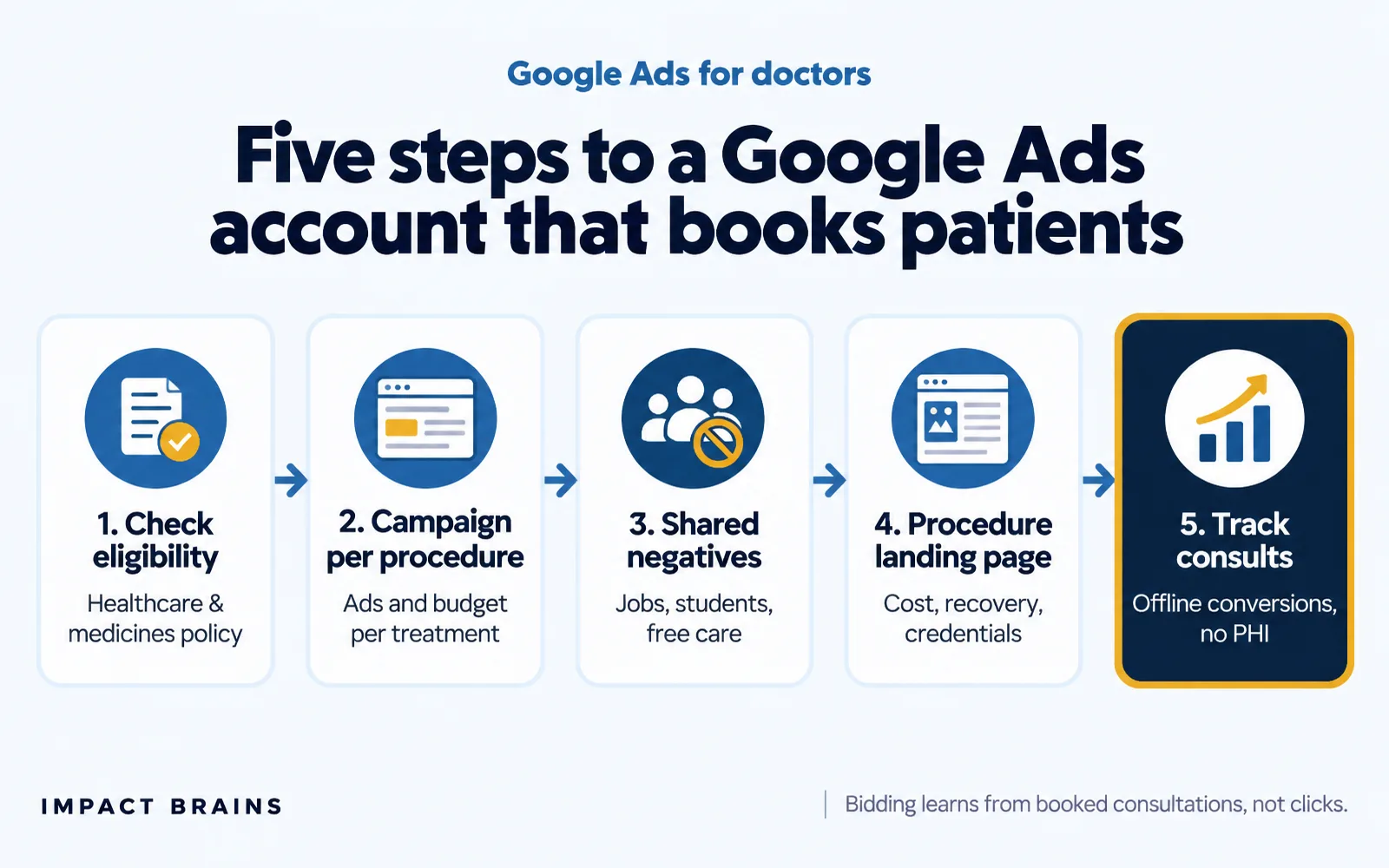
How do you set up Google Ads for a medical practice?
- Confirm eligibility.Check each service against the healthcare policy and get certification first where it’s required.
- Build one campaign or ad group per procedure.Implants, knee replacement and Botox consultations each need their own keywords, ads and budget.
- Add shared negative keyword lists.Exclude jobs, salaries, schools, free clinics, DIY and unrelated conditions from day one.
- Send each procedure to a dedicated landing page.Answer cost, candidacy, recovery and credentials, with a short form and a phone number.
- Track what matters.Count qualified calls, form submissions and booked consultations as separate conversions, then import outcomes from your CRM.
Why should campaigns be organized by procedure?
Because each procedure has different searchers, values and questions. A facelift prospect is comparing surgeons and recovery times; an injectables shopper is comparing prices. In one account we rebuilt for a Washington, D.C. facial plastic surgery practice, separating procedures (facelift, mini facelift and deep plane facelift) and tracking booked consults cut cost per conversion from $141.68 to $61.12 in three months.
| Campaign | Example keywords | Landing page |
|---|---|---|
| Procedure A (high value) | “deep plane facelift surgeon”, “facelift cost [city]” | Facelift consultation page |
| Procedure B | “rhinoplasty consultation [city]” | Rhinoplasty page |
| Brand | Practice and surgeon names | Homepage or contact page |
| Condition-led (where allowed) | “knee pain specialist near me” | Condition page with booking |
How much should doctors spend on Google Ads?
Work backward from patients. Multiply the leads you need by your expected cost per lead. LocaliQ’s 2025 healthcare data puts average search cost per lead at $18.54 for dermatology, $62.80 for family medicine, $84.77 for general dentistry and $102.51 for plastic and cosmetic surgery. Our budget guide walks through the math.
For context, the D.C. facial plastic surgery account above spent about $2,000 a month during the rebuild and produced 99 conversions in three months.
See where your practice is losing patientsGet a free recorded audit of your ads, website, tracking and follow-up from the team that builds the Patient Acquisition System, with the three fixes that will move your numbers fastest.
Get my free patient growth audit →How do you track Google Ads conversions without violating HIPAA?
Track events, not people. Fire conversions on non-identifying actions (a qualified call, a form submission, a booking), route them through a server-side container that strips personal and health details, and import booked consultations as offline conversions using the Google click ID and a timestamp only.
- No pixels or conversion tags on patient portals or intake pages that collect health information.
- Form tools that hold patient details must be HIPAA-eligible with a signed Business Associate Agreement.
- Define a qualified call (for example, longer than 60 seconds, new caller, within service area) instead of counting every ring.
What should a medical landing page include?
- A headline that matches the search (“Deep plane facelift in Washington, D.C.”)
- Surgeon or provider credentials and photo above the fold
- Cost context, candidacy and recovery answers
- Reviews and, where appropriate, consented before-and-after images
- A short form (3–5 fields) and a click-to-call button
- No claims Google’s policy forbids: guarantees, misleading results, unapproved drugs
Read Why facelift patients rarely convert on service pages for a teardown of why dedicated pages win.
What are the most common Google Ads mistakes doctors make?
- One campaign for every service, so budget flows to the cheapest clicks, not the most valuable patients.
- Broad match without negatives, paying for job seekers and students.
- Sending ads to the homepage.
- Counting every call or page view as a conversion.
- Ignoring policy until ads are disapproved.
- Paying an agency a percentage of spend, which rewards spending more.
We keep a running guide to the rules in Google Ads healthcare policies explained (2026), and our healthcare Google Ads service is built on everything above.
See where your practice is losing patientsGet a free recorded audit of your ads, website, tracking and follow-up from the team that builds the Patient Acquisition System, with the three fixes that will move your numbers fastest.
Get my free patient growth audit →Frequently asked questions
Can doctors advertise on Google Ads?
Yes. Most medical practices can run Google Ads if ads and landing pages follow Google’s Healthcare and medicines policy. Prescription drugs, addiction services and some other categories require certification or are restricted.
How much do Google Ads cost for doctors?
Costs depend on specialty and market. LocaliQ’s 2025 healthcare data shows average search cost per lead from about $19 (dermatology) to $141 (mental health). Budget from the number of new patients you want and what each one is worth.
Can medical practices use remarketing?
Only with non-sensitive audiences. Google’s personalized advertising policy doesn’t allow targeting or remarketing based on health conditions, so practices rely on search intent and general site audiences.
Do I need a landing page for each procedure?
For paid traffic, yes. Dedicated procedure pages answer the questions that specific patients ask and typically convert better than general service pages.
How long does it take Google Ads to work for a practice?
A clean, well-tracked account usually produces qualified inquiries within two to four weeks; bidding improves further as booked-consultation data accumulates.
- Google Ads Help: Healthcare and medicines policy
- Google Ads Help: Personalized advertising policy
- LegitScript: healthcare merchant certification
- Google Ads Help: About offline conversion imports
- LocaliQ: Healthcare search advertising benchmarks (3,542 US campaigns, Oct 2024 to Sep 2025)
- Impact Brains case study: Washington, D.C. facial plastic surgery practice
This article is educational marketing guidance, not legal or medical advice. Confirm advertising and privacy decisions with your own counsel.
By Dr. Muhammad Abdullah, Pharm.D, MBA, Founder & Chief Systems Architect
Last updated: October 13, 2026 · 6 min read
Doctors can run Google Ads as long as ads and landing pages follow Google’s Healthcare and medicines policy. Build one campaign per procedure, send each to a dedicated landing page, exclude job and education searches, and track calls and booked consultations without sending patient data to Google. Budget from your cost per new patient.
- Most medical services are eligible; prescription drugs, addiction services and unproven treatments are restricted or need certification.
- Structure by procedure, not by “services”: each treatment gets its own ads, budget and landing page.
- Count booked consultations, not clicks or 10-second calls, or bidding learns the wrong thing.
- Remarketing and audiences can’t be built on health conditions under Google’s personalized advertising policy.
In this article
- Can doctors advertise on Google Ads?
- How do you set up Google Ads for a medical practice?
- Why should campaigns be organized by procedure?
- How much should doctors spend on Google Ads?
- How do you track Google Ads conversions without violating HIPAA?
- What should a medical landing page include?
- What are the most common Google Ads mistakes doctors make?
- Frequently asked questions
Can doctors advertise on Google Ads?
Yes. Most medical practices can advertise on Google, and search ads are one of the fastest ways to reach patients who are actively looking for a treatment. The condition is compliance: ads, keywords and landing pages must follow Google’s Healthcare and medicines policy.
- Generally allowed: consultations, elective procedures, general and specialty medical services, dental care.
- Restricted or certification required: prescription drugs, online pharmacies, addiction treatment (LegitScript certification in the US), some clinical trials.
- Not allowed: unproven or speculative treatments, misleading health claims, guaranteed outcomes.
One more rule catches practices out: under Google’s personalized advertising policy, you can’t target or remarket to people based on health conditions. Search intent does the targeting for you.
How do you set up Google Ads for a medical practice?
- Confirm eligibility.Check each service against the healthcare policy and get certification first where it’s required.
- Build one campaign or ad group per procedure.Implants, knee replacement and Botox consultations each need their own keywords, ads and budget.
- Add shared negative keyword lists.Exclude jobs, salaries, schools, free clinics, DIY and unrelated conditions from day one.
- Send each procedure to a dedicated landing page.Answer cost, candidacy, recovery and credentials, with a short form and a phone number.
- Track what matters.Count qualified calls, form submissions and booked consultations as separate conversions, then import outcomes from your CRM.
Why should campaigns be organized by procedure?
Because each procedure has different searchers, values and questions. A facelift prospect is comparing surgeons and recovery times; an injectables shopper is comparing prices. In one account we rebuilt for a Washington, D.C. facial plastic surgery practice, separating procedures (facelift, mini facelift and deep plane facelift) and tracking booked consults cut cost per conversion from $141.68 to $61.12 in three months.
| Campaign | Example keywords | Landing page |
|---|---|---|
| Procedure A (high value) | “deep plane facelift surgeon”, “facelift cost [city]” | Facelift consultation page |
| Procedure B | “rhinoplasty consultation [city]” | Rhinoplasty page |
| Brand | Practice and surgeon names | Homepage or contact page |
| Condition-led (where allowed) | “knee pain specialist near me” | Condition page with booking |
How much should doctors spend on Google Ads?
Work backward from patients. Multiply the leads you need by your expected cost per lead. LocaliQ’s 2025 healthcare data puts average search cost per lead at $18.54 for dermatology, $62.80 for family medicine, $84.77 for general dentistry and $102.51 for plastic and cosmetic surgery. Our budget guide walks through the math.
For context, the D.C. facial plastic surgery account above spent about $2,000 a month during the rebuild and produced 99 conversions in three months.
See where your practice is losing patientsGet a free recorded audit of your ads, website, tracking and follow-up from the team that builds the Patient Acquisition System, with the three fixes that will move your numbers fastest.
Get my free patient growth audit →How do you track Google Ads conversions without violating HIPAA?
Track events, not people. Fire conversions on non-identifying actions (a qualified call, a form submission, a booking), route them through a server-side container that strips personal and health details, and import booked consultations as offline conversions using the Google click ID and a timestamp only.
- No pixels or conversion tags on patient portals or intake pages that collect health information.
- Form tools that hold patient details must be HIPAA-eligible with a signed Business Associate Agreement.
- Define a qualified call (for example, longer than 60 seconds, new caller, within service area) instead of counting every ring.
What should a medical landing page include?
- A headline that matches the search (“Deep plane facelift in Washington, D.C.”)
- Surgeon or provider credentials and photo above the fold
- Cost context, candidacy and recovery answers
- Reviews and, where appropriate, consented before-and-after images
- A short form (3–5 fields) and a click-to-call button
- No claims Google’s policy forbids: guarantees, misleading results, unapproved drugs
Read Why facelift patients rarely convert on service pages for a teardown of why dedicated pages win.
What are the most common Google Ads mistakes doctors make?
- One campaign for every service, so budget flows to the cheapest clicks, not the most valuable patients.
- Broad match without negatives, paying for job seekers and students.
- Sending ads to the homepage.
- Counting every call or page view as a conversion.
- Ignoring policy until ads are disapproved.
- Paying an agency a percentage of spend, which rewards spending more.
We keep a running guide to the rules in Google Ads healthcare policies explained (2026), and our healthcare Google Ads service is built on everything above.
See where your practice is losing patientsGet a free recorded audit of your ads, website, tracking and follow-up from the team that builds the Patient Acquisition System, with the three fixes that will move your numbers fastest.
Get my free patient growth audit →Frequently asked questions
Can doctors advertise on Google Ads?
Yes. Most medical practices can run Google Ads if ads and landing pages follow Google’s Healthcare and medicines policy. Prescription drugs, addiction services and some other categories require certification or are restricted.
How much do Google Ads cost for doctors?
Costs depend on specialty and market. LocaliQ’s 2025 healthcare data shows average search cost per lead from about $19 (dermatology) to $141 (mental health). Budget from the number of new patients you want and what each one is worth.
Can medical practices use remarketing?
Only with non-sensitive audiences. Google’s personalized advertising policy doesn’t allow targeting or remarketing based on health conditions, so practices rely on search intent and general site audiences.
Do I need a landing page for each procedure?
For paid traffic, yes. Dedicated procedure pages answer the questions that specific patients ask and typically convert better than general service pages.
How long does it take Google Ads to work for a practice?
A clean, well-tracked account usually produces qualified inquiries within two to four weeks; bidding improves further as booked-consultation data accumulates.
- Google Ads Help: Healthcare and medicines policy
- Google Ads Help: Personalized advertising policy
- LegitScript: healthcare merchant certification
- Google Ads Help: About offline conversion imports
- LocaliQ: Healthcare search advertising benchmarks (3,542 US campaigns, Oct 2024 to Sep 2025)
- Impact Brains case study: Washington, D.C. facial plastic surgery practice
This article is educational marketing guidance, not legal or medical advice. Confirm advertising and privacy decisions with your own counsel.