
By Dr. Muhammad Abdullah, Pharm.D, MBA, Founder & Chief Systems Architect
Last updated: November 3, 2026 · 5 min read
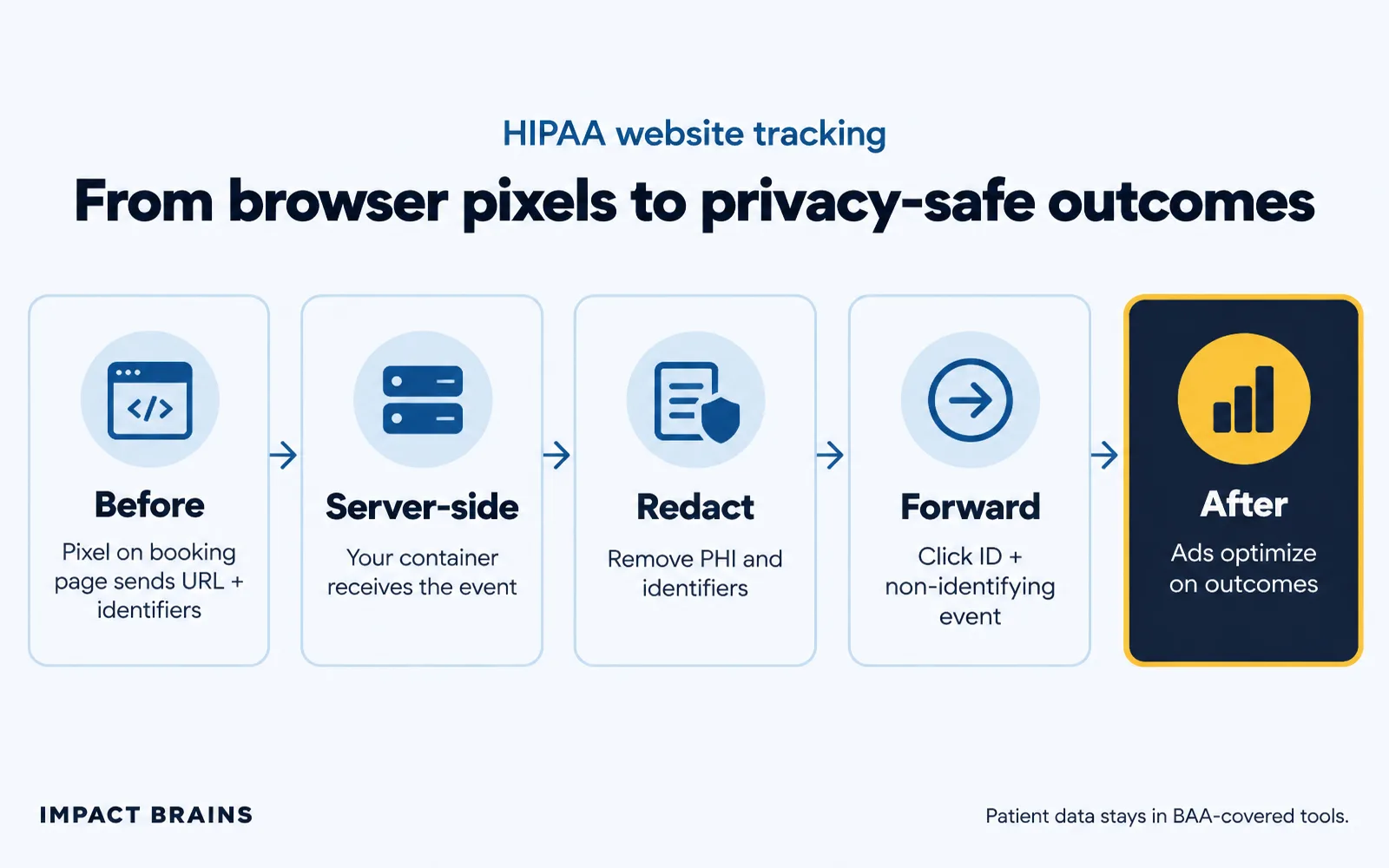
Practices should keep advertising pixels off authenticated pages such as patient portals, booking and intake flows; move tracking to a server-side container that strips identifiers; use HIPAA-eligible forms with a Business Associate Agreement; and send ad platforms only outcomes and click IDs. A 2024 court ruling narrowed HHS guidance, but did not remove these risks.
- HHS warned in December 2022 that tracking technologies on healthcare websites can disclose PHI to vendors.
- In June 2024 a federal court vacated the part of that guidance covering many unauthenticated public pages; authenticated pages remain the main risk.
- Google and Meta generally don’t sign BAAs for advertising, so PHI must never reach them.
- Server-side tracking with redaction plus offline conversions keeps measurement without exposing patients.
In this article
Why is website tracking a HIPAA issue?
A standard advertising pixel sends the page address, the visitor’s IP address and browser identifiers to the ad platform. On a healthcare website, that combination can reveal that a specific person sought a specific kind of care. If the practice is a HIPAA covered entity and the vendor has no Business Associate Agreement, that disclosure can be a violation.
What changed in the rules since 2022?
| When | What happened | What it means |
|---|---|---|
| Dec 2022 | HHS publishes its bulletin on online tracking technologies | Tracking on healthcare sites can disclose PHI |
| Mar 2024 | HHS revises the bulletin | Clarifies, but keeps the core position |
| Jun 2024 | AHA v. Becerra: court vacates the guidance’s rule for many unauthenticated pages | Public pages carry less HIPAA risk |
| Aug 2024 | HHS withdraws its appeal | The ruling stands; authenticated pages are still the main risk |
| Jan 2025 | Meta restricts lower-funnel data for many health advertisers | Pixel-based optimization weakens; server-side outcomes matter more |
Outside HIPAA, health apps and D2C brands can fall under the FTC’s Health Breach Notification Rule, and several states have their own health-privacy laws. The direction across all of them is the same: keep health information out of advertising systems.
Which pages carry the most risk?
| Page type | Examples | Approach |
|---|---|---|
| Public, general pages | Homepage, about, blog | Analytics with consent; lower risk |
| Condition or treatment pages | “Addiction treatment”, “IVF options” | Limit identifiers; avoid ad pixels where sensitive |
| Booking and intake | Appointment request, eligibility forms | No ad pixels; server-side events only |
| Authenticated pages | Patient portal, telehealth sessions | No third-party tracking |
See where your practice is losing patientsGet a free recorded audit of your ads, website, tracking and follow-up from the team that builds the Patient Acquisition System, with the three fixes that will move your numbers fastest.
Get my free patient growth audit →What should practices change now? A 12-point checklist
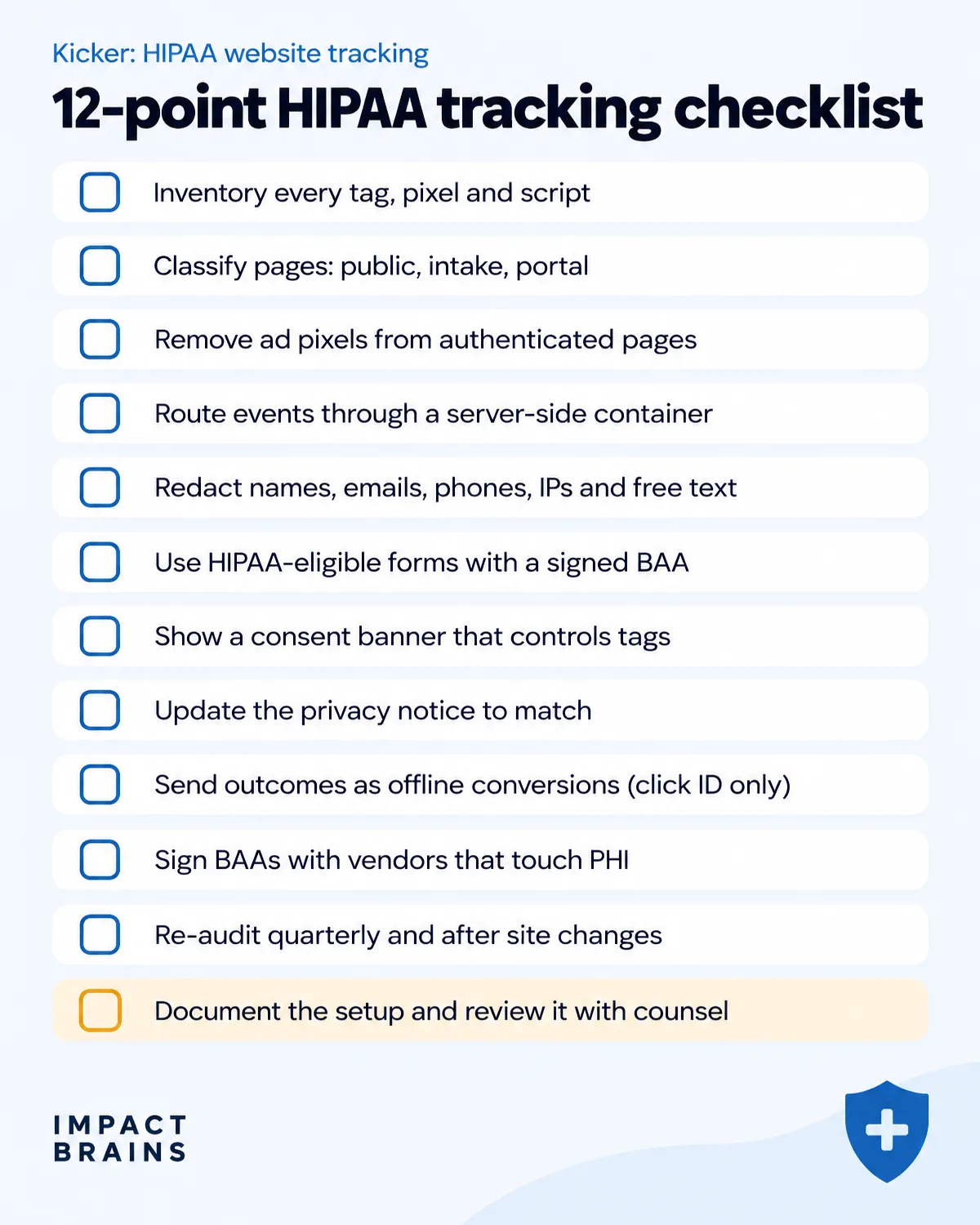
- Inventory every tag, pixel and script on the site, by page.
- Classify pages as public, intake or authenticated.
- Remove advertising pixels from authenticated pages and intake flows.
- Route events through a server-side container you control.
- Redact names, emails, phone numbers, IP addresses and free-text fields before forwarding.
- Use HIPAA-eligible form and booking tools with a signed Business Associate Agreement.
- Show a consent banner that actually controls which tags fire.
- Update your privacy notice to match what the site does.
- Send booked consultations to ad platforms as offline conversions with click IDs only.
- Sign BAAs with any vendor that receives PHI, or stop sending it to them.
- Re-audit quarterly and after every site or tool change.
- Document the setup and review it with your counsel.
Is Google Analytics HIPAA compliant?
Google states that Google Analytics is not intended for PHI and Google does not sign BAAs for it, so practices must not send PHI to it. You can still use analytics on public pages with consent, configured to avoid identifiers, and measure booking outcomes server-side.
Can practices still measure marketing after removing pixels?
Yes, and often more accurately. Server-side events are not blocked by browsers the way pixels are, and offline conversions tell Google and Meta which clicks became booked consultations. We built this architecture for three Premier Metabolic & Men’s Health Care telehealth pages where compliance had blocked ad spend.
For forms, hosting and privacy notices, see Is your website HIPAA compliant? The complete 2026 guide. For the implementation, see HIPAA-compliant marketing and tracking.
See where your practice is losing patientsGet a free recorded audit of your ads, website, tracking and follow-up from the team that builds the Patient Acquisition System, with the three fixes that will move your numbers fastest.
Get my free patient growth audit →Frequently asked questions
Can healthcare websites use the Meta Pixel?
Not on authenticated pages or intake flows, and only with care elsewhere. Meta does not sign BAAs, so PHI must not reach it. Server-side events with identifiers removed are the safer route.
Did the 2024 court ruling end HIPAA tracking risk?
No. It vacated part of HHS’s guidance for many unauthenticated pages, but tracking on authenticated pages and intake flows can still involve PHI, and state laws and FTC rules still apply.
Is server-side tracking HIPAA compliant?
Server-side tracking is a tool, not a compliance status. It helps because you can remove identifiers before events leave your server, but the setup must be designed and documented with counsel.
Do we need a BAA with our form provider?
Yes, if the form collects PHI. Use a HIPAA-eligible tool and sign its Business Associate Agreement.
How often should we audit website tracking?
At least quarterly, and after every website, plugin or marketing-tool change, because new tags are often added without anyone noticing.
- U.S. HHS: Use of online tracking technologies by HIPAA covered entities
- Holland & Knight: American Hospital Assn. v. Becerra
- U.S. HHS: Sample business associate agreement provisions
- FTC: Health Breach Notification Rule
- Digiday: Health and wellness brands brace for ad restrictions on Meta
- Google for Developers: Server-side Tag Manager
This article is educational marketing guidance, not legal or medical advice. Confirm advertising and privacy decisions with your own counsel.
By Dr. Muhammad Abdullah, Pharm.D, MBA, Founder & Chief Systems Architect
Last updated: November 3, 2026 · 5 min read
Practices should keep advertising pixels off authenticated pages such as patient portals, booking and intake flows; move tracking to a server-side container that strips identifiers; use HIPAA-eligible forms with a Business Associate Agreement; and send ad platforms only outcomes and click IDs. A 2024 court ruling narrowed HHS guidance, but did not remove these risks.
- HHS warned in December 2022 that tracking technologies on healthcare websites can disclose PHI to vendors.
- In June 2024 a federal court vacated the part of that guidance covering many unauthenticated public pages; authenticated pages remain the main risk.
- Google and Meta generally don’t sign BAAs for advertising, so PHI must never reach them.
- Server-side tracking with redaction plus offline conversions keeps measurement without exposing patients.
In this article
Why is website tracking a HIPAA issue?
A standard advertising pixel sends the page address, the visitor’s IP address and browser identifiers to the ad platform. On a healthcare website, that combination can reveal that a specific person sought a specific kind of care. If the practice is a HIPAA covered entity and the vendor has no Business Associate Agreement, that disclosure can be a violation.
What changed in the rules since 2022?
| When | What happened | What it means |
|---|---|---|
| Dec 2022 | HHS publishes its bulletin on online tracking technologies | Tracking on healthcare sites can disclose PHI |
| Mar 2024 | HHS revises the bulletin | Clarifies, but keeps the core position |
| Jun 2024 | AHA v. Becerra: court vacates the guidance’s rule for many unauthenticated pages | Public pages carry less HIPAA risk |
| Aug 2024 | HHS withdraws its appeal | The ruling stands; authenticated pages are still the main risk |
| Jan 2025 | Meta restricts lower-funnel data for many health advertisers | Pixel-based optimization weakens; server-side outcomes matter more |
Outside HIPAA, health apps and D2C brands can fall under the FTC’s Health Breach Notification Rule, and several states have their own health-privacy laws. The direction across all of them is the same: keep health information out of advertising systems.
Which pages carry the most risk?
| Page type | Examples | Approach |
|---|---|---|
| Public, general pages | Homepage, about, blog | Analytics with consent; lower risk |
| Condition or treatment pages | “Addiction treatment”, “IVF options” | Limit identifiers; avoid ad pixels where sensitive |
| Booking and intake | Appointment request, eligibility forms | No ad pixels; server-side events only |
| Authenticated pages | Patient portal, telehealth sessions | No third-party tracking |
See where your practice is losing patientsGet a free recorded audit of your ads, website, tracking and follow-up from the team that builds the Patient Acquisition System, with the three fixes that will move your numbers fastest.
Get my free patient growth audit →What should practices change now? A 12-point checklist
- Inventory every tag, pixel and script on the site, by page.
- Classify pages as public, intake or authenticated.
- Remove advertising pixels from authenticated pages and intake flows.
- Route events through a server-side container you control.
- Redact names, emails, phone numbers, IP addresses and free-text fields before forwarding.
- Use HIPAA-eligible form and booking tools with a signed Business Associate Agreement.
- Show a consent banner that actually controls which tags fire.
- Update your privacy notice to match what the site does.
- Send booked consultations to ad platforms as offline conversions with click IDs only.
- Sign BAAs with any vendor that receives PHI, or stop sending it to them.
- Re-audit quarterly and after every site or tool change.
- Document the setup and review it with your counsel.
Is Google Analytics HIPAA compliant?
Google states that Google Analytics is not intended for PHI and Google does not sign BAAs for it, so practices must not send PHI to it. You can still use analytics on public pages with consent, configured to avoid identifiers, and measure booking outcomes server-side.
Can practices still measure marketing after removing pixels?
Yes, and often more accurately. Server-side events are not blocked by browsers the way pixels are, and offline conversions tell Google and Meta which clicks became booked consultations. We built this architecture for three Premier Metabolic & Men’s Health Care telehealth pages where compliance had blocked ad spend.
For forms, hosting and privacy notices, see Is your website HIPAA compliant? The complete 2026 guide. For the implementation, see HIPAA-compliant marketing and tracking.
See where your practice is losing patientsGet a free recorded audit of your ads, website, tracking and follow-up from the team that builds the Patient Acquisition System, with the three fixes that will move your numbers fastest.
Get my free patient growth audit →Frequently asked questions
Can healthcare websites use the Meta Pixel?
Not on authenticated pages or intake flows, and only with care elsewhere. Meta does not sign BAAs, so PHI must not reach it. Server-side events with identifiers removed are the safer route.
Did the 2024 court ruling end HIPAA tracking risk?
No. It vacated part of HHS’s guidance for many unauthenticated pages, but tracking on authenticated pages and intake flows can still involve PHI, and state laws and FTC rules still apply.
Is server-side tracking HIPAA compliant?
Server-side tracking is a tool, not a compliance status. It helps because you can remove identifiers before events leave your server, but the setup must be designed and documented with counsel.
Do we need a BAA with our form provider?
Yes, if the form collects PHI. Use a HIPAA-eligible tool and sign its Business Associate Agreement.
How often should we audit website tracking?
At least quarterly, and after every website, plugin or marketing-tool change, because new tags are often added without anyone noticing.
- U.S. HHS: Use of online tracking technologies by HIPAA covered entities
- Holland & Knight: American Hospital Assn. v. Becerra
- U.S. HHS: Sample business associate agreement provisions
- FTC: Health Breach Notification Rule
- Digiday: Health and wellness brands brace for ad restrictions on Meta
- Google for Developers: Server-side Tag Manager
This article is educational marketing guidance, not legal or medical advice. Confirm advertising and privacy decisions with your own counsel.