
The short answer
Med spa SEO fills the book when local searches for treatments such as injectables, laser hair removal or facials lead to a profile and a page that answer price, provider and availability, with booking one tap away. Get the Medical spa category right, build one page per treatment, earn honest reviews and measure booked appointments.
Key takeaways
- Choose Medical spa as the primary category if a licensed provider performs treatments.
- Give every treatment family its own page with price, provider, downtime and a booking button.
- Ask every client for a review, and never steer what they write.
- Client photos used in marketing need written HIPAA authorization.
- Judge med spa SEO by booked and rebooked appointments, not rankings.
In this article
- Why is SEO for medical spas different from other local SEO?
- 11 med spa SEO moves that fill your book
- Which med spa SEO moves should you do first?
- What compliance rules affect local SEO for med spas?
- How long does med spa SEO take to work?
- What to do next with your med spa SEO
Search laser hair removal near me on a Tuesday evening and look at what comes back. Three med spas in the map pack, one with no prices, one with a booking button that opens a phone number, and one with a slot available Thursday at 6:15. Guess which one gets the appointment.
That is local search for aesthetics. Clients compare quickly, usually on a phone, and most of them decide on four things: price, provider, downtime and the next open slot. A med spa with no prices online is asking clients to fill out a form to find out whether they can afford to fill out a form.
This guide lists 11 moves that improve local rankings and turn them into bookings. It is the SEO layer of the med spa marketing system we build, written for owners and managers of one or two location med spas with a medical director. Each move follows the same pattern: what it is, why it works, how to do it and the number that proves it.
Why is SEO for medical spas different from other local SEO?
SEO for medical spas is different because clients shop like retail customers but buy a medical service. They compare prices and open slots the way they compare restaurants. Yet the treatments involve licensed providers, health information and ad rules. Good med spa SEO answers the shopping questions and stays inside the medical rules.
Three things set med spas apart. Clients search by treatment and often by product brand, so a single services page cannot rank for everything. Repeat visits drive revenue, so rebooking matters as much as first bookings. And photos, reviews and claims carry compliance rules that a hair salon never has to think about. The moves below handle all three.
Google ranks local results mainly on relevance, distance and prominence, according to its page on how local ranking works. Moves 1 to 7 build relevance, moves 8 to 10 build prominence, and move 11 makes sure the traffic turns into appointments.
11 med spa SEO moves that fill your book
These 11 med spa SEO moves are ordered roughly the way we would do them for a new client. The first three are fast fixes inside the Business Profile. The middle group builds the website. The last group runs every month for as long as the spa wants new clients.
- Choose Medical spa as the primary category
- List every treatment as a service and keep hours honest
- Connect online booking to the profile
- Build one page per treatment family
- Show who performs each treatment
- Publish prices or starting prices
- Use product brand names carefully
- Ask every client for a review without steering what they write
- Show real photos and handle before and after images with consent
- Earn local links and mentions
- Make the site fast on phones and track bookings
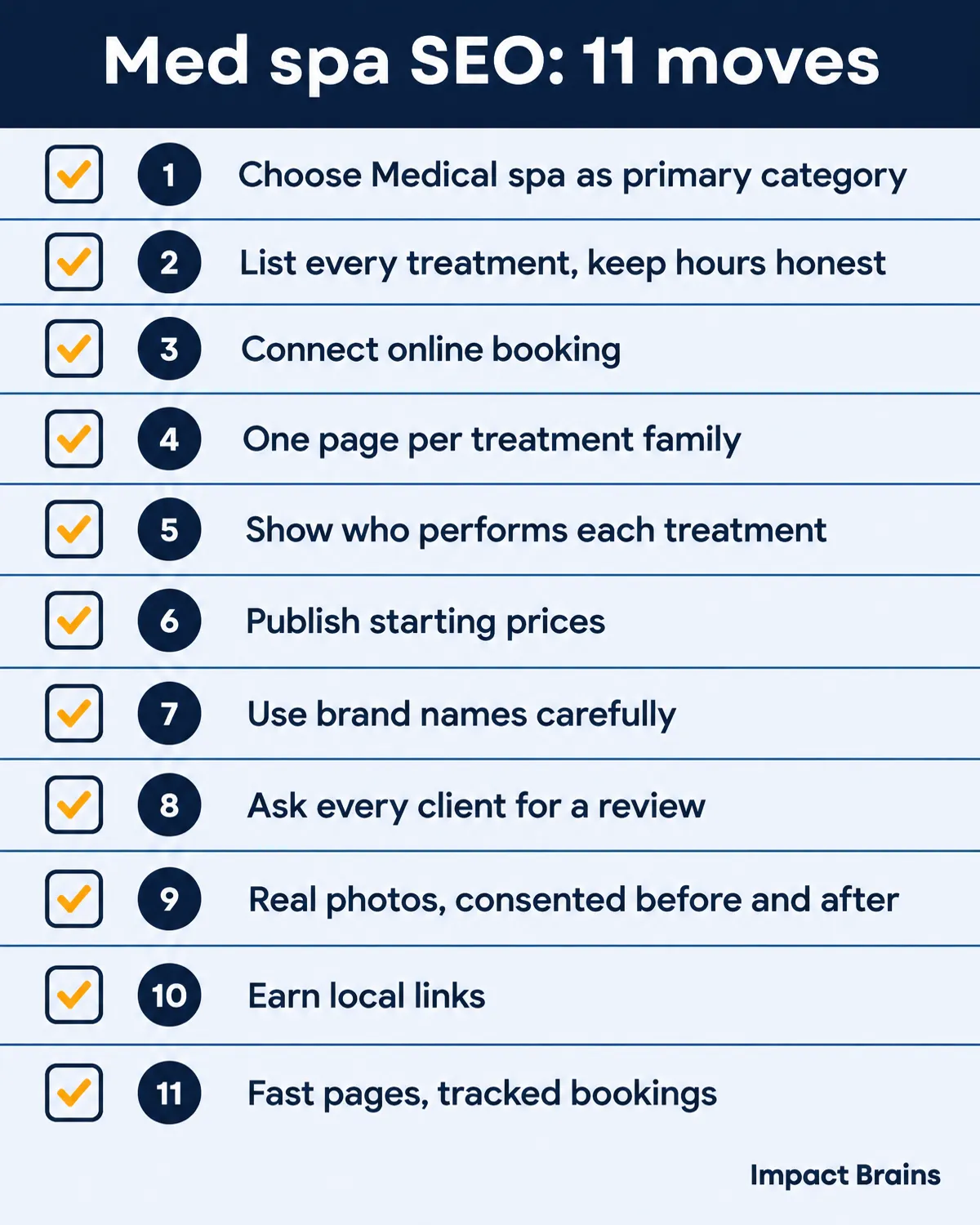
Every move has its own section below, with the metric that proves it worked.
1. Choose Medical spa as the primary category
The primary category tells Google what kind of business you are. A med spa with licensed providers should choose Medical spa. Google's Business Profile guidelines ask for the fewest, most specific categories that describe the core business, using the test: this business is a. Add secondary categories only for real lines of business.
Listing a med spa as a day spa is how you end up ranking for couples massage gift cards. The reverse matters too: a spa that offers only facials and massage should not claim Medical spa. The number to watch is the share of profile searches that come from treatment terms, which shows in the profile's performance report.
2. List every treatment as a service and keep hours honest
Services listed on the profile help Google match it to treatment searches. Accurate hours keep clients from driving to a locked door. Add each treatment by its plain name, such as laser hair removal, chemical peel, microneedling or dermal fillers, and set special hours before every holiday.
Keep the description factual: who you treat, what you specialize in and who your medical director is. Google does not allow links in the description. The metric: calls and direction requests from the profile, which should rise once the services list is complete.
3. Connect online booking to the profile
A booking link on the profile turns a map view into an appointment with no phone call. Many med spa clients book after hours. If your booking software is one of Google's booking partners (often called Reserve with Google), connect it. Otherwise add your online booking page as the profile's appointment link.
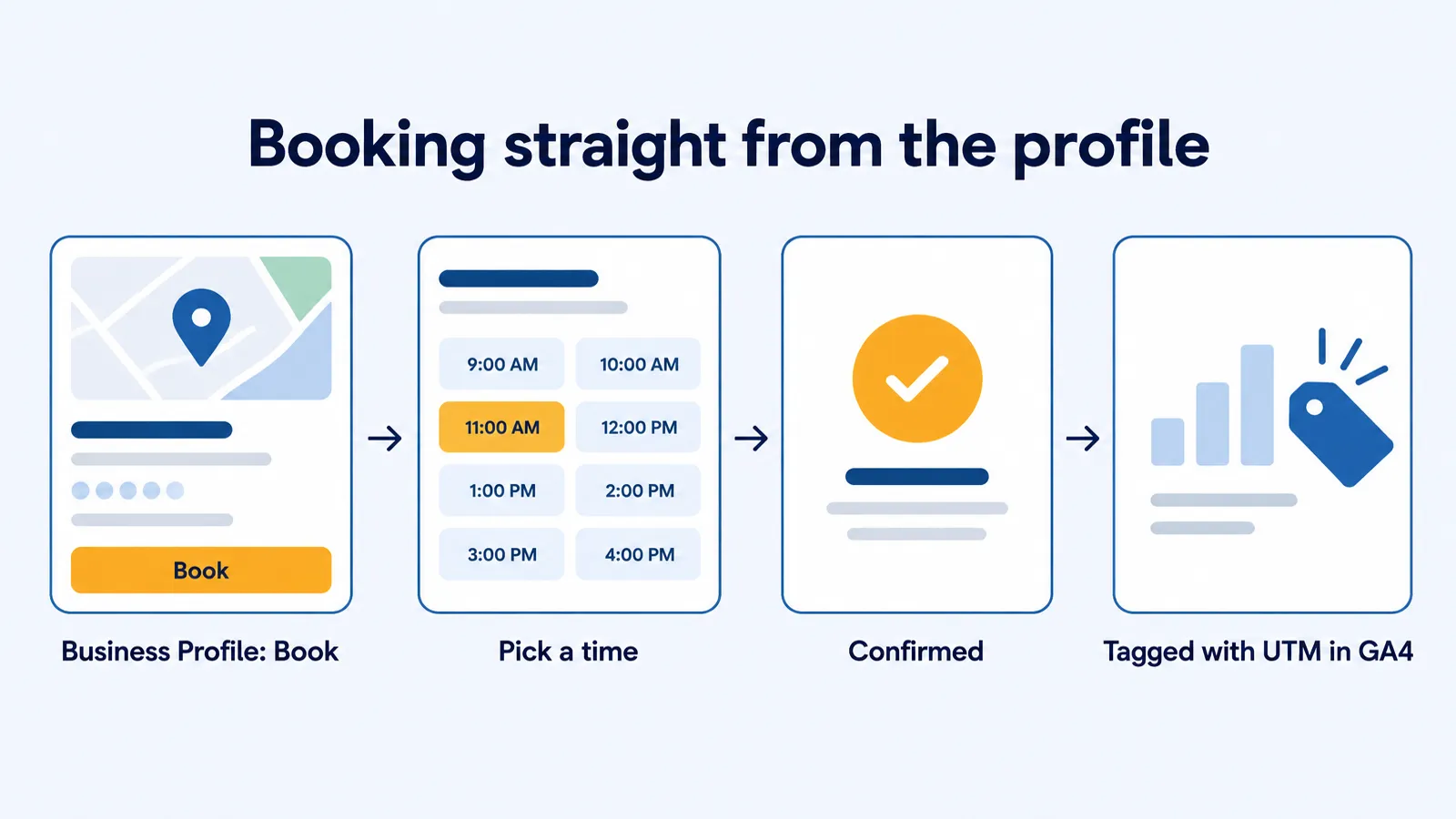
Every extra step between the map and an open slot loses some clients.
Tag the appointment link with UTM parameters so visits show up separately in Google Analytics 4, for example utm_source=google, utm_medium=organic and utm_campaign=gbp-booking. The metric: bookings that start from the profile link, counted in your booking software.
4. Build one page per treatment family
One page per treatment family gives Google a page to rank for each treatment search. It also gives clients what they need to book. A treatment family is a group clients research together, such as neuromodulators, dermal fillers, laser hair removal, skin resurfacing or body contouring. This is the core of any medical spa seo strategy.
A treatment page that says we offer a full menu of rejuvenating services reads like a candle label, and ranks like one too. Each page should answer the four booking questions on the first screen of a phone:
- Price: a starting price or price range, and what changes it (units, areas, sessions).
- Provider: who performs the treatment, with their license type.
- Downtime and duration: what to expect after the visit and how long results usually last, written without promises.
- Availability: a booking button showing the next open appointment.
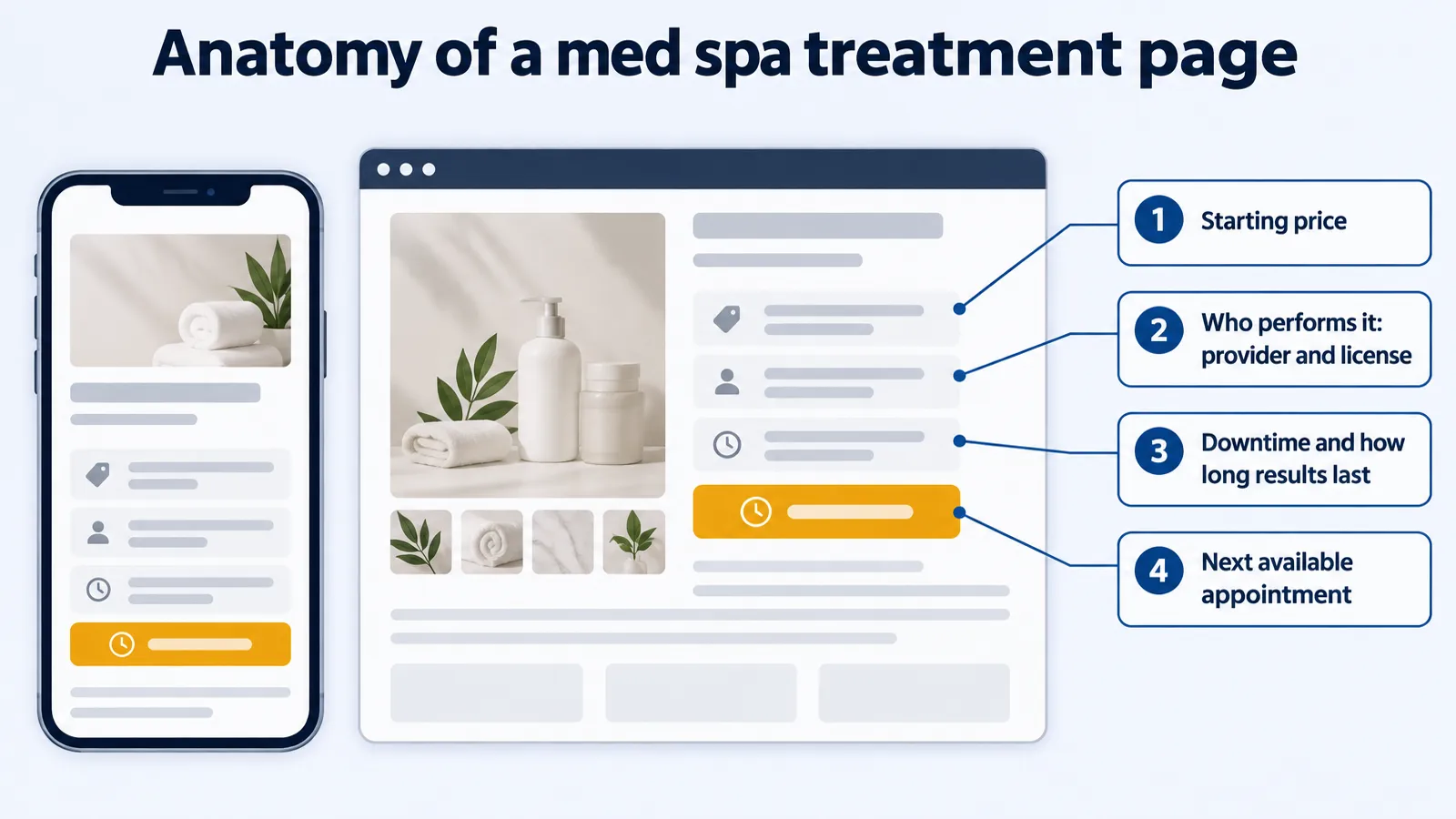
Annotated layout of a med spa treatment page answering price, provider, downtime and next available appointment above the fold
Add a short FAQ on each page with the questions your front desk hears most. Link each treatment page to your location page and to related treatments. Our healthcare website design work builds these pages as templates, so adding a new treatment takes hours instead of weeks. The metric: Search Console clicks for treatment plus city searches, per page.
5. Show who performs each treatment
Aesthetic treatments are medical procedures done by licensed people. Provider pages build trust with clients and show search engines who has the expertise. Give each provider a short profile page with their license type, training and the treatments they perform, and name the medical director on the site and the profile.
Clients book a person as much as a treatment, so provider pages and bios carry real weight.
Clients often book a person as much as a treatment, so link provider pages from every treatment they perform. Keep credentials factual and current, and only list certifications you can document. The metric: visits to provider pages that continue to a booking.
6. Publish prices or starting prices
Published prices match the cost searches clients make, such as laser hair removal cost. They also filter out bookings that would cancel at checkout. A starting price or a range with a clear explanation works when exact pricing depends on units, areas or sessions. Hiding every price pushes clients to a competitor that shows one.
Explain what affects the price in one or two plain sentences, show membership or package pricing if you offer it, and update the page when prices change. The metric: booking rate on treatment pages before and after prices go live.
7. Use product brand names carefully
Many clients search by product brand rather than treatment type, so brand names can bring relevant traffic when the spa really uses those products. Mention only products you actually stock, use the generic treatment name alongside the brand, and follow each manufacturer's trademark guidance. Never use a brand you do not offer to attract searches.
A neuromodulators page can explain the products you use by name and what they are for, while the page title and headings stay with the treatment people understand. The metric: Search Console impressions for product brand searches that lead to a booking.
See where your med spa is losing bookings
Get a free, recorded audit of your Business Profile, treatment pages, booking flow and follow-up, delivered within two business days.
Get my free patient growth audit →
8. Ask every client for a review without steering what they write
Reviews are the main prominence signal a med spa controls. The compliant way to earn them is to ask every client the same way, with nothing offered in return. Google's Maps user contributed content policy removes incentivized reviews, bans selectively asking happy clients only, and says solicitation must not try to influence the rating or content.
That last point is the trap. Asking every client for a review is policy. Asking them to please mention lip filler and your city name is a script, and Google can tell. The FTC's final rule on fake reviews and testimonials (announced August 2024) adds a ban on paying for reviews that express a particular sentiment, on undisclosed reviews from staff and on suppressing negative reviews.
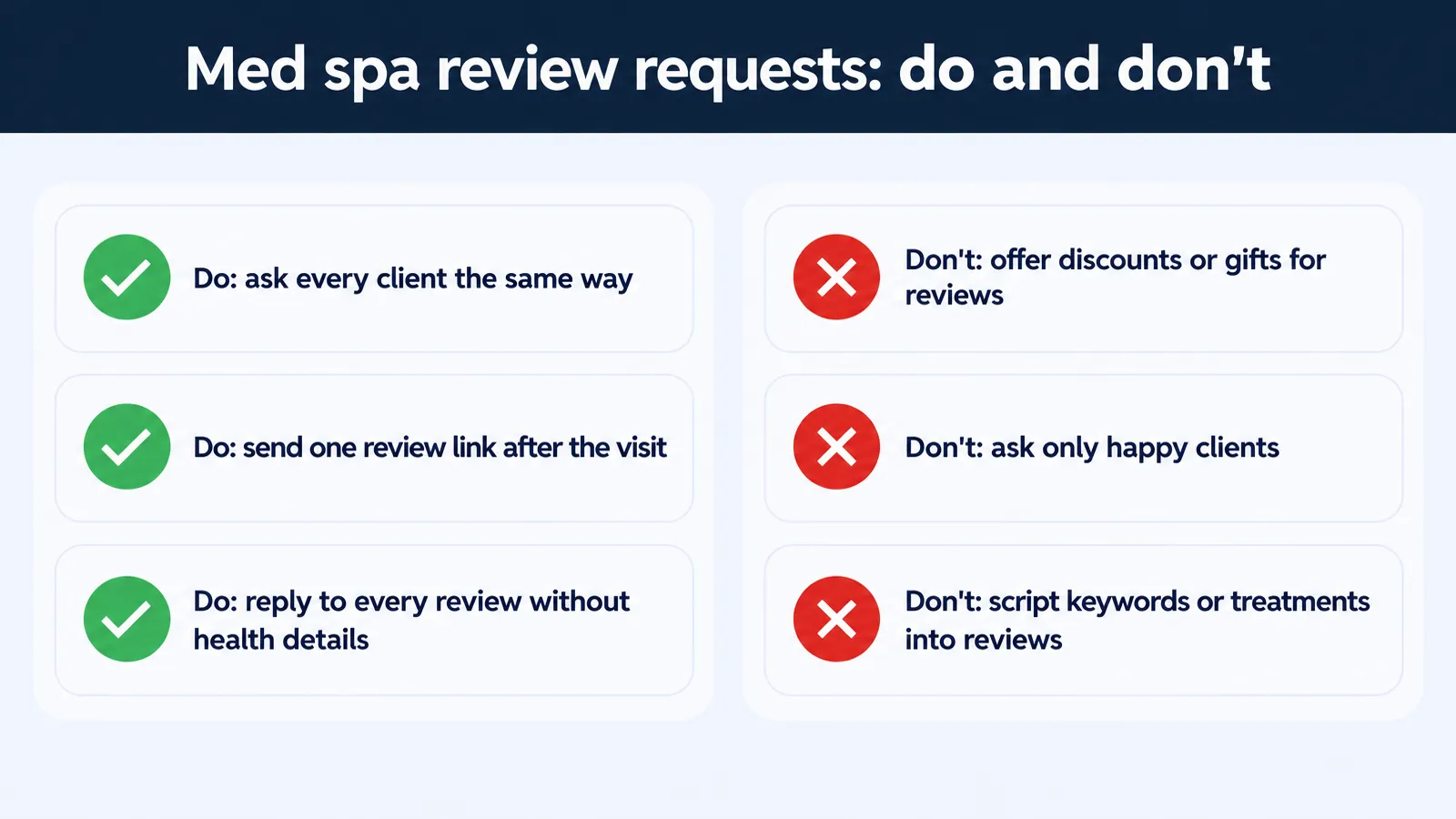
Based on Google's Maps content policy and the FTC's 2024 rule on fake reviews and testimonials.
- Send one review link by text or email after every visit, through your booking system or CRM.
- Send the same request to every client, whatever their visit was like.
- Reply to every review within a few days without confirming treatments or health details, since even confirming someone is a client can disclose information.
- Answer negative reviews calmly in public and offer to continue the conversation privately.
Automation makes this consistent. We often build the request and the reply reminders in GoHighLevel, and our guide to GoHighLevel and HIPAA covers how to set it up for a clinic. The metric: new reviews per month and the share of clients who leave one.
Architect's note
When I review a med spa's local SEO, the first report I open is the booking software, not the rank tracker. Med spas live on rebooking, so I want to see new clients by source and how many came back within a few months. A spa can climb the map pack and still shrink if first-time clients never return. So I treat move 8 and the follow-up behind it as one system: the same automation that asks for the review also books the next visit. Rankings bring the first appointment; follow-up earns the second.
Dr. Muhammad Abdullah, Founder & Chief Systems Architect
9. Show real photos and handle before and after images with consent
Real photos of the spa, treatment rooms and providers help a Business Profile and website feel trustworthy, and Google's local ranking page encourages businesses to add photos and videos. Stock photos of a stranger in a robe with cucumbers on their eyes have never booked a laser appointment. Before and after photos need extra care because they show identifiable clients.
Under the HIPAA Privacy Rule, a covered entity needs a client's written authorization before using their protected health information for marketing, as explained on the HHS marketing guidance page. Get signed authorization before any client photo appears online, store it with the image, and ask counsel whether your spa is a covered entity. The metric: photo views in the profile performance report, refreshed every quarter.
10. Earn local links and mentions
Local links and mentions raise prominence, which Google's local ranking page says depends partly on how many websites link to the business. For a med spa, the best links come from real local relationships: a medical director's hospital or practice page, local news coverage, community events and partnerships with nearby businesses that share clients.
- Ask the medical director's practice to list the spa on its website.
- Sponsor a local event or charity, and make sure the listing links to you.
- Offer a local news outlet a practical piece, such as sun safety before summer.
- Keep the spa's name, address and phone the same on every directory you appear in.
Avoid paid link schemes and directories nobody visits. The metric: referring domains in Search Console and mentions you can find with a monthly search of the spa's name.
11. Make the site fast on phones and track bookings
Med spa website optimization ends with speed and measurement. Most local clients arrive on phones, and the result that matters is a booked appointment. Google's Core Web Vitals give clear targets: on web.dev, a good experience means LCP within 2.5 seconds, INP under 200 milliseconds and CLS under 0.1. A slow booking page is a waiting room with no chairs.
Then track the full path: profile and organic visits in GA4, calls by source, bookings by source in your booking software, and rebookings within 90 days. Our local SEO service reports on these numbers each month, and the missed-call calculator shows what unanswered calls cost. Ranking first is pleasant. Ranking first while the phone goes to voicemail at lunch is a very expensive kind of pleasant.
Which med spa SEO moves should you do first?
Do the profile moves first, because they take hours and Google reads them directly: the Medical spa category, a complete services list, honest hours and a booking link. Then build treatment, provider and price pages, which take weeks. Reviews, photos and local links run every month. The table rates each move for a team of one or two people.
Med spa SEO moves by effort and impact (our ratings)
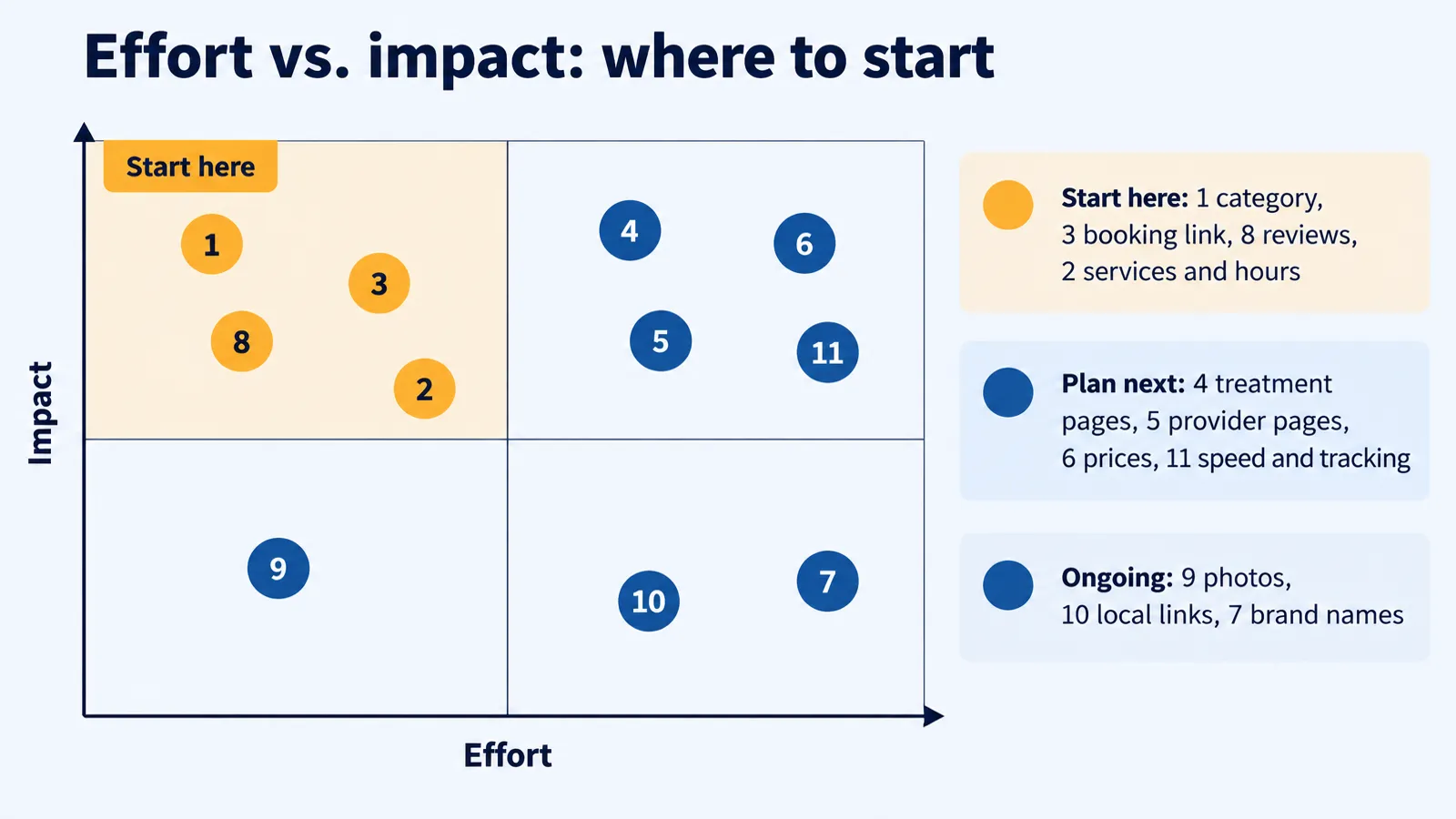
Med spa SEO effort and impact
What compliance rules affect local SEO for med spas?
Local SEO for med spas touches four sets of rules: Google's Maps content policy for reviews, the FTC's rule on fake reviews and testimonials, HIPAA for client photos and health details in replies, and advertising rules for health claims. None of them stop good SEO, but each one changes how a task is done.
Compliance rules that change med spa SEO tasks
For health claims, the FTC's Health Products Compliance Guidance explains the substantiation it expects. Keep treatment pages descriptive and leave promised results out. Our HIPAA-compliant marketing setup covers forms, tracking and photo consent in one place.
How long does med spa SEO take to work?
Med spa SEO usually shows early gains from profile fixes within a few weeks. Treatment pages and reviews take three to six months to build steady rankings. The profile changes first because Google reads it directly. Pages need to be crawled and trusted, and review volume grows one visit at a time.
These periods are planning ranges, not promises. A spa in a dense market with many competitors will take longer than one in a smaller town. Track booked appointments from local search every month so progress shows up in the numbers that pay for the work, and compare them with your med spa social and Meta ads results if you run both.
Frequently asked questions
What Google Business Profile category should a med spa use?
Use Medical spa as the primary category if licensed providers perform medical aesthetic treatments under a medical director. Google asks for the fewest, most specific categories that describe the core business. Add secondary categories only for real lines of business, and do not use categories as keywords.
Should a med spa publish prices online?
Yes, at least starting prices or ranges. Clients search for costs before they book, and a clear price filters out bookings that would cancel. When the final price depends on units, areas or sessions, explain that in one or two sentences next to the starting price.
Can a med spa ask clients to mention treatments in reviews?
It should not. Google's Maps content policy allows businesses to ask for genuine reviews but not in a way that influences the rating or content. Asking every client for a review is fine; scripting which treatments or keywords they mention is not. Send the same simple request to everyone.
Can a med spa post before and after photos for SEO?
Only with written consent. If the spa is a HIPAA covered entity, HHS says marketing uses of protected health information need the client's written authorization. Get it signed before posting, store it with the photo and ask counsel to review your consent form.
Does local seo for med spas need a page for each city?
Only for cities where you have a real location. Each location should have its own Business Profile and location page. Pages for nearby towns with no office tend to repeat the same content and rarely help; treatment pages and reviews do more.
How do I measure med spa SEO results?
Measure booked appointments by source, rebookings within a few months, calls answered and reviews per month. Rankings and map views explain changes but do not prove them. Tag profile links with UTM parameters and count bookings in your booking software.
What to do next with your med spa SEO
Med spa SEO comes down to answering the four booking questions everywhere a client looks: price, provider, downtime and the next open slot. Start with the profile, because those moves take hours and work quickly.
- Check that Medical spa is the primary category and every treatment is listed as a service.
- Add your booking page as the profile's appointment link, tagged with UTM parameters.
- Pick the treatment family that earns the most and build its page first, with a starting price and the provider who performs it.
Then set up the review request so it goes to every client after every visit. You can see how we measure results for other clients in our case studies, and how med spa SEO connects with healthcare SEO across the healthcare marketing system.
Find the leaks between local search and your booking calendar
Get a free, recorded audit of your med spa's Business Profile, treatment pages, reviews and follow-up, delivered within two business days.
Get my free patient growth audit →
Find the leaks between local search and your booking calendar
Get a free, recorded audit of your med spa's Business Profile, treatment pages, reviews and follow-up, delivered within two business days.
Get my free patient growth audit →

Keep reading
- Cosmetic Surgery Marketing: 12 Strategies That Book Consultations
- How to Rank a Medical Practice in Google's Local Pack (2026 Guide)
- The Patient Follow-Up System Every Clinic Needs
- Why Your Website Speed Is Secretly Killing Your Google Ads Performance
Sources
- Google Business Profile Help: Tips to improve your local ranking on Google (accessed 2026-10-28)
- Google Business Profile Help: Guidelines for representing your business on Google (accessed 2026-10-28)
- Google Maps Help: Maps user contributed content policy: fake engagement (accessed 2026-10-28)
- Federal Trade Commission: Federal Trade Commission announces final rule banning fake reviews and testimonials (August 14, 2024) (accessed 2026-10-28)
- U.S. Department of Health and Human Services: Marketing (HIPAA Privacy Rule guidance) (accessed 2026-10-28)
- Federal Trade Commission: Health Products Compliance Guidance (accessed 2026-10-28)
- web.dev (Google): Web Vitals (accessed 2026-10-28)
This article is educational marketing guidance, not legal or medical advice. Confirm compliance decisions with qualified counsel.