The short answer
Pest control SEO is the work of making your company show up on Google when homeowners search for pest help. That covers the map results and organic listings. It books jobs when your Google Business Profile, service pages, reviews and phone handling are built around one count: jobs actually booked.
Key takeaways
- Set up call and form tracking before you change a page, so every ranking gain can be tied to a booked job.
- Build one page per pest and service, and add a city page only where you actually run jobs.
- Your Google Business Profile, reviews and phone answer rate shape map-pack calls, so fix them before writing blog posts.
- Value each lead by what a plan pays over its life, since 85.4% of residential pest control revenue recurs (NPMA, 2025 results).
- Judge SEO by cost per booked job after about six months, and fix call handling first if calls rise but jobs don't.
In this article
- What do you need before you start pest control SEO?
- How do you do local SEO for pest control, step by
step? - How long does pest control SEO take, and what does it cost?
- How do you know pest control SEO is working?
- What goes wrong with pest control SEO, and how do you fix it?
- How should a pest control company plan content around the seasons?
- Does pest control SEO still matter with AI answers?
- What should you do first with pest control SEO?
Picture a homeowner who finds ants marching across the kitchen counter and opens Google on a phone. She taps the first company that shows a number, calls, and either reaches a person or doesn't. Nobody finds a wasp nest in the attic and decides to read three comparison articles first. This is a search business where the winner is the company that shows up and picks up the phone.
That makes pest control SEO unusually concrete. The goal is to be the call a specific homeowner in a specific town makes on a specific bad morning.
This guide covers SEO for pest control companies with 5 to 40 technicians that want organic search to produce booked jobs instead of a traffic report. It follows the order we use in our pest control marketing system, part of The Local Lead Generation System: measurement first, then pages, then rankings. Some of it you can finish this week without an agency.
What do you need before you start pest control SEO?
Before you start pest control SEO, you need five things. They are a verified Google Business Profile, an editable website, tracked calls and forms, a list of pests and towns you serve, and a booked-job log. Without the last two, you cannot tell good work from busy work.
What to have in place before you change anything
Tracking is the item owners are most tempted to postpone. A pest control site that cannot count booked jobs is a rodent bait station nobody checks: it may be working, and you will find out the hard way. Start with call tracking. Then mark form submits as key events in GA4, which Google's GA4 events documentation explains. Our GA4 and Google Tag Manager tracking work covers the tags behind both.
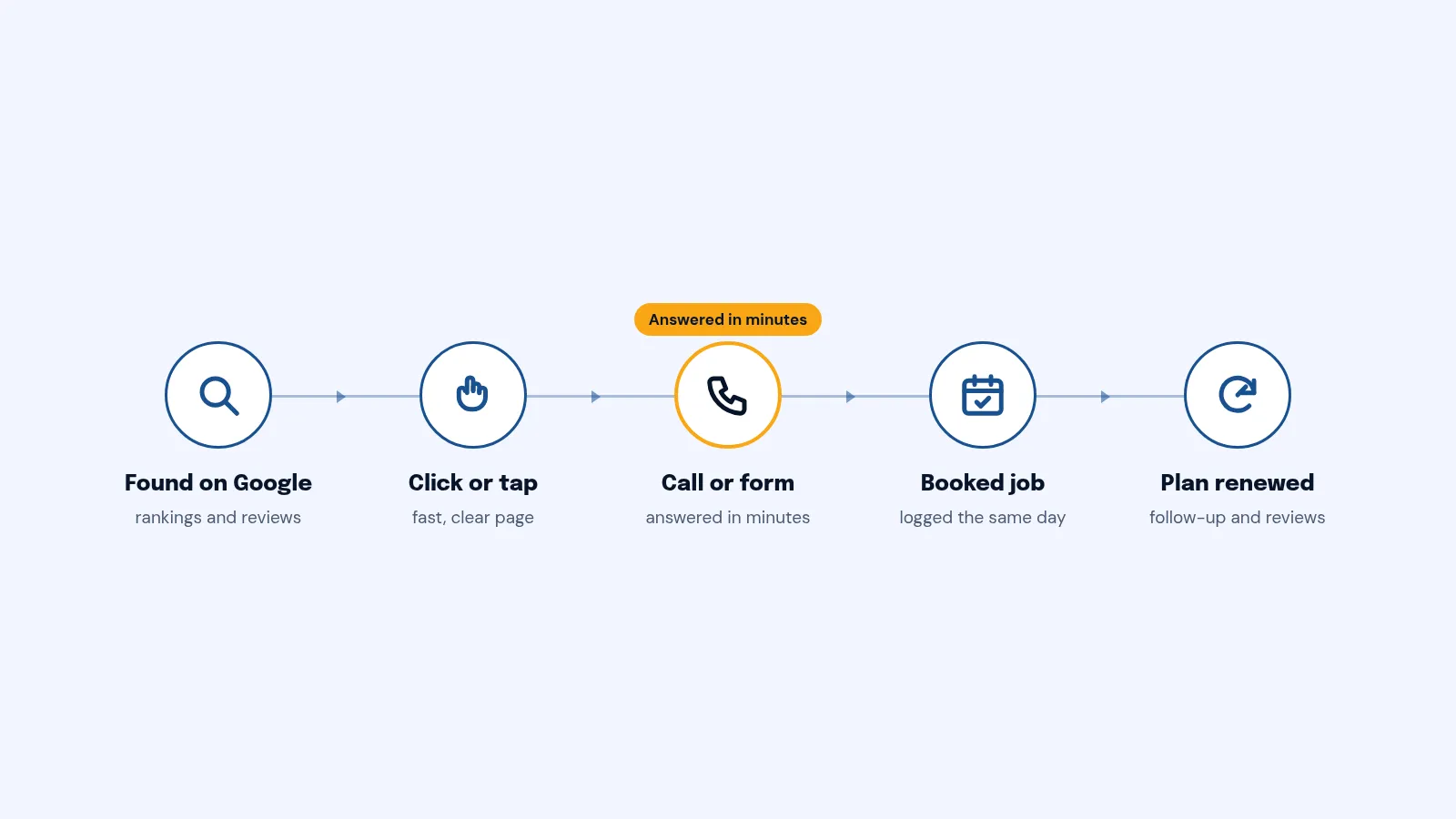
A lead can disappear at any of five points between the search and the renewed plan.
How do you do local SEO for pest control, step by step?
Local SEO for pest control runs in nine steps, in a fixed order. Count booked jobs first. Then map keywords, rebuild your Google Business Profile, build service and city pages, speed up the site, earn reviews, publish technician-written content, and answer every lead fast. Measurement comes first so every later step can be judged.
- Set the booked-job count before you change anything
- Map keywords to pests, seasons and service areas
- Rebuild your Google Business Profile around calls
- Give each pest and service its own page
- Add city pages only where you run real jobs
- Make the site fast and easy to call from a phone
- Ask for a review after every job and answer each one
- Publish content only a technician could write
- Answer every lead in minutes, then log the outcome
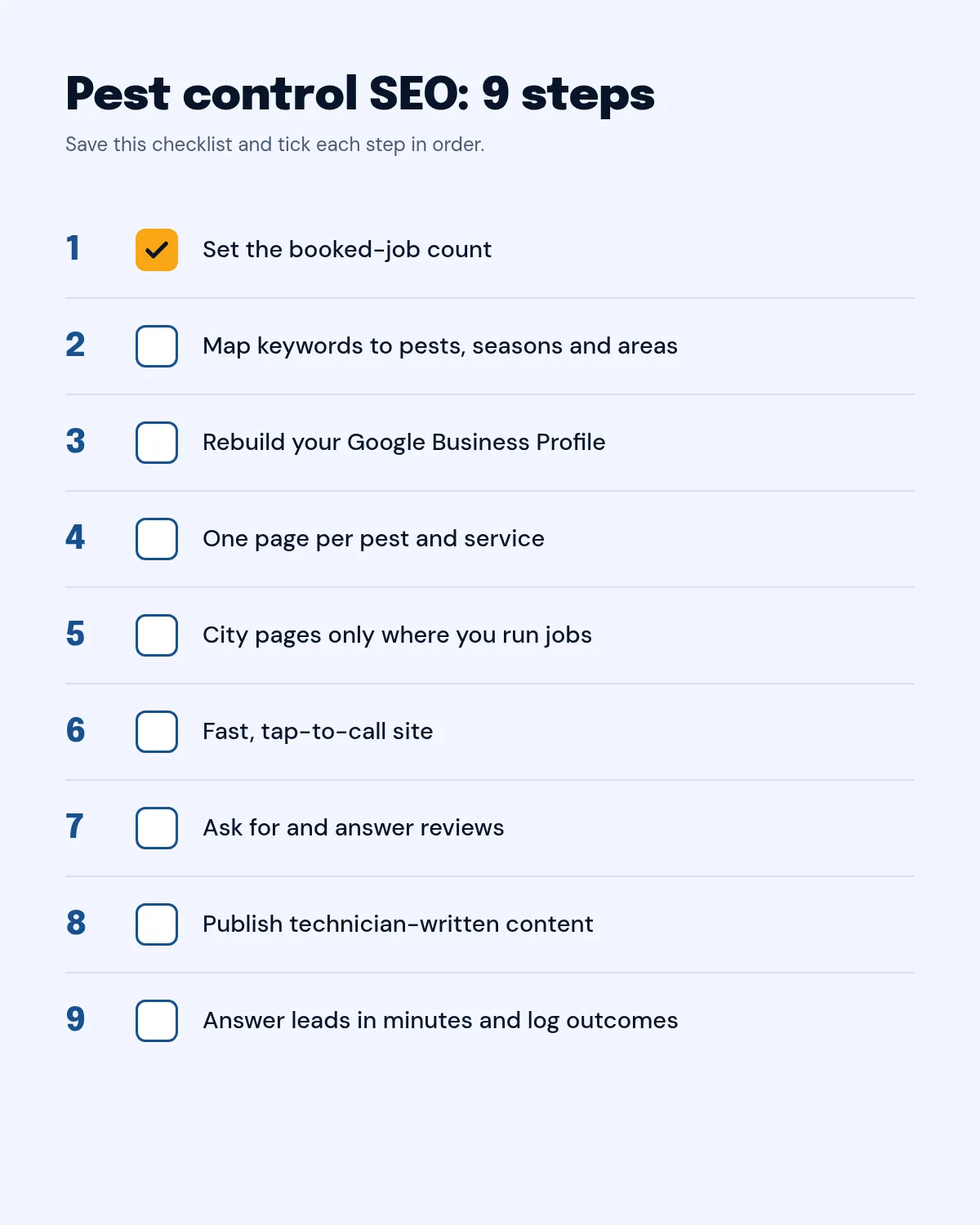
Step 1: Set the booked-job count before you change anything
Write down what a lead and a booked job mean in your company, then count both from day one. A lead is a call that lasted long enough to be a conversation, or a form with a real address. A booked job is a lead that ended up on a technician's schedule.
- Turn on call tracking for the website so each call is tied to the page and source that produced it.
- Mark form submits and tap-to-call clicks as key events in GA4.
- Add two columns to the office job log or CRM: lead source, and booked yes or no.
- If you also run Google Ads, send booked jobs back as an offline conversion so bidding learns from real jobs.
The mistake to avoid is counting the thank-you page view as a lead, because it also fires when someone refreshes the page. In a Google Ads engagement for a Canadian pest control company, Impact Brains got 5.6× conversions on the same budget. Cost per conversion fell 4.7% (see the pest control Google Ads case study). That is a paid-search result, so read it as proof that pest control leads can be counted and improved. It says nothing about organic rankings.
Step 2: Map keywords to pests, seasons and service areas
List every pest you treat, the moment that sends a homeowner to Google, and the towns your trucks reach. Then give each combination one page or one profile service. The table shows how the searcher's state decides which page should answer.
Pest control keyword map by searcher state
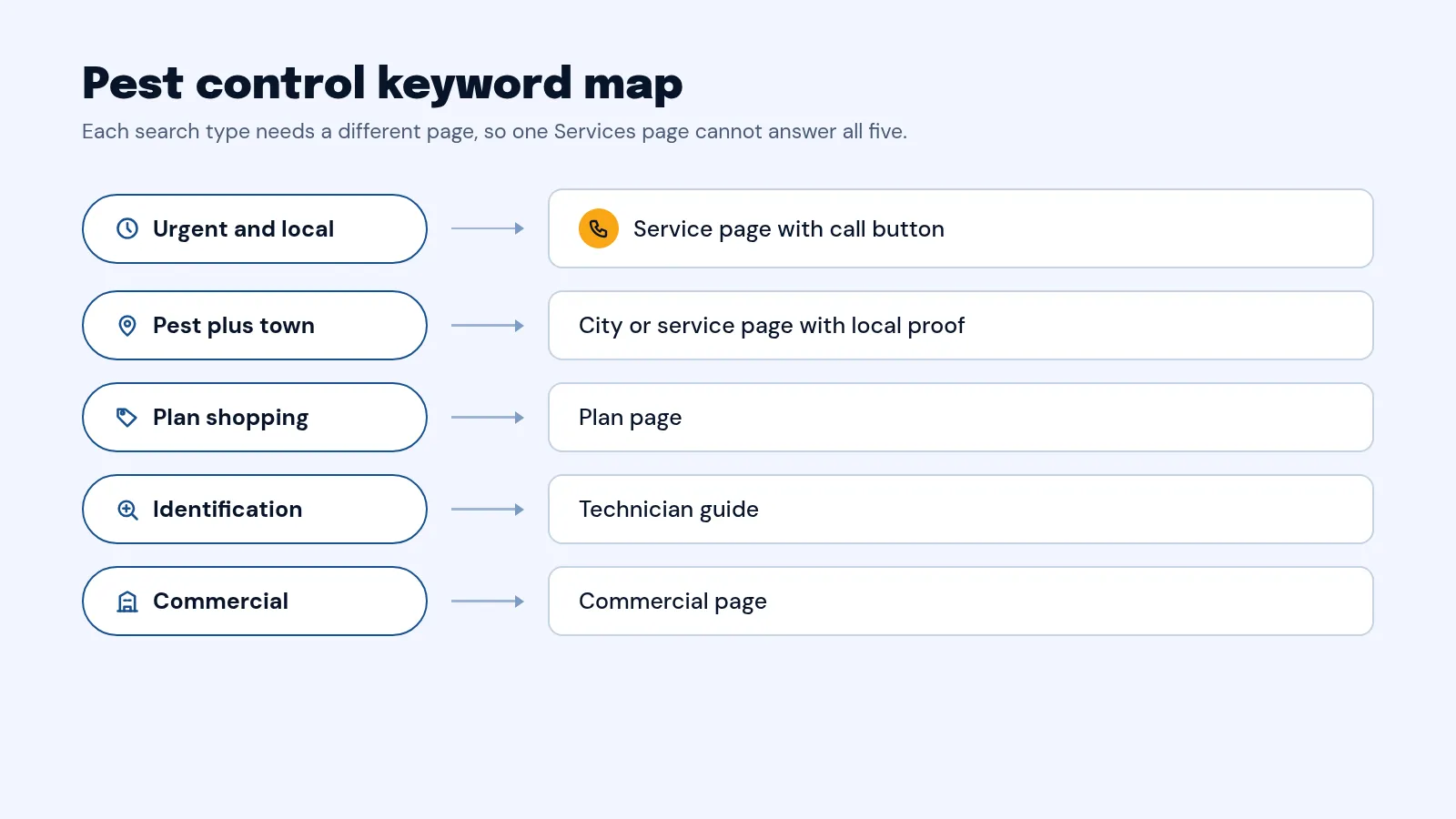
Each search type needs a different page, so one Services page cannot answer all five.
A page that ranks for ant control in a county you never drive to is a polite way to collect wrong numbers. More background on how these searches behave sits in our pest control SEO research.
Step 3: Rebuild your Google Business Profile around calls
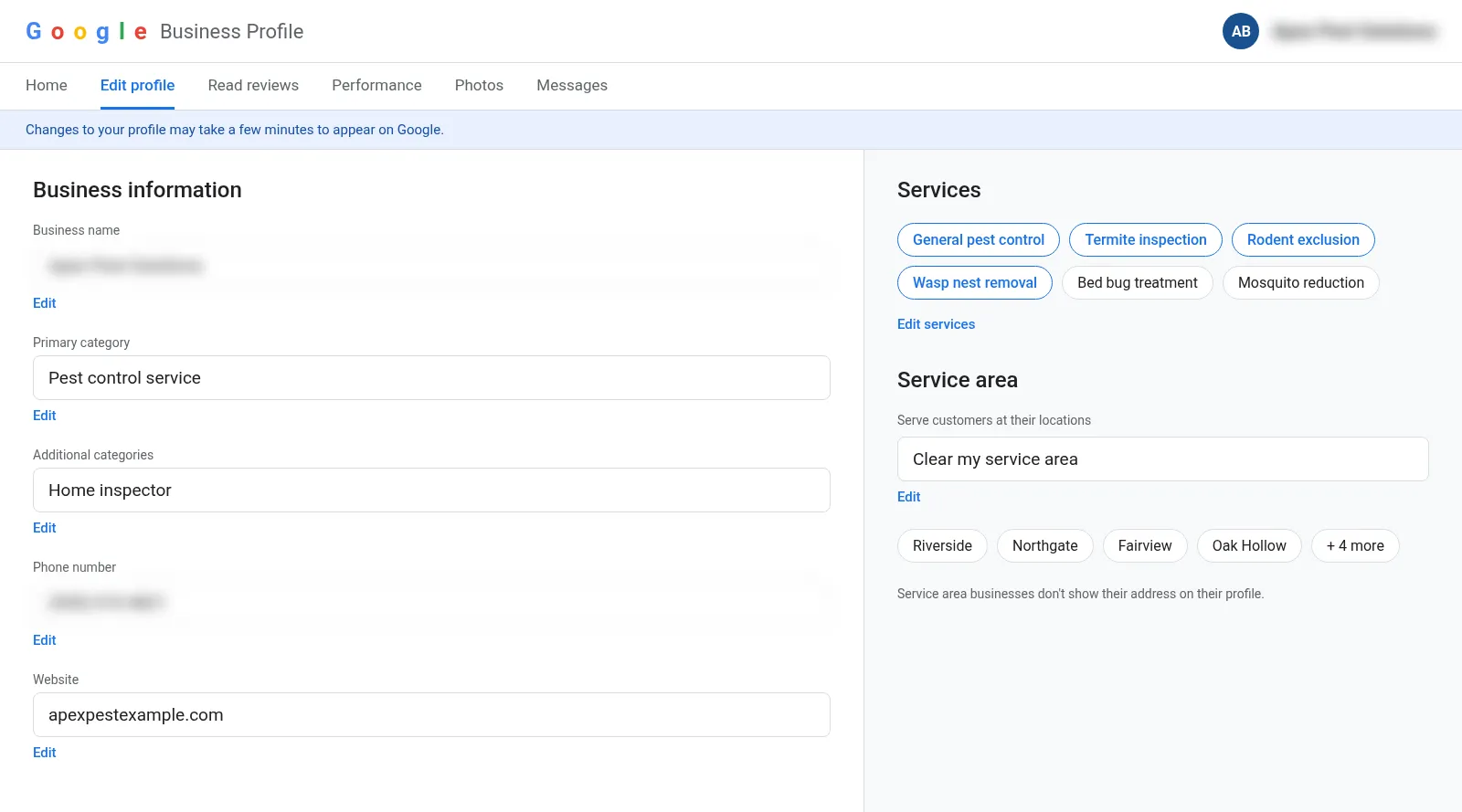
Your Google Business Profile fills the map results, so build it like a sales page. Google says local results rely mainly on relevance, distance and prominence, and that complete, accurate business information helps it match you to searches (Google Business Profile Help).
- Choose the category that matches your main revenue, usually pest control service, and add extra categories only for work you perform.
- List each service with a plain-language description, one entry per pest or treatment.
- Set your service area to the towns you serve. If customers never visit your office, hide the street address, as Google's guidelines for representing your business allow for service-area businesses.
- Use your real business name with no added keywords or towns, since extra words in the name break those same guidelines.
- Match your listed hours to when someone actually answers, including emergency hours if you offer them.
- Upload recent photos of real jobs, with house numbers and faces removed.
Photos of a branded van are a gallery. Photos of a sealed foundation gap or a cleared crawl space are evidence.
Our local SEO and Google Business Profile work follows this setup. The local pack ranking guide we wrote for medical practices covers the same Maps mechanics.
Step 4: Give each pest and service its own page
One page per pest or service lets each page answer one question well. A worried homeowner should see, on the first phone screen, what you treat, how soon you can come and how to call. Each service page should include:
- The pest or treatment, named the way customers say it, with your own photos of the work
- What happens during a visit and what the homeowner should do beforehand
- A starting price or a plain list of what changes the price
- Safety notes for children and pets, written in plain words and matched to the product label
- Your license or certification details
- Reviews that mention this pest or service
- A tap-to-call button and a short form
Treat each page as a landing page: one pest, one action. Link every blog post and city page to the service page it supports, so the page that books the job collects the strength.
Step 5: Add city pages only where you run real jobs
A city page earns its place when you can show work in that town. Add one when you have completed jobs there, have photos or reviews from there, and can describe details a local technician would know.
Each city page needs content a copy-and-paste cannot produce. Use the pests you treat most often there, the kinds of homes you service, one or two job photos with addresses removed, and reviews from customers in that town. Link it to the matching service pages.
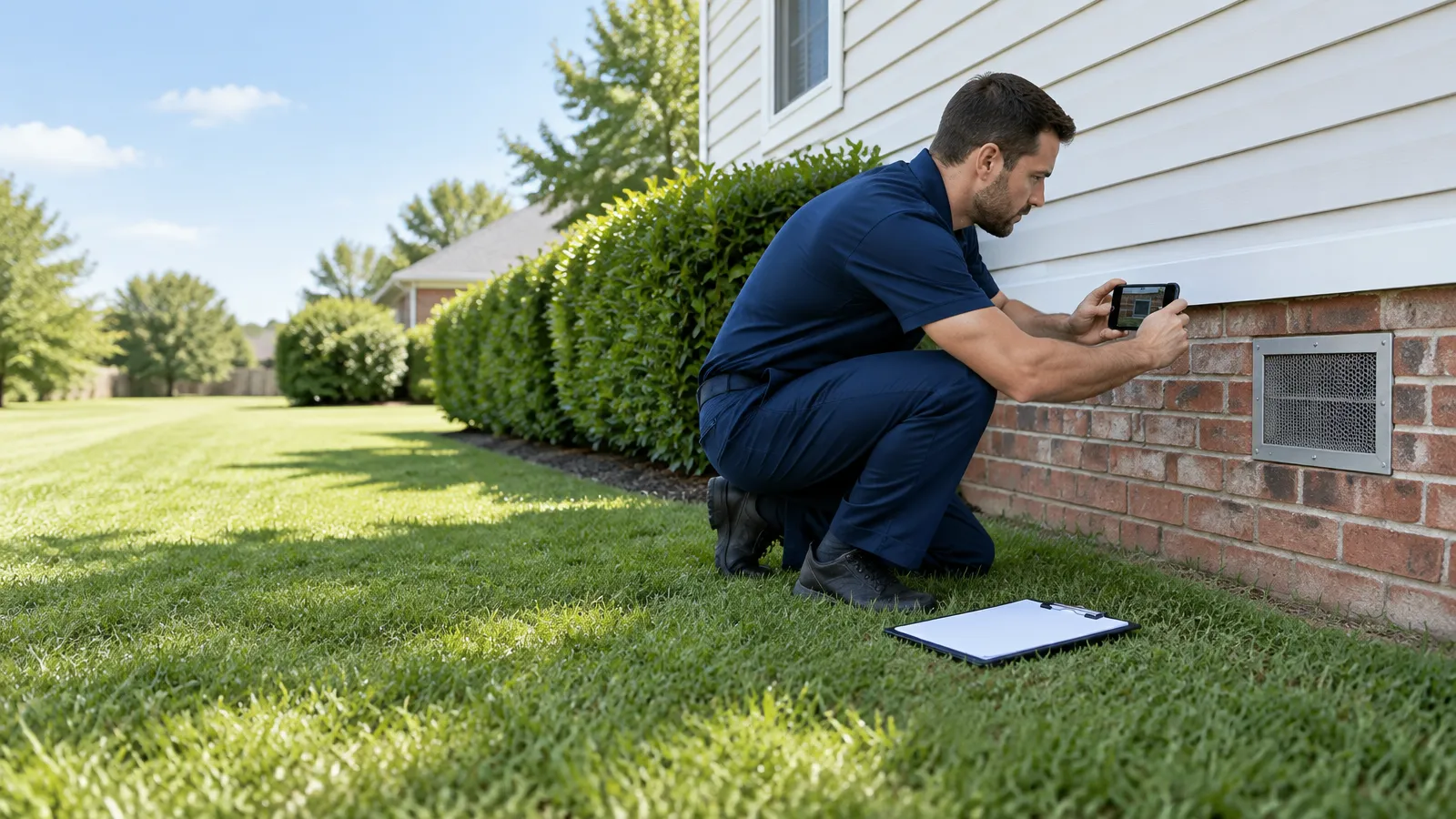
One photo and one sentence per job turns daily work into proof for service and city pages.
Doorway risk
Google's guidance on helpful, people-first content asks whether a page offers original information and was made for people first. A page whose only unique word is the town name fails that test.
Fifty city pages that share one paragraph and swap the town
name are a mail merge. Start with your three best towns, measure booked jobs
from them, and add more only when those pages earn calls.
Step 6: Make the site fast and easy to call from a phone
Judge your site the way a homeowner uses it: on a phone, on cellular data, in a hurry. Google's Core Web Vitals set the targets. Pages should load their main content in 2.5 seconds or less, respond to taps in 200 milliseconds or less, and keep layout shift at 0.1 or less (web.dev).
- Put a tap-to-call button in a fixed bar at the bottom of every mobile page.
- Keep forms to the fields you need to call back: name, phone and pest.
- Compress job photos and set their dimensions so the page does not jump while loading.
- Remove auto-playing video and pop-ups that cover the call button.
- Test the quote form on a real phone after every change.
Run the main pages through PageSpeed Insights, fix the largest image first, and check again.
Step 7: Ask for a review after every job and answer each one
Reviews help a homeowner choose which listing to call. Make the ask part of the job: the technician sends the review link by text before leaving the driveway, when the customer is happiest. Ask every customer without picking favorites.
Reply to every review within a business day, using the pest and town where it fits and leaving out personal details. A three-paragraph defense in reply to a one-star review gets read by everyone except the reviewer. Two sentences, an apology if one is due and a phone number are enough. If you offer anything in return for a review, read the FTC's Endorsement Guides questions and answers first.
Step 8: Publish content only a technician could write
Competitors publish the same tips, so original information is your advantage. Google's people-first guidance asks for first-hand experience and original information, and your technicians have both.
Build a job-log content engine. Every technician sends one photo and one sentence per job covering the pest, the entry point and the fix. Once a month, the owner turns the best three into a page update or a short article. Over a year, the log becomes city-page proof and a library of answers no template site has.
- How to tell flying ants from termite swarmers, with your own photos
- What a first visit involves, step by step
- What a real job found and what it took to fix
- Which pests your area sees in each season
Nobody has ever bookmarked 'quality service you can trust.' Write each answer so it stands on its own. Name the pest, the fix and the town in the same paragraph. Search engines and AI assistants can quote a paragraph like that without the rest of the page.
Step 9: Answer every lead in minutes, then log the outcome
Rankings send calls, and the phone decides who gets the job. Speed to lead is the time between a homeowner reaching out and a person responding. Our rule of thumb is a live answer for calls during business hours and a response within five minutes for forms.
- Route the main number to a person first, then a backup cell, then voicemail with a text-back.
- Send an automatic text within a minute of any missed call.
- Send a phone alert the moment a form arrives.
- Log the outcome of every lead the same day

Fast answers and a same-day job log keep ranking gains from leaking away.
A homeowner who has just seen a cockroach on the counter does not run a comparison: they call the first number, then the second if nobody picks up. The missed-call calculator shows what those unanswered calls cost you. Our CRM and follow-up automation work handles the texts and alerts.
Architect's
note
When I audit a local service account, I start with the phone before I look at keywords. The question I ask is simple: what happens to a call at 6:40 on a Saturday morning? If the answer is voicemail, ranking work cannot pay for itself, because the homeowner has already called the next company. So before I touch a title tag, I check who answers, how fast a missed call gets a text back, and whether the booked job is recorded anywhere. Fixing that costs far less than another month of SEO, and it makes every later ranking gain count.
Dr. Muhammad Abdullah, Founder & Chief Systems Architect
Score your leaks before you pay for more traffic
Answer a short set of questions and see where leads slip away between the search and the booked job.
How long does pest control SEO take, and what does it cost?
Plan on about three months of setup and early signals, and judge pest control SEO on booked jobs after about six months. Cost depends on how many towns you serve, how many pests you cover and how much content you need. Price it by working back from cost per booked job instead of a monthly fee.
A realistic first six months
Profile changes and new reviews tend to move map results before new pages rank in organic results, so expect the first gains there. The National Pest Management Association reported that recurring revenue made up 85.4% of residential pest control service revenue in 2025, across nearly 13.29 million residential customers. For budgeting, that means a booked job is usually the first payment in a plan.
Illustrative math, not a client result
Say a new residential customer starts with a $180 initial service and then pays $110 per quarterly visit. If the average customer stays two years, that is 8 quarterly visits: $180 + (8 × $110) = $1,060. Now say you invest $2,500 a month in SEO and it produces 12 booked jobs a month. Cost per booked job is $2,500 ÷ 12, about $208, and those 12 jobs bring about $12,720 in revenue over two years, roughly five times the monthly spend. That figure is before technician time, products and fuel, which means it is a revenue figure only.
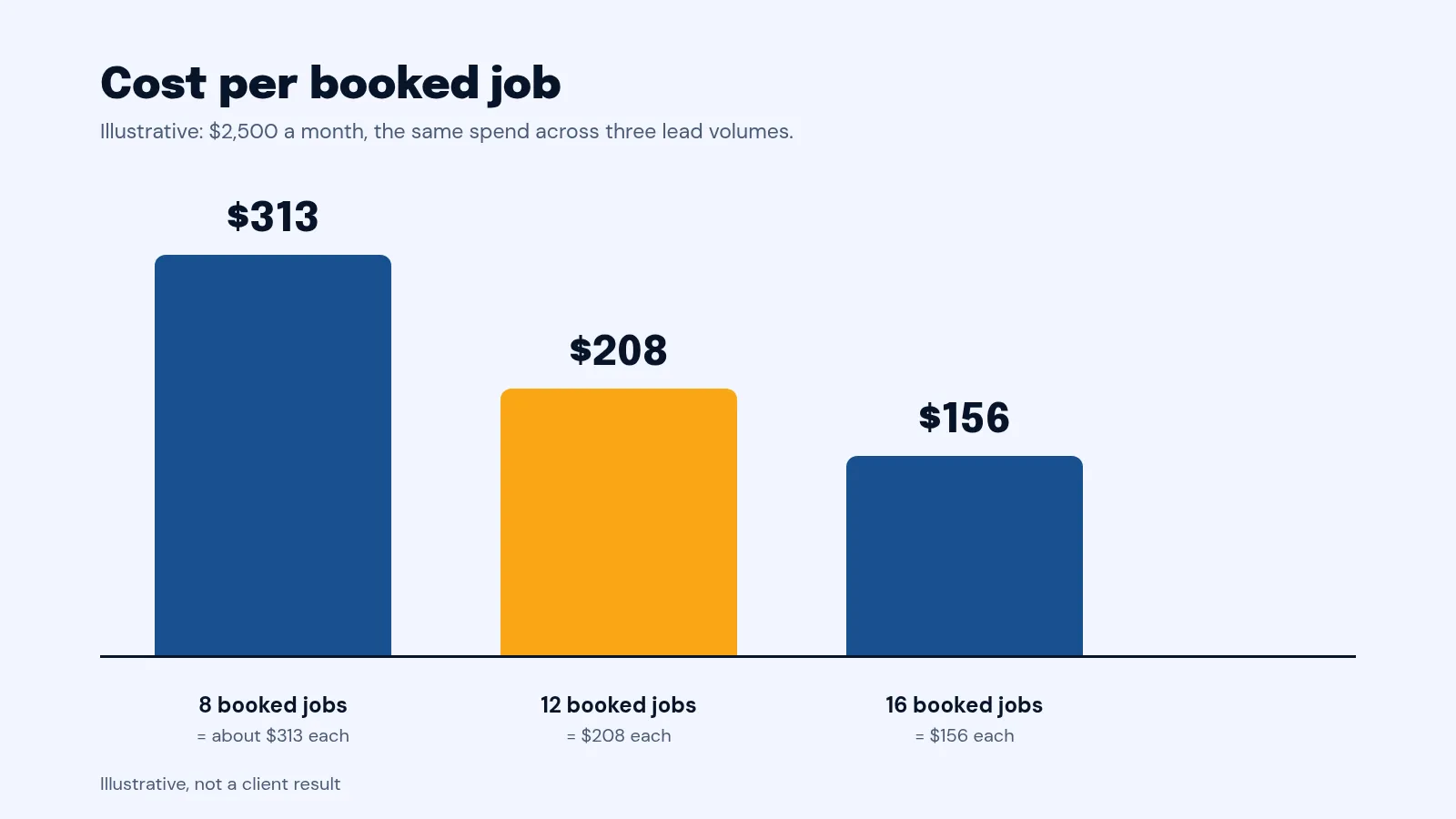
Illustrative math: the same monthly spend costs less per job as booked jobs rise, which is why the job count is the number to watch.
Score your leaks before you pay for more traffic
Answer a short set of questions and see where leads slip away between the search and the booked job.
How do you know pest control SEO is working?
You know pest control SEO is working when booked jobs from organic and map listings rise month over month while cost per booked job falls. Rankings and traffic are early signs, but calls, booked jobs and plan value decide whether the spend pays.
The six numbers to review every month
Two decision rules cover most months. If calls rise but booked jobs stay flat, fix phone handling before you touch content. If booked jobs rise but cost per booked job does not fall, you are paying for pages that rank for the wrong pests.
A dashboard that counts form fills but not booked jobs will report a great month even when every lead was a bot offering SEO packages. Count qualified leads only, and review the log with the office manager once a month.
Hold a 20-minute review on the same day each month, with the office manager in the room, and keep the scorecard below up to date:
- Fill in one row of the scorecard from the six numbers above.
- Listen to five calls that did not become jobs and note why.
- Read the newest reviews and reply to any that are unanswered.
- Pick one page to improve and one phone-handling fix for the month.
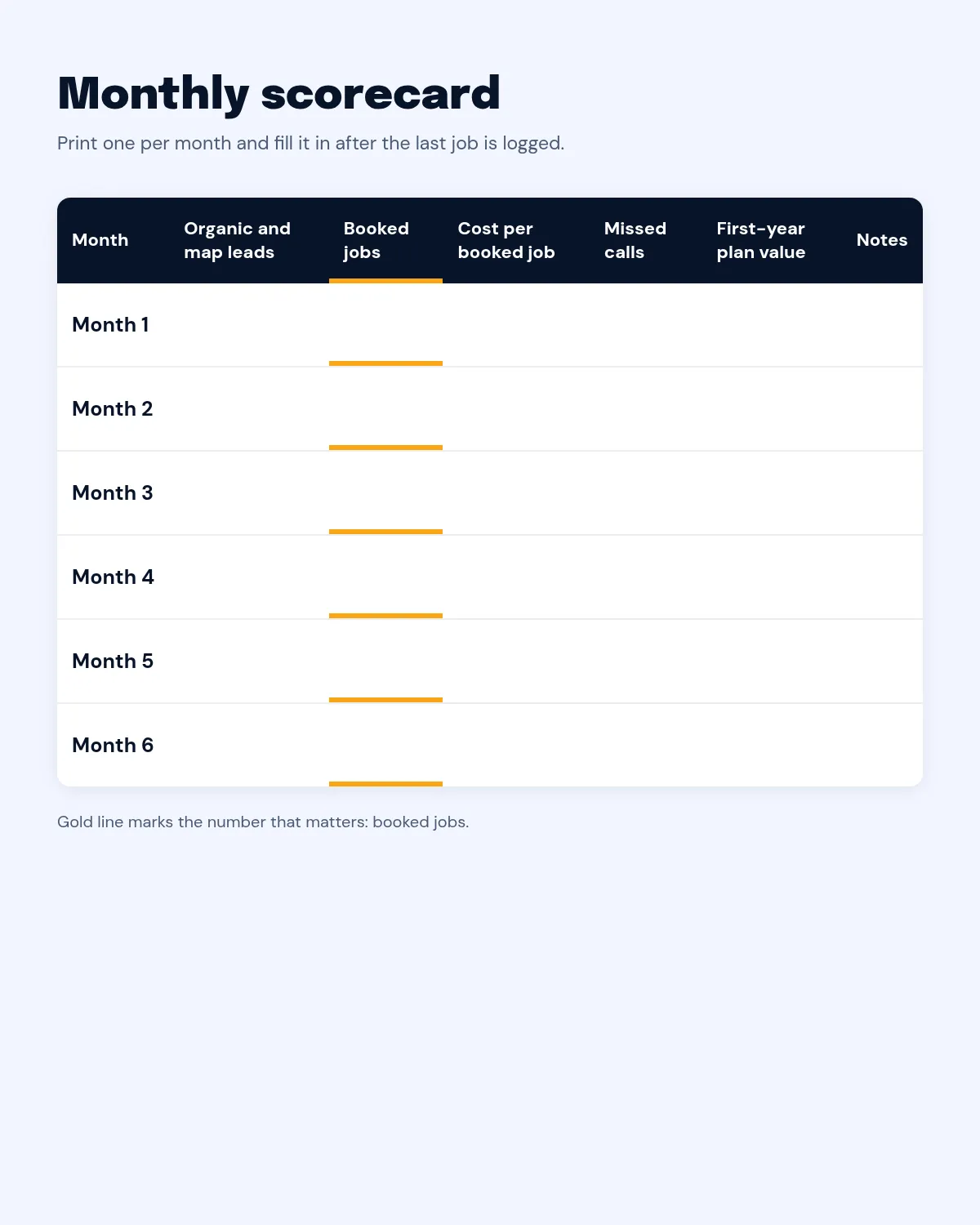
Fill in one row a month: the trend in booked jobs and missed calls tells you more than a ranking report.
What goes wrong with pest control SEO, and how do you fix it?
The most common pest control SEO problems are calls that never become jobs, traffic from the wrong searches, and pages that look like every competitor's. Each has a specific cause and fix, and most start with checking the phone and the booked-job log before touching the website.
Symptom, cause and fix
How should a pest control company plan content around the seasons?
Plan content around the seasons by refreshing each pest's page, photos and profile details about a month before its busy period. Your job log gives you your own calendar: count booked jobs by pest and month, and prepare first for the pests that repeat every year.
A starting seasonal refresh calendar (adjust to your region)
Treat the table as a starting point and overwrite it with your own booked-job counts. A company on the Gulf Coast and one in Minnesota will not share a calendar.
Does pest control SEO still matter with AI answers?
Pest control SEO still matters with AI answers. Google says its AI features run on the same core ranking and quality systems as regular search (AI features and your website). Pages and profiles that are easy to crawl, clearly written and backed by real reviews are what those answers can draw from.
In practice, SEO for pest control now includes how a paragraph reads when it is quoted alone. Name the pest, the fix and the town, keep your business details identical across listings, and keep collecting reviews. Our AI search optimization service covers this work, and the post on what AI Overviews do to clicks explains the click side.
Frequently asked questions
Is pest control SEO worth it compared with Google Ads?
Yes for most companies, because the two do different jobs. Google Ads fills the schedule while you build, and pest control SEO keeps leads coming when you stop paying per click. Compare both on cost per booked job, since cost per lead hides what happens after the call.
Should a pest control company put a tracking number on its Google Business Profile?
It can, but handle it carefully. Google's guidelines ask for a phone number that connects to your business as directly as possible. Check the current guidance on primary and additional numbers before you change anything. A safe start is tracking calls from your website with a swapped number.
Can a small pest control company outrank national brands?
Yes, in the map results and neighborhood searches. NPMA's 2025 survey counted 16,565 pest control firms, and 81.4% ran one or two locations, so most competitors are local too. A local company wins by showing job photos, reviews and technician notes from each town it serves.
Do blog posts help pest control SEO?
They help when they answer a real customer question with first-hand detail and point to the matching service page. They rarely book jobs alone. A post on telling flying ants from termite swarmers, with your own photos, has a better chance than a generic list of tips.
Which parts of this work can an owner do alone?
Most of the groundwork. An owner can verify and complete the Google Business Profile, set up a review text, write down services and towns, and log booked jobs. Tracking setup, page speed fixes and a content plan across many towns go faster with specialist help.
Does pest control SEO work for commercial accounts?
Yes, but commercial buyers search differently, so they need their own pages. Restaurants, property managers and warehouses look for inspection records, response times and reporting. NPMA reported nearly 7.0% growth in commercial service revenue in 2025, so the segment earns a dedicated page.
What should you do first with pest control SEO?
Start with the count, then the profile, then the phone. That order costs little and shows you where leads leak before you pay for more traffic. The work pays when booked jobs are measured, the Google Business Profile earns calls, and someone answers every lead fast.
- This week: define a lead and a booked job, then add lead source and booked columns to your job log.
- In the next 30 days: finish your Google Business Profile and start the review text after every job.
- In the next 60 days: rebuild your top three service pages with real job photos and a tap-to-call bar.
Impact Brains is a marketing systems agency that builds the ads, conversion websites, server-side tracking and CRM automation behind growth, and measures all of it to booked patients, jobs and orders. Our local and home services marketing covers pest control, HVAC, plumbing and other trades.

Keep reading
- Google Ads Audit Checklist for Cleaning Businesses: Find & Fix Wasted Ad Spend
- 7 Website Design Mistakes That Kill Conversion Rates
- What Is a Marketing System? And Why Campaigns Stall Without One
- The Patient Follow-Up System Every Clinic Needs
Sources
- National Pest Management Association (NPMA): Pest Control Industry Sustains Steady Growth with 6% Increase in 2025 (accessed 2026-10-27)
- Google Business Profile Help: Tips to improve your local ranking on Google (accessed 2026-10-27)
- Google Business Profile Help: Guidelines for representing your business on Google (accessed 2026-10-27)
- Google Search Central: Creating helpful, reliable, people-first content (accessed 2026-10-27)
- web.dev (Google): Web Vitals (accessed 2026-10-27)
- Google Analytics Help: About events (accessed 2026-10-27)
- Google Search Central: AI features and your website (accessed 2026-10-27)
- Federal Trade Commission: FTC's Endorsement Guides: What People Are Asking (accessed 2026-10-27)