The short answer
Plastic surgery PPC lowers cost per consult when the account follows your procedures. Give face, breast, body and non-surgical work their own campaigns, budgets, keywords and landing pages, count a qualified consultation request as the conversion, and send booked consults back to Google Ads so bidding learns which clicks become patients.
Key takeaways
- Measure cost per booked consultation; cost per lead hides which procedures pay.
- Give each procedure family its own campaign, budget and landing page.
- Return booked consults to Google Ads with the click ID only, never patient details.
- Cosmetic surgery is a sensitive health category, so Customer Match and your data segments are off the table.
In this article
- What do you need before restructuring plastic surgery PPC?
- How to structure plastic surgery PPC campaigns: 8 steps
- What do Google's health ad rules mean for plastic surgery Google Ads?
- How long does a plastic surgery PPC restructure take to work?
- How do you know the new PPC structure is working?
- Why is my plastic surgery PPC still expensive after restructuring?
- What to do next with your plastic surgery PPC account
Open most plastic surgery PPC accounts and you find the same thing: one search campaign called something like "Plastic Surgery General", a few hundred keywords, a single budget and every ad pointing at the homepage. The report says it produced 40 conversions last month. The coordinator's calendar says nine consults, and three of those were for Botox.
That gap is a structure problem. When facelift, breast augmentation, tummy tuck and injectables share one budget, Google spends where conversions are cheapest, and the cheapest conversions are rarely your most valuable patients. Somewhere a surgeon is paying facelift prices for a click from someone who typed plastic surgery jobs near me.
This guide is the Google Ads build we use inside a plastic surgery marketing system: eight steps that reorganize the account around procedures and measure it to booked consultations. It is written for owner-surgeons and practice managers spending roughly $8K to $25K a month on media. If your leads already cost too much across every channel, start with our breakdown of why plastic surgery leads get expensive, then come back for the account build.
What do you need before restructuring plastic surgery PPC?
Before restructuring plastic surgery PPC, you need four things in place: a way to see which ad produced each consult request, a CRM or scheduling stage that marks a consult as booked, one landing page per procedure you want to advertise, and a monthly budget split you can defend by procedure. Without them, a new structure only reorganizes guesses.
- Conversion tracking that separates form submissions, calls from ads and calls from the website.
- Call tracking with recording turned off or reviewed under your privacy policy, so you can see which campaigns make the phone ring.
- A booked-consult stage in your CRM or practice software, with the click ID stored on the lead record.
- Procedure pages for each family you advertise (facelift, rhinoplasty, breast augmentation, tummy tuck, and so on).
- A list of the procedures that matter most to revenue and surgeon time this year.
- A current read of Google's health ad rules, which we summarize in the policy section below.
Good PPC marketing for plastic surgery depends on all of this. Most of it sits outside the ad account, which is why we treat PPC as one layer of the IMPACT Marketing System. The ads layer cannot fix a missing booking stage, and the booking stage cannot fix ads aimed at the wrong searches.
How to structure plastic surgery PPC campaigns: 8 steps
The structure below gives every procedure family its own budget and every ad group a single job. Work through the steps in order, because each one depends on the one before it. Steps 1 and 6 are the measurement steps, and they matter more than any keyword choice.
- Make the booked consultation the goal
- Split campaigns by procedure family
- Build ad groups around one procedure and one intent
- Shut out the wrong searches with negative keywords
- Send every ad group to its own landing page
- Track calls, forms and booked consults without sending PHI
- Let bidding learn from booked consults, then tighten
- Set budgets per procedure and review weekly
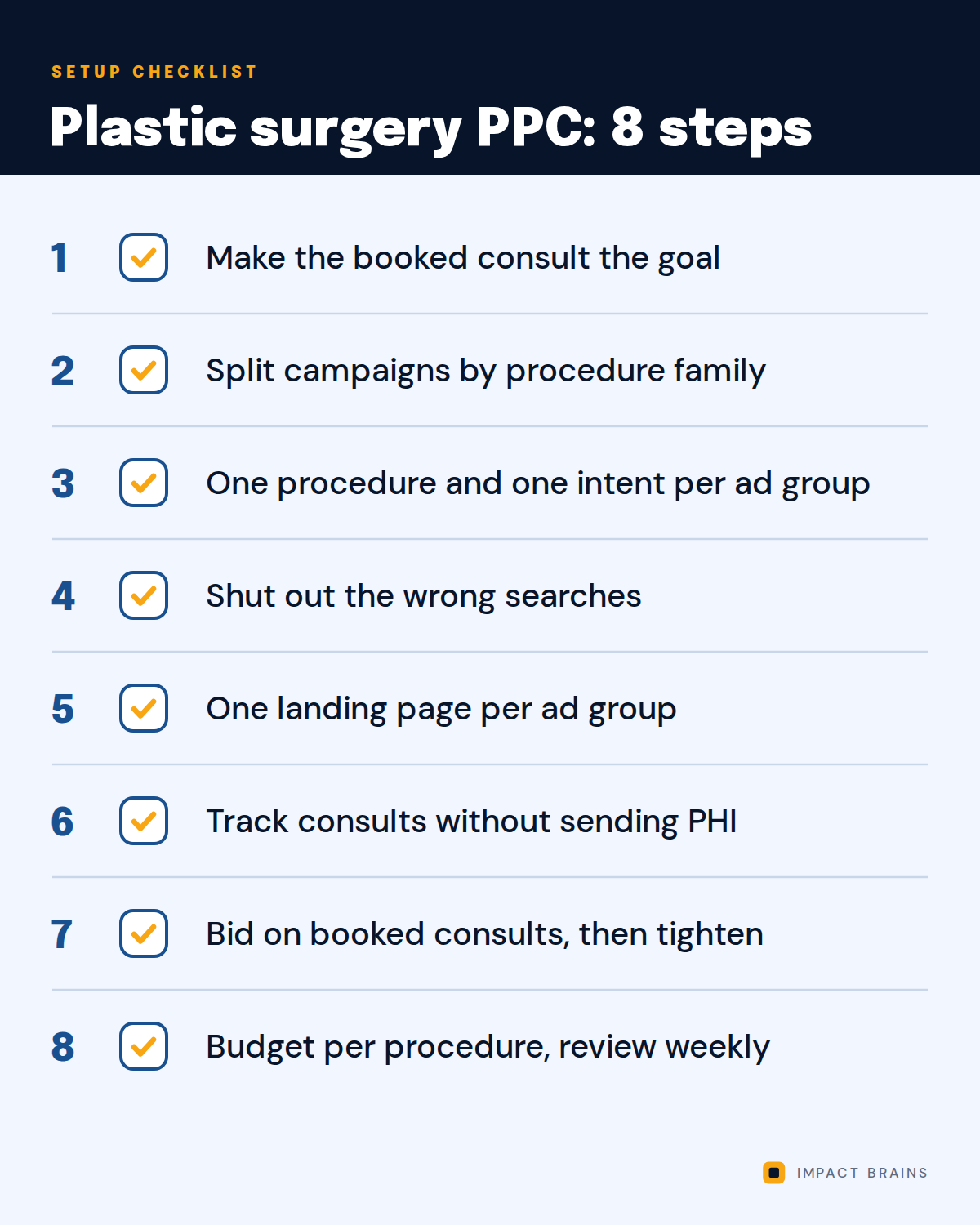
Each step has its own section below.
Step 1: Make the booked consultation the goal
In plastic surgery PPC, the booked consult is the first event that predicts revenue. Judge the account on it. Cost per lead treats a spam form, a price shopper and a qualified facelift candidate as equal. Cost per booked consult does not, and it shows which procedures earn their budget.
Set this up as three numbers you track every month: cost per consult request, booking rate (requests that become scheduled consults) and cost per booked consult. Later you can add cost per scheduled surgery, which is the closest thing to patient acquisition cost a cosmetic practice can measure from ads.
Smart Bidding is a very fast intern with no context: tell it a scroll is a win and it will bring you the most dedicated scrollers in your zip code. Whatever you mark as the primary conversion is what the account will buy more of.
Step 2: Split campaigns by procedure family
Splitting campaigns by procedure family gives each group its own daily budget. Cheap searches can no longer drain money meant for surgery. A family is a set of procedures with similar patients, similar consult paths and similar value. Five families cover most practices.
Procedure families for plastic surgery Google Ads
Two choices deserve a deliberate decision. First, non-surgical treatments convert cheaply, so they belong in their own campaign with a capped budget, or in a separate account if a med spa runs them. Second, brand searches are cheap and convert well, so keep them in their own campaign; mixed in with surgery they make the whole account look better than it is.
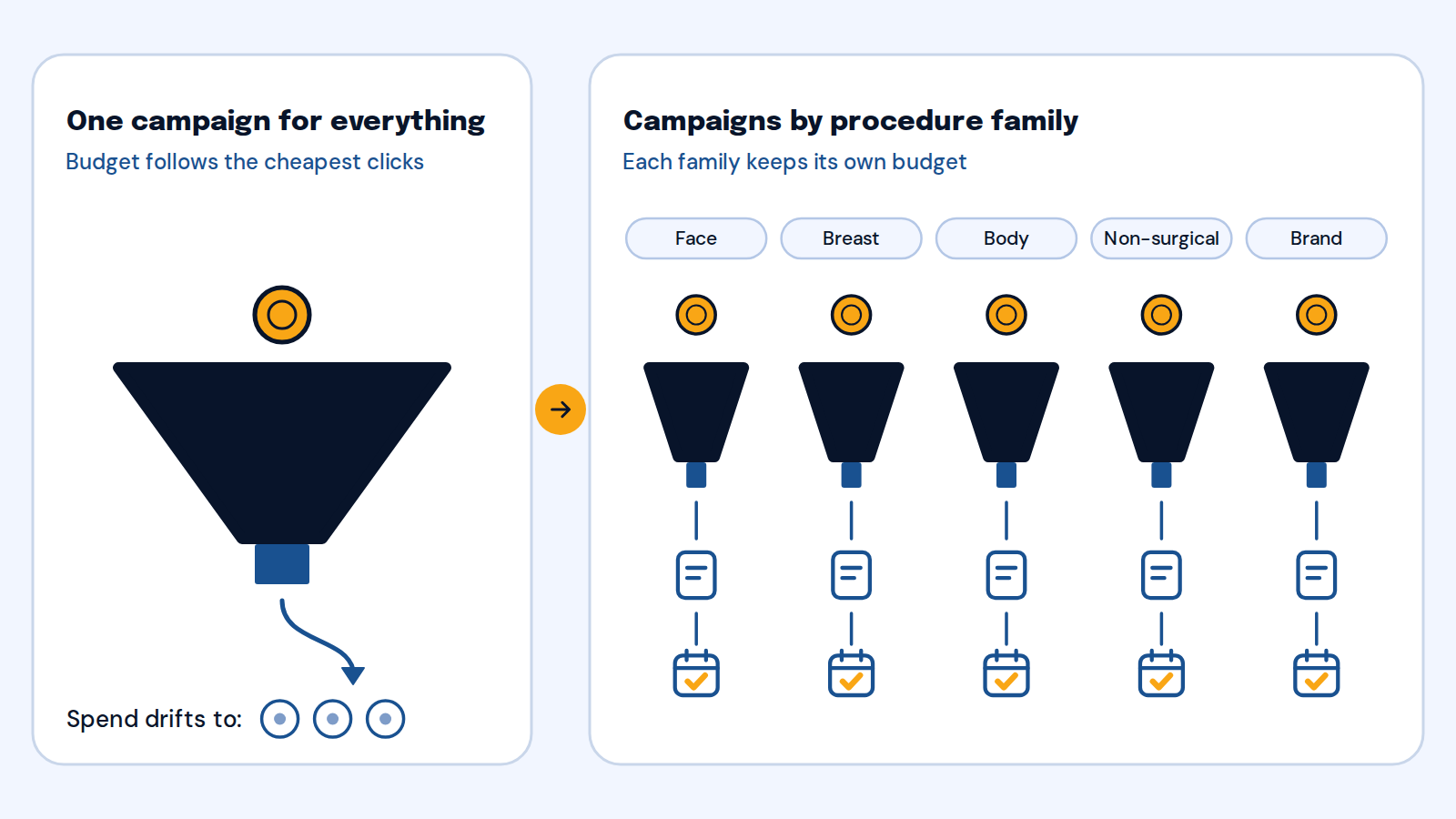
When every procedure shares a budget, spend drifts toward the cheapest conversions, not the most valuable ones.
Step 3: Build ad groups around one procedure and one intent
Each ad group in plastic surgery advertising campaigns should hold one procedure and one intent, such as facelift cost or rhinoplasty near me. Tight ad groups let the ad repeat the searcher's words. The page can then answer the exact question. Broad ad groups force one ad to speak to everyone.
Inside a facelift campaign, four intents usually earn their own ad group:
- Cost: facelift cost, facelift price, how much is a facelift. The page needs a price range or a financing answer near the top.
- Location: facelift near me, facelift plus your city. The page needs the address, parking and a map.
- Surgeon: facelift surgeon, best facelift surgeon in your city. The page needs credentials, years in practice and the consult process.
- Variant: mini facelift, deep plane facelift, if your surgeon performs them. The page needs a section that explains the difference.
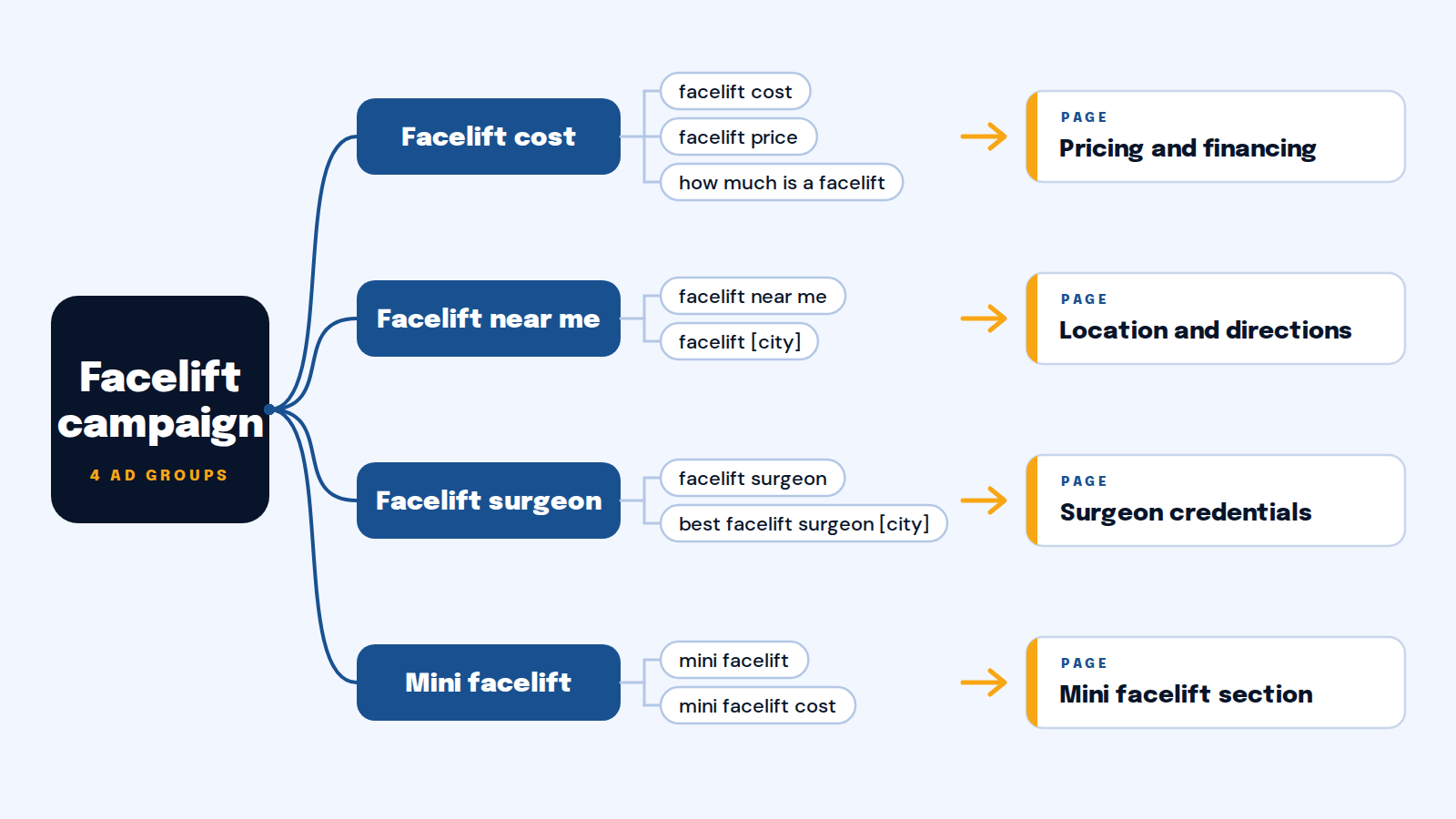
Each ad group answers one question, so the ad and the page can answer it in the first screen.
Start with phrase and exact match for these themes. Broad match can work later, once the account is learning from booked consults, because broad match relies on the conversion signal to stay on course.
Step 4: Shut out the wrong searches with negative keywords
Negative keywords stop your ads from showing on searches that will never book a consult. They often save more money than any bid change. Build one shared negative list for the whole account and add procedure-specific negatives inside each campaign.
The shared list usually starts with these themes:
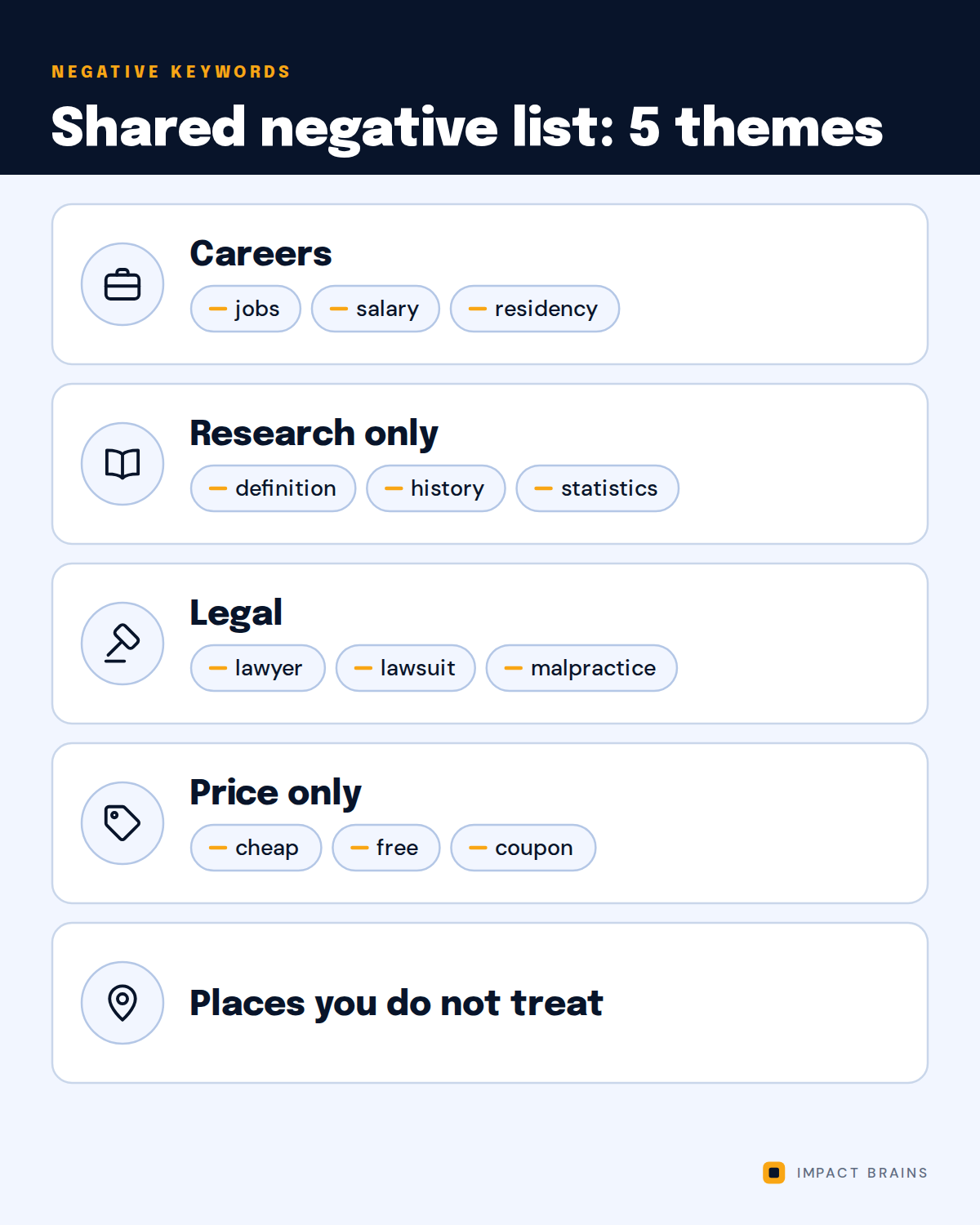
Start the shared negative list with these themes, then add terms from the weekly search terms report.
- Careers and training: jobs, salary, residency, fellowship, school, course, how to become.
- Research with no buying intent: definition, history, statistics, pictures of celebrities.
- Legal and complaint searches: lawyer, lawsuit, malpractice.
- Price-only shopping you do not serve: cheap, free, discount, coupon (unless you run promotions).
- Locations you will not treat, if medical travel searches are wasting budget.
Check the search terms report every week in Google Ads (Campaigns > Insights and reports > Search terms) and add negatives as you go. Google's guide to negative keywords explains how match types work for negatives, which behave differently from normal keywords.
Step 5: Send every ad group to its own landing page
Every ad group should land on a page built for that procedure. A matching page answers the question before the visitor hits the back button. A homepage asks a facelift shopper to find their own answer, which is a bit like handing a menu to someone who already ordered.
A good procedure page for paid traffic has the procedure name in the headline, the surgeon's credentials, a recovery overview, a price range or financing note, and a consult form visible on a phone without scrolling. We explain why in why facelift patients rarely convert on service pages, and our facelift landing page case study shows the layout in practice.
If you do not have these pages yet, build them before you scale spend. Our landing page design service starts with the highest-value procedure and adds pages one family at a time.
Step 6: Track calls, forms and booked consults without sending PHI
Tracking for plastic surgery Google Ads should report three conversions: a qualified consult request, a call from an ad that lasts long enough to be real, and a booked consult imported from your CRM. Only the booked consult tells bidding which clicks become patients. You can send it without any patient details.
- Create a primary conversion for qualified consult requests. Fire it when the form submits successfully, not on the thank-you page view.
- Create a call conversion for calls from ads. A 60-second minimum is a sensible starting threshold; adjust it once you hear what short calls usually are.
- Store the Google click ID (GCLID) on the lead record in your CRM when the form submits.
- When the coordinator marks the consult as booked, send the click ID, the conversion name, the time and a value to Google Ads through an offline conversion import.
- Set page views, scrolls and button clicks as secondary conversions so they report without steering bids.
Count the booked consultation as the conversion, not the thank-you page view, which also fires every time the office manager tests the form. And keep patient information out of the ad platform. The HHS guidance on online tracking technologies explains when tracking on health pages can disclose protected health information. Our HIPAA-compliant marketing setup and the guide to offline conversion tracking for healthcare cover the details. Check with counsel before turning on enhanced conversions for leads, because that feature sends hashed contact details to Google.
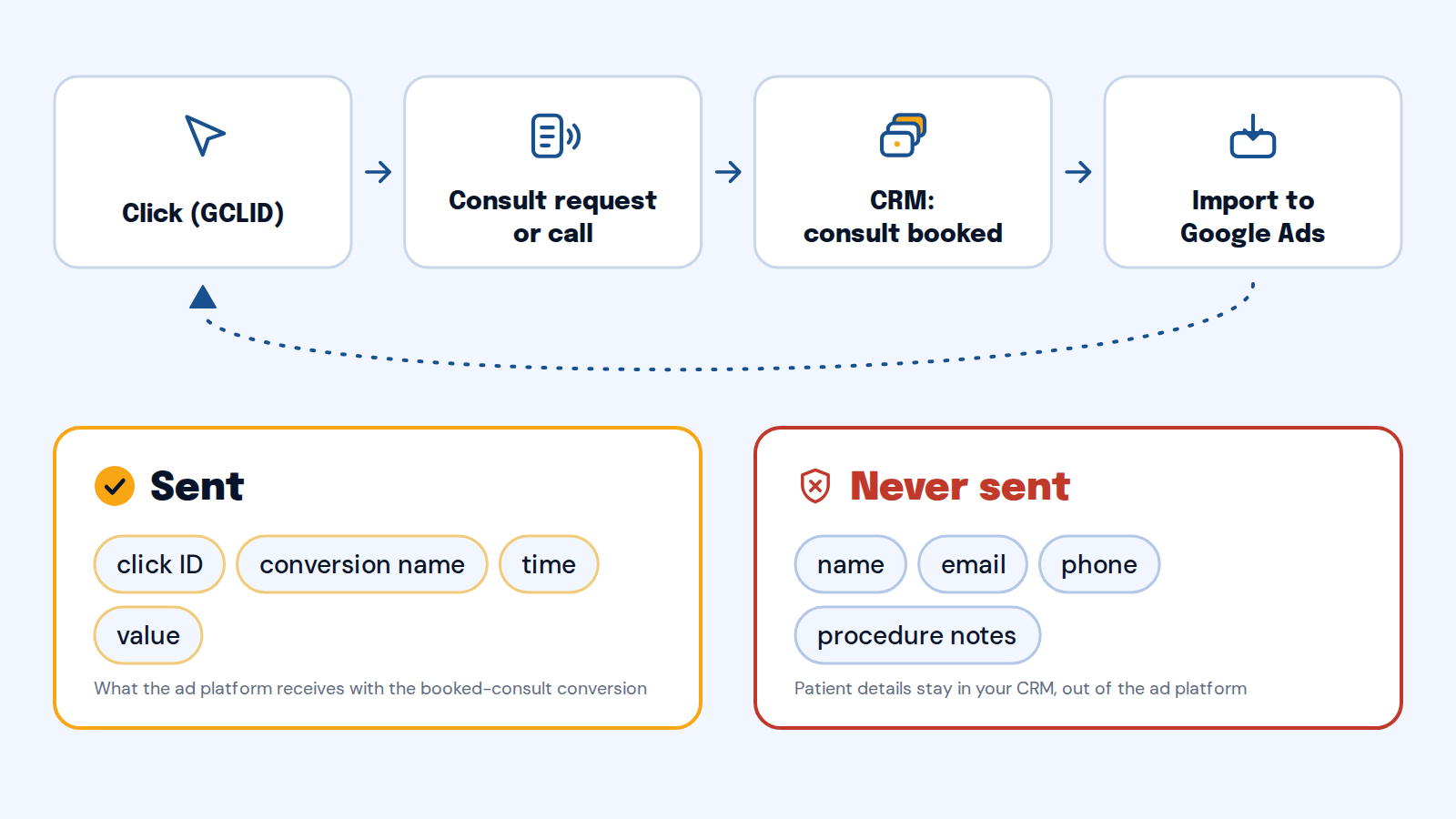
The ad platform gets the click ID, the conversion name, the time and the value. It never gets names, contact details or medical information.
Step 7: Let bidding learn from booked consults, then tighten
Bidding should run on the booked-consult signal once enough of it exists, starting with Maximize conversions and moving to a target cost per acquisition when results settle. Google's Smart Bidding documentation describes how these strategies use conversion data, so the quality of that data decides how well they work.
Three rules keep this calm. Change one thing at a time. Give each bid target change at least two weeks before judging it, because consults book days after the click. And raise or lower targets in small steps instead of cutting them in half after one bad week.
Google Ads will tell you the campaign is Eligible. So is a lottery ticket. The status only says the ads can show; the booked-consult report says whether showing them was worth it.
Step 8: Set budgets per procedure and review weekly
Set plastic surgery PPC budgets per procedure family. Work back from the consults you want, then check cost per booked consult every week. This turns a vague monthly spend into a number tied to surgeon time.
Worked example (illustrative numbers)
Say you want 10 booked facelift consults a month. Your facelift page turns 5% of clicks into consult requests, and your coordinator books half of them. You need 20 requests, so 400 clicks. At an illustrative $7 per click, that is $2,800 a month for the facelift campaign and $280 per booked consult. Swap in your own click costs and rates; our Google Ads budget calculator does the same math.
The weekly review takes about 30 minutes and covers the same list every time:
- Search terms report: add negatives and spot new procedure themes.
- Cost per booked consult by campaign, compared with last week and last month.
- Booking rate by campaign: a drop usually points to follow-up, not ads.
- Missed and unanswered calls by hour, so the front desk schedule matches ad hours.
- Budget share by procedure family, checked against this year's priorities.
Nobody has ever lowered cost per consult by renaming a campaign Final_v3_NEW. The weekly list is dull on purpose, and it is the part most accounts skip.
Architect's note
When I audit a plastic surgery account, I look at the conversion list before the keywords. In our facial plastic surgery case in Washington, D.C., the account was not short of budget; it was short of signal. We rebuilt it by procedure and made the consultation request the conversion that bidding chased. Over three months, cost per conversion fell from $141.68 to $61.12, conversions rose from 34 to 99 and conversion value grew 161%. The keywords barely changed. What changed was what we told Google a good click looks like.
Dr. Muhammad Abdullah, Founder & Chief Systems Architect
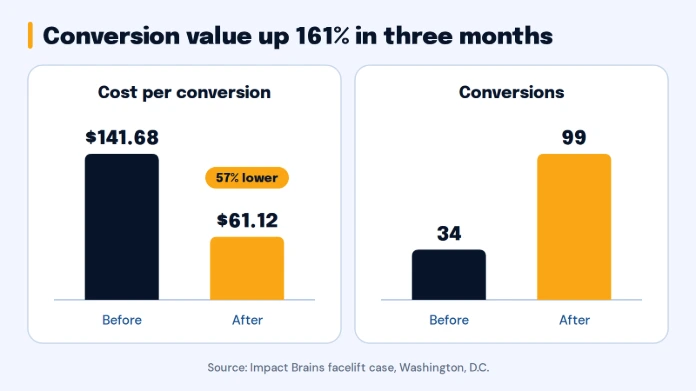
Ledger figures from our facial plastic surgery case in Washington, D.C., measured over three months.
You can read how that account was rebuilt in the facelift Google Ads case study. The same structure carries across every procedure family, and it is how we run healthcare Google Ads for other specialties too.
See where your practice is losing consults
Get a free, recorded audit of your Google Ads structure, tracking, landing pages and follow-up, delivered within two business days. We used the same review on the facelift account that cut cost per conversion 57%.
Get my free patient growth audit →
What do Google's health ad rules mean for plastic surgery Google Ads?
Google treats cosmetic surgery as a sensitive health category for personalized advertising, so plastic surgery Google Ads cannot use advertiser-built audiences such as Customer Match or your data segments. Google's predefined audiences and location targeting are still supported. Search campaigns built on keywords, which is where most consults come from, are not affected by this rule.
Google's Health in personalized advertising policy lists "invasive medical procedures, including cosmetic surgery, surgical procedures, or injections" as personal health content. As of October 2026, the page lists these targeting options:
Audience options for cosmetic surgery ads under Google's Health in personalized advertising policy (checked October 2026)
Ad copy and landing pages also fall under Google's Healthcare and medicines policy, and our summary of Google Ads healthcare policies for 2026 covers the rest. Keep ads factual: name the procedure and the surgeon, and leave outcome promises out of headlines. Policies change, so re-check the pages above before launching a new campaign.
How long does a plastic surgery PPC restructure take to work?
Give a plastic surgery PPC restructure four to eight weeks before you judge cost per booked consult. New campaigns start with little history, and consults book days after the click. The first two weeks show whether the right searches are coming in; the following weeks show whether they book.
What to expect after a plastic surgery PPC rebuild
These ranges are planning guides, not promises. A practice with low search volume for a procedure will need longer, and a practice that is slow to answer consult requests will see the ads improve while bookings stay flat.
How do you know the new PPC structure is working?
The new structure is working when booked consults rise and cost per booked consult falls or holds. Spend should also shift toward the procedures that matter most. Clicks, click-through rate and cost per click are diagnostic numbers; they explain changes but do not prove them.
Plastic surgery PPC metrics that matter

Fast, consistent follow-up turns paid clicks into booked consults; slow follow-up wastes the ad spend that came before it.
The five minutes after a consult request matter more than the next thousand dollars of ads, and the phone does not care how pretty the ad was. If booking rate is the weak number, look at speed to lead and call answering before you touch bids.
Why is my plastic surgery PPC still expensive after restructuring?
Plastic surgery PPC stays expensive when the problem sits outside the campaigns. The usual causes are tracking that counts the wrong thing, pages that miss the ad's promise, and slow follow-up. Use the table below to match the symptom to the likely cause before changing bids.
Plastic surgery PPC troubleshooting
If two or more rows describe your account, the fix is
usually a rebuild of tracking and pages before any new keyword work. Our revenue attribution service starts there.
Frequently asked questions
How much should a plastic surgery practice spend on PPC?
Spend should come from the consults you want, not a round number. Multiply target booked consults by your expected cost per booked consult for each procedure family, then add a testing budget for new procedures. Our Google Ads budget calculator works the numbers backwards from your goals so the budget ties to surgeon time.
Is plastic surgery PPC better than SEO?
Plastic surgery PPC and SEO do different jobs. PPC buys visibility on high-intent procedure searches from the day ads are approved, which helps when the schedule has gaps. SEO builds rankings that keep working without click costs but takes months. Most practices run both and use PPC data to choose which procedure pages SEO should build next.
Should injectables and surgery share one Google Ads campaign?
No. Injectables convert cheaply and often, so in a shared campaign they absorb budget meant for surgery. Give non-surgical treatments their own campaign with a capped budget, or run them from a separate med spa account, and judge each campaign on its own cost per booked consult.
Can plastic surgeons use remarketing or Customer Match?
Not with advertiser-built audiences. Google's Health in personalized advertising policy treats cosmetic surgery as sensitive, and as of October 2026 it does not support Customer Match, your data segments, audience expansion or lookalike segments for those ads. Predefined Google audiences and location targeting are still supported.
Does Performance Max work for plastic surgeons?
Performance Max can find conversions, but it blends search, display, YouTube and other placements, which makes procedure-level intent harder to control. Build search campaigns measured to booked consults first. Test Performance Max afterward with its own budget, and compare it on cost per booked consult, not on reported conversions.
What is the best conversion action for PPC for plastic surgeons?
The best primary conversion is a qualified consult request, with booked consults imported from your CRM as the signal bidding learns from. Calls from ads above a minimum length can also count. Page views, scrolls and button clicks should be secondary conversions so they report without steering bids.
What to do next with your plastic surgery PPC account
Rebuilding plastic surgery PPC around procedures is the fastest way we know to stop paying surgery prices for the wrong clicks. The decision is simple: if your account has one budget for every procedure, or counts anything other than consult requests as the main conversion, restructure before you add spend.
Start with three actions this week:
- Open your conversion list and mark which actions are primary. Anything that is not a consult request or a real call should be secondary.
- Group your keywords into the five procedure families and note how much each family spent last month.
- Ask your coordinator how many consults each family booked in the same month, then divide.
That last number, cost per booked consult by procedure, will tell you where the budget should move. If you would like a second set of eyes on it, the healthcare marketing team behind the facelift case can review the account with you.
Talk it through with the architect
Book a call with Dr. Muhammad Abdullah to walk through your account structure, tracking and consult numbers. You leave with a plan whether or not we work together.
Book a call with Dr. Abdullah →

Keep reading
- The Plastic Surgery Marketing ROI Blueprint: Which Channels Actually Generate Surgical Patients?
- The Modern Patient Journey: How Cosmetic Surgery Patients Actually Choose a Surgeon in 2026
- Cosmetic Surgery Marketing: 12 Strategies That Book Consultations
- Google Ads for Doctors: Setup, Policies and Budgets
Sources
- Google Advertising Policies Help: Health in personalized advertising (accessed 2026-10-28)
- Google Advertising Policies Help: Healthcare and medicines policy (accessed 2026-10-28)
- Google Ads Help: About negative keywords (accessed 2026-10-28)
- Google Ads Help: About offline conversion imports (accessed 2026-10-28)
- Google Ads Help: About Smart Bidding (accessed 2026-10-28)
- U.S. Department of Health and Human Services: Use of Online Tracking Technologies by HIPAA Covered Entities and Business Associates (accessed 2026-10-28)
This article is educational marketing guidance, not legal or medical advice. Confirm compliance decisions with qualified counsel.