SEO for doctors is the work of making your practice appear in Google Search, Google Maps and AI answers when patients look for your procedures nearby. The 15 steps below cover your Google Business Profile, procedure pages, reviews, schema, tracking and local links, in the order we use them on client accounts.
Patients compare practices on Google Maps, read reviews, ask AI assistants and only then call. Local SEO for medical professionals puts your practice in front of them at each of those moments. This guide is the checklist behind our medical SEO services, written so you or your team can start today.
How do doctors rank locally on Google?
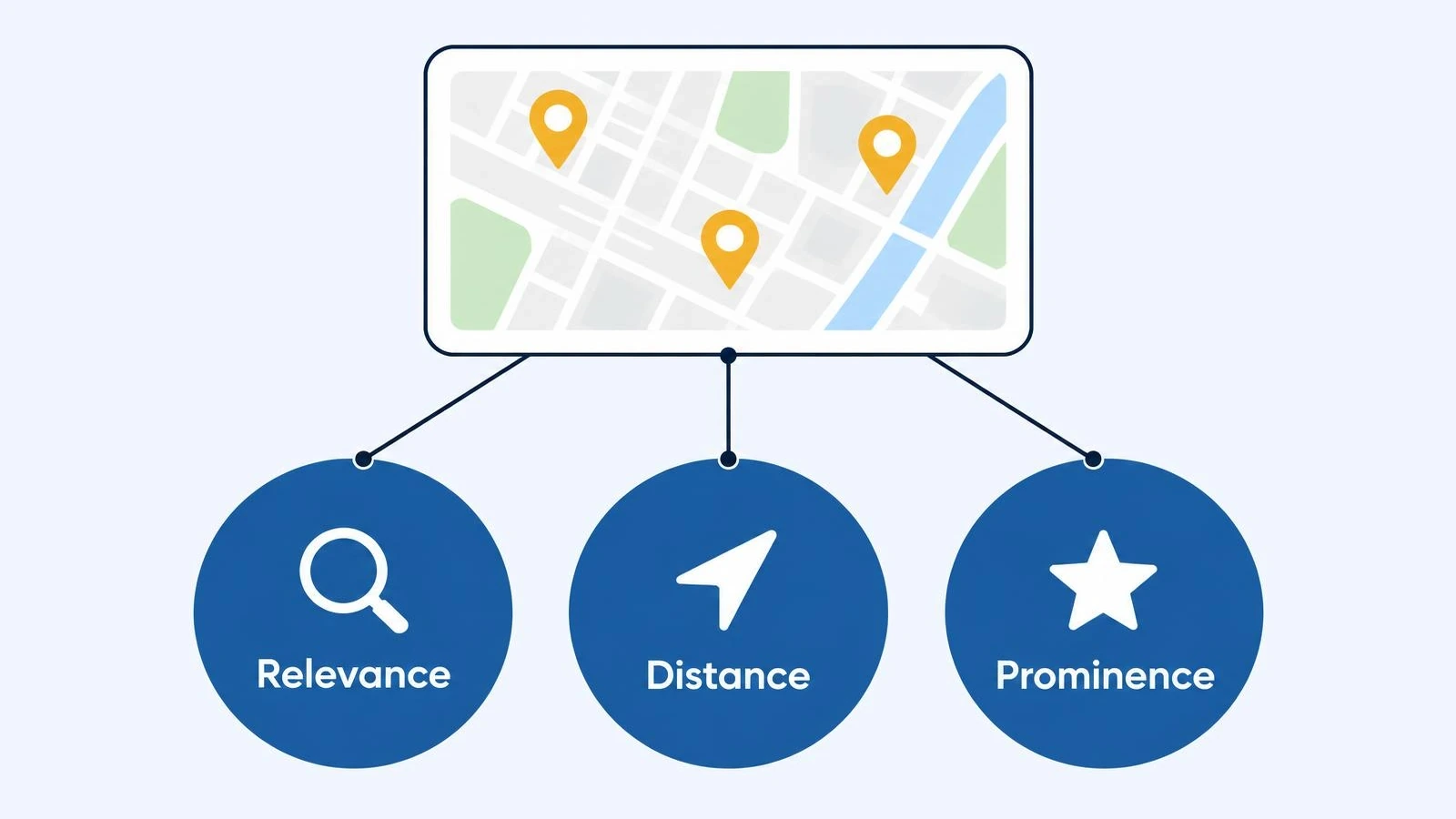
Google weighs three things for local results: relevance (does your profile and site match the search), distance (how close you are to the searcher) and prominence (reviews, links and mentions). You cannot change distance. Steps 1 to 9 improve relevance and prominence. Steps 10 to 15 turn that visibility into measured appointments.
1. Claim and verify your Google Business Profile
Your profile drives the map pack. Claim it, complete verification and confirm that the name matches your signage and legal practice name exactly. Use one profile per physical location and never add keywords to the business name. Keyword stuffing is a common reason profiles get suspended.
2. Choose the right primary and secondary categories
Pick the one category that matches your core specialty, such as “Dermatologist” or “Plastic surgeon”, then add secondary categories for real sub-services. The primary category is one of the strongest relevance signals you control. Check which categories the top three local competitors use before you decide.
3. Make your name, address and phone match everywhere
Use the same name, address and phone number (NAP) on your site, profile and every listing. Differences such as “Suite 4” versus “Ste. 4” create doubt about which record is real. Set a single format, then audit your top 20 listings against it.
4. Build a dedicated page for every procedure and condition
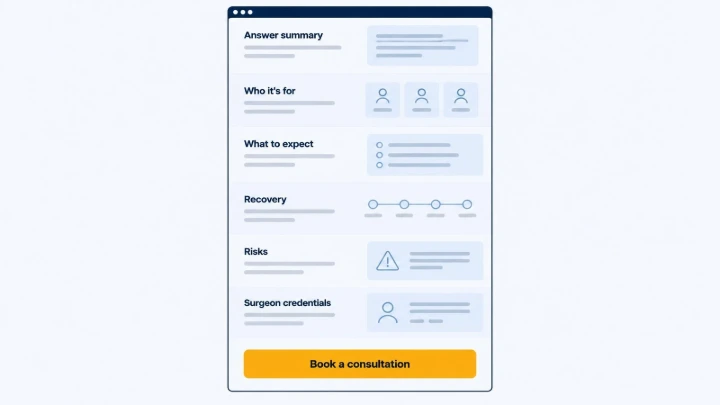
One page per procedure or condition lets Google match each search to the right answer. Each page should cover who the procedure is for, what to expect, recovery, risks, cost factors and a clear booking action. Avoid one long “Services” page, which ranks for almost nothing.
5. Give every clinician a bio page with credentials
Health content is judged on experience, expertise, authoritativeness and trust (E-E-A-T). A bio page with board certifications, education, hospital affiliations and publications gives Google and patients proof. Link each procedure page to the clinician who performs it.
6. Create a page for each location
If you have more than one office, each needs its own page with its address, hours, map, parking notes, local team and a location-specific FAQ. Do not clone the same text across locations. Duplicate pages compete with each other and dilute rankings.
7. Add medical schema markup
Schema is code that labels your content for search engines. Use Physician or MedicalClinic for practice and clinician pages, FAQPage for question sections and BreadcrumbList for navigation. It helps search engines and AI systems understand who you are and what you treat. Validate it in Google’s Rich Results Test.
8. Earn reviews steadily and reply to every one
Ask every satisfied patient for a review at the moment of highest goodwill, using a direct link to your profile. A steady flow beats a burst. Reply to every review in a few sentences, and never include protected health information in a reply, even if the patient does.
9. Keep your profile fresh with photos, posts and services
Add real photos of your office, team and equipment, list every service and publish short updates about new treatments or seasonal offers. Answer the questions patients ask in the profile Q&A yourself. An active profile signals that the practice is open and cared for.
10. Fix mobile speed and usability
Most local searches happen on phones. Compress images, use modern formats such as WebP, remove unused scripts and make the phone number a tap-to-call link. Test your key pages in PageSpeed Insights and fix the largest issues first, starting with the slowest-loading image on each page.
11. Track calls and form fills, not just visits
Traffic does not pay your bills; booked consultations do. Set up GA4 conversion events for form submissions and calls, and use call tracking that records source without recording PHI. This is the Attribution layer of the IMPACT Marketing System™, and it is what lets you see which steps produce patients.
12. Clean up directory and health listings
Claim and correct your profiles on the major healthcare directories your patients use, plus your state medical board and hospital affiliation pages. Keep NAP and specialty identical across them. Remove duplicates, which confuse both patients and search engines.
13. Earn local links and mentions
Links from local sources show prominence: hospital and medical society pages, community sponsorships, local news quotes and university partnerships. Offer a clinician as an expert source for a local story. A few relevant links are worth more than many low-quality ones.
14. Publish answers to real patient questions
Write pages that answer what patients ask before booking: cost factors, recovery, candidacy, insurance and alternatives. Start each with a direct answer in 40 to 60 words, then add detail. Have a clinician review each piece and show the reviewer and review date.
Want to know which of these 15 steps your practice is missing?
We review your profile, site and tracking and show you the gaps, in plain numbers.
Get a free patient growth audit15. Report in booked appointments and tune every month
Review rankings, calls, forms and booked consultations monthly. Find the pages and locations that book patients and put the next hour of work there. Ranking reports alone hide the truth, so tie every metric to an appointment.
A Washington, D.C. facial plastic surgery practice cut cost per conversion from $141.68 to $61.12 and grew conversions from 34 to 99 in three months once procedure pages and clean tracking were in place. Read the case study.

Frequently asked questions
How long does SEO for doctors take to work?
Most practices see early movement in the map pack within a few months, while procedure pages and content usually take six to twelve months to reach stable rankings. Timing depends on competition, your starting profile and how quickly fixes are published.
How much does SEO for doctors cost?
Medical SEO retainers vary with the number of locations, procedures and market competitiveness. Most single-location practices invest a fixed monthly fee for six to twelve months. We quote after a free audit so the scope matches your goals.
Do I need a separate page for each procedure?
Yes. A dedicated page lets Google match each search to a specific answer and lets patients find the details they need. A single services page rarely ranks for individual procedures, and it gives patients too little to act on.
Can I do local SEO myself?
Steps 1 to 3, 8 and 9 are manageable for most practice teams. Technical fixes, schema, tracking and content at scale usually need a specialist. A good approach is to start with the profile and reviews, then bring in help for the rest.
Get more booked patients from local search
See how our Patient Acquisition System connects SEO, ads, tracking and follow-up.
Book my free auditRelated reading: How to Rank a Medical Practice in Google’s Local Pack. This article is marketing guidance, not medical or legal advice. Reviewed by Muhammad Abdullah, Impact Brains.
SEO for doctors is the work of making your practice appear in Google Search, Google Maps and AI answers when patients look for your procedures nearby. The 15 steps below cover your Google Business Profile, procedure pages, reviews, schema, tracking and local links, in the order we use them on client accounts.
Patients compare practices on Google Maps, read reviews, ask AI assistants and only then call. Local SEO for medical professionals puts your practice in front of them at each of those moments. This guide is the checklist behind our medical SEO services, written so you or your team can start today.
How do doctors rank locally on Google?
Google weighs three things for local results: relevance (does your profile and site match the search), distance (how close you are to the searcher) and prominence (reviews, links and mentions). You cannot change distance. Steps 1 to 9 improve relevance and prominence. Steps 10 to 15 turn that visibility into measured appointments.
1. Claim and verify your Google Business Profile
Your profile drives the map pack. Claim it, complete verification and confirm that the name matches your signage and legal practice name exactly. Use one profile per physical location and never add keywords to the business name. Keyword stuffing is a common reason profiles get suspended.
2. Choose the right primary and secondary categories
Pick the one category that matches your core specialty, such as “Dermatologist” or “Plastic surgeon”, then add secondary categories for real sub-services. The primary category is one of the strongest relevance signals you control. Check which categories the top three local competitors use before you decide.
3. Make your name, address and phone match everywhere
Use the same name, address and phone number (NAP) on your site, profile and every listing. Differences such as “Suite 4” versus “Ste. 4” create doubt about which record is real. Set a single format, then audit your top 20 listings against it.
4. Build a dedicated page for every procedure and condition
One page per procedure or condition lets Google match each search to the right answer. Each page should cover who the procedure is for, what to expect, recovery, risks, cost factors and a clear booking action. Avoid one long “Services” page, which ranks for almost nothing.
5. Give every clinician a bio page with credentials
Health content is judged on experience, expertise, authoritativeness and trust (E-E-A-T). A bio page with board certifications, education, hospital affiliations and publications gives Google and patients proof. Link each procedure page to the clinician who performs it.
6. Create a page for each location
If you have more than one office, each needs its own page with its address, hours, map, parking notes, local team and a location-specific FAQ. Do not clone the same text across locations. Duplicate pages compete with each other and dilute rankings.
7. Add medical schema markup
Schema is code that labels your content for search engines. Use Physician or MedicalClinic for practice and clinician pages, FAQPage for question sections and BreadcrumbList for navigation. It helps search engines and AI systems understand who you are and what you treat. Validate it in Google’s Rich Results Test.
8. Earn reviews steadily and reply to every one
Ask every satisfied patient for a review at the moment of highest goodwill, using a direct link to your profile. A steady flow beats a burst. Reply to every review in a few sentences, and never include protected health information in a reply, even if the patient does.
9. Keep your profile fresh with photos, posts and services
Add real photos of your office, team and equipment, list every service and publish short updates about new treatments or seasonal offers. Answer the questions patients ask in the profile Q&A yourself. An active profile signals that the practice is open and cared for.
10. Fix mobile speed and usability
Most local searches happen on phones. Compress images, use modern formats such as WebP, remove unused scripts and make the phone number a tap-to-call link. Test your key pages in PageSpeed Insights and fix the largest issues first, starting with the slowest-loading image on each page.
11. Track calls and form fills, not just visits
Traffic does not pay your bills; booked consultations do. Set up GA4 conversion events for form submissions and calls, and use call tracking that records source without recording PHI. This is the Attribution layer of the IMPACT Marketing System™, and it is what lets you see which steps produce patients.
12. Clean up directory and health listings
Claim and correct your profiles on the major healthcare directories your patients use, plus your state medical board and hospital affiliation pages. Keep NAP and specialty identical across them. Remove duplicates, which confuse both patients and search engines.
13. Earn local links and mentions
Links from local sources show prominence: hospital and medical society pages, community sponsorships, local news quotes and university partnerships. Offer a clinician as an expert source for a local story. A few relevant links are worth more than many low-quality ones.
14. Publish answers to real patient questions
Write pages that answer what patients ask before booking: cost factors, recovery, candidacy, insurance and alternatives. Start each with a direct answer in 40 to 60 words, then add detail. Have a clinician review each piece and show the reviewer and review date.
Want to know which of these 15 steps your practice is missing?
We review your profile, site and tracking and show you the gaps, in plain numbers.
Get a free patient growth audit15. Report in booked appointments and tune every month
Review rankings, calls, forms and booked consultations monthly. Find the pages and locations that book patients and put the next hour of work there. Ranking reports alone hide the truth, so tie every metric to an appointment.
A Washington, D.C. facial plastic surgery practice cut cost per conversion from $141.68 to $61.12 and grew conversions from 34 to 99 in three months once procedure pages and clean tracking were in place. Read the case study.
Frequently asked questions
How long does SEO for doctors take to work?
Most practices see early movement in the map pack within a few months, while procedure pages and content usually take six to twelve months to reach stable rankings. Timing depends on competition, your starting profile and how quickly fixes are published.
How much does SEO for doctors cost?
Medical SEO retainers vary with the number of locations, procedures and market competitiveness. Most single-location practices invest a fixed monthly fee for six to twelve months. We quote after a free audit so the scope matches your goals.
Do I need a separate page for each procedure?
Yes. A dedicated page lets Google match each search to a specific answer and lets patients find the details they need. A single services page rarely ranks for individual procedures, and it gives patients too little to act on.
Can I do local SEO myself?
Steps 1 to 3, 8 and 9 are manageable for most practice teams. Technical fixes, schema, tracking and content at scale usually need a specialist. A good approach is to start with the profile and reviews, then bring in help for the rest.
Get more booked patients from local search
See how our Patient Acquisition System connects SEO, ads, tracking and follow-up.
Book my free auditRelated reading: How to Rank a Medical Practice in Google’s Local Pack. This article is marketing guidance, not medical or legal advice. Reviewed by Muhammad Abdullah, Impact Brains.