
By Dr. Muhammad Abdullah, Pharm.D, MBA, Founder & Chief Systems Architect
Last updated: November 10, 2026 · 5 min read
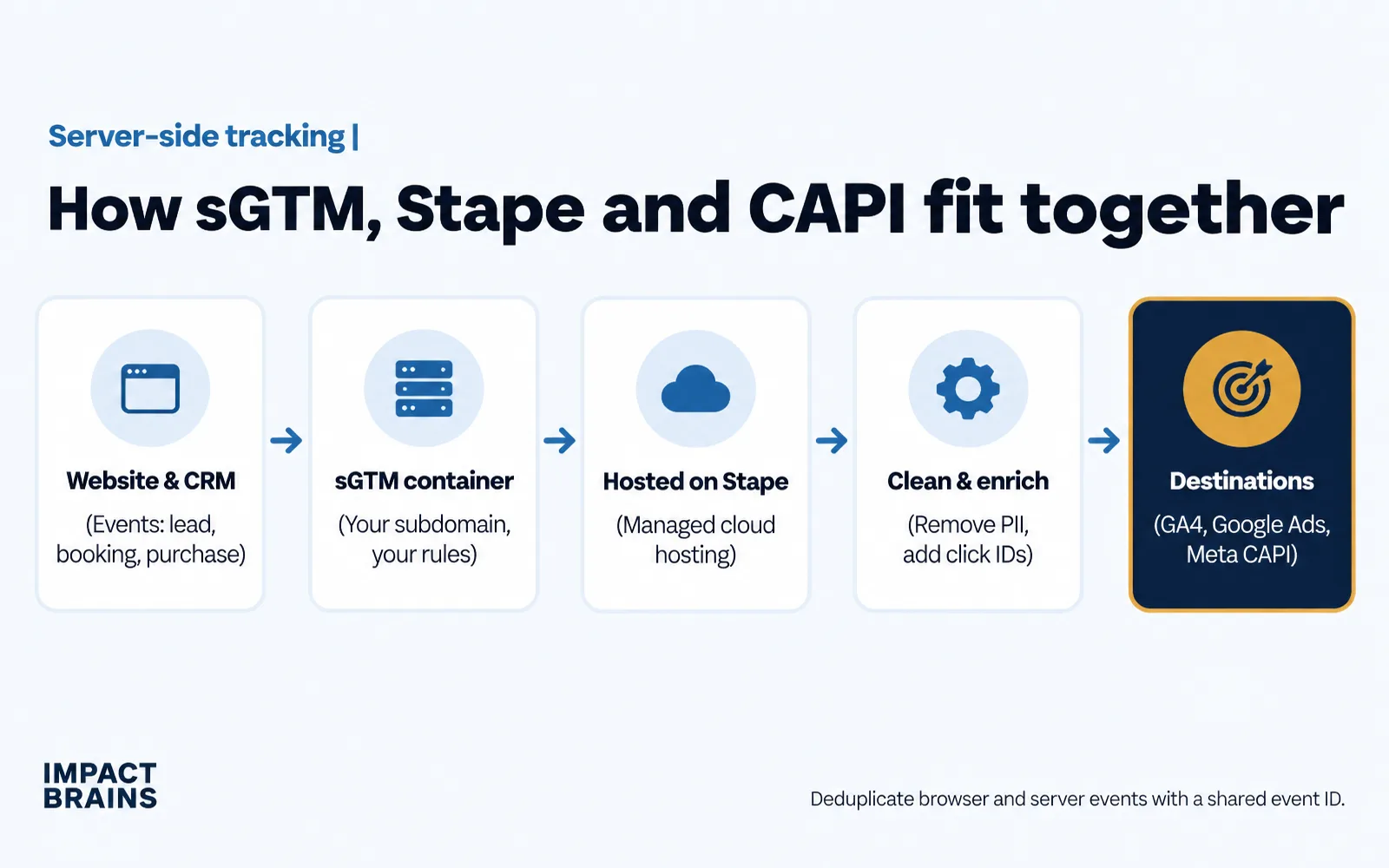
Server-side tracking sends conversion events from a server container you control, instead of directly from the visitor’s browser to each ad platform. A server-side Google Tag Manager container, often hosted on Stape, receives events, cleans them and forwards them to GA4, Google Ads and Meta’s Conversions API. The result is more complete, privacy-controlled data.
- Browser pixels lose data to ad blockers, browser privacy limits and consent; server-side events recover part of it.
- Server-side GTM is Google’s container; Stape is a popular managed host for it.
- Meta’s Conversions API (CAPI) is Meta’s server-side endpoint; pair it with the pixel and deduplicate.
- Server-side lets you remove personal and health data before anything leaves your server.
In this article
- What is server-side tracking?
- Why does browser-only tracking lose data?
- What are sGTM, Stape and the Conversions API?
- Do you still need the pixel if you use the Conversions API?
- Why does server-side tracking matter for healthcare and regulated businesses?
- How much does server-side tracking cost?
- How do you implement server-side tracking?
- Frequently asked questions
What is server-side tracking?
Server-side tracking moves the job of sending conversion data from the visitor’s browser to a server you control. Instead of five pixels each sending data straight from the page, the page (or your CRM) sends one event to your server container, which decides what to forward, to whom, and with which fields removed.
Why does browser-only tracking lose data?
- Ad blockers and privacy browsers block common tracking scripts.
- Browsers limit how long third-party and some first-party cookies last.
- Consent choices (correctly) stop tags from firing.
- Offline outcomes such as booked appointments or signed contracts never happen in the browser at all.
Server-side tracking can’t override consent, and it shouldn’t. What it does is make the data you are allowed to collect more reliable, and let you add outcomes from your CRM.
What are sGTM, Stape and the Conversions API?
| Component | What it is | Role |
|---|---|---|
| Server-side Google Tag Manager (sGTM) | Google’s server container | Receives events and forwards them to destinations |
| Stape | Managed hosting for sGTM | Runs the container on a custom subdomain without managing cloud servers |
| Meta Conversions API (CAPI) | Meta’s server-to-server endpoint | Receives web and offline events from your server |
| GA4 Measurement Protocol / server tags | Google Analytics server input | Sends events to GA4 from the server |
| Google Ads offline conversions | Import of outcomes by click ID | Teaches bidding which clicks became customers |
Do you still need the pixel if you use the Conversions API?
Usually yes, on pages where it is appropriate. Meta recommends running the pixel and the Conversions API together and deduplicating with a shared event ID, so each conversion is counted once. On sensitive pages, such as healthcare intake forms, use server events only.
See where your marketing leaks revenueGet a free recorded audit of your ads, website, tracking and follow-up from the team that builds the Client Acquisition System, with the three fixes that will move your numbers fastest.
Get my free growth audit →Why does server-side tracking matter for healthcare and regulated businesses?
Because the server is where you can remove what must never be shared. In healthcare, a server container can strip names, emails, phone numbers, IP addresses and free-text fields before forwarding an event, and send ad platforms only a click ID and a non-identifying outcome. It isn’t a compliance certificate on its own, but it is the foundation of HIPAA-aligned measurement. See HIPAA-compliant marketing and tracking.
How much does server-side tracking cost?
There are two parts: hosting (Stape and similar hosts offer tiered monthly plans based on request volume, including small free tiers) and setup (a one-time project to design events, build the container, connect destinations and QA). Most of the value, and most of the risk, is in the setup.
How do you implement server-side tracking?
- Write a tracking plan.List events, parameters, destinations and which fields must be removed.
- Set up the server container.Create sGTM, host it (for example on Stape) on a first-party subdomain.
- Send events to it.From the web container, your forms and your CRM.
- Add destinations.GA4, Google Ads (with enhanced or offline conversions) and Meta CAPI with deduplication.
- Redact and test.Remove personal data where required; QA every event in preview mode.
- Monitor.Watch event match quality and conversion counts weekly.
Related: Why you need GA4 and GTM before running ads and our GA4, GTM and tracking service.
See where your marketing leaks revenueGet a free recorded audit of your ads, website, tracking and follow-up from the team that builds the Client Acquisition System, with the three fixes that will move your numbers fastest.
Get my free growth audit →Frequently asked questions
What is server-side tracking?
Server-side tracking sends conversion events from a server container you control, rather than directly from the visitor’s browser to each ad platform, so data is more complete and you control what is shared.
Is server-side tracking worth it?
For businesses spending meaningfully on ads, usually yes: it improves data completeness, adds offline outcomes and gives you privacy control. Small sites with little ad spend may not need it yet.
What is Stape?
Stape is a managed hosting provider for server-side Google Tag Manager containers, so you don’t have to run cloud servers yourself.
Does server-side tracking bypass consent?
No, and it shouldn’t. Consent rules still apply; server-side tracking makes permitted data more reliable.
Is server-side tracking HIPAA compliant?
It’s a tool, not a certification. It enables HIPAA-aligned setups by removing identifiers before data leaves your server, but the design must be documented and reviewed with counsel.
This article is educational marketing guidance. Results depend on your market, offer and execution.
By Dr. Muhammad Abdullah, Pharm.D, MBA, Founder & Chief Systems Architect
Last updated: November 10, 2026 · 5 min read
Server-side tracking sends conversion events from a server container you control, instead of directly from the visitor’s browser to each ad platform. A server-side Google Tag Manager container, often hosted on Stape, receives events, cleans them and forwards them to GA4, Google Ads and Meta’s Conversions API. The result is more complete, privacy-controlled data.
- Browser pixels lose data to ad blockers, browser privacy limits and consent; server-side events recover part of it.
- Server-side GTM is Google’s container; Stape is a popular managed host for it.
- Meta’s Conversions API (CAPI) is Meta’s server-side endpoint; pair it with the pixel and deduplicate.
- Server-side lets you remove personal and health data before anything leaves your server.
In this article
- What is server-side tracking?
- Why does browser-only tracking lose data?
- What are sGTM, Stape and the Conversions API?
- Do you still need the pixel if you use the Conversions API?
- Why does server-side tracking matter for healthcare and regulated businesses?
- How much does server-side tracking cost?
- How do you implement server-side tracking?
- Frequently asked questions
What is server-side tracking?
Server-side tracking moves the job of sending conversion data from the visitor’s browser to a server you control. Instead of five pixels each sending data straight from the page, the page (or your CRM) sends one event to your server container, which decides what to forward, to whom, and with which fields removed.
Why does browser-only tracking lose data?
- Ad blockers and privacy browsers block common tracking scripts.
- Browsers limit how long third-party and some first-party cookies last.
- Consent choices (correctly) stop tags from firing.
- Offline outcomes such as booked appointments or signed contracts never happen in the browser at all.
Server-side tracking can’t override consent, and it shouldn’t. What it does is make the data you are allowed to collect more reliable, and let you add outcomes from your CRM.
What are sGTM, Stape and the Conversions API?
| Component | What it is | Role |
|---|---|---|
| Server-side Google Tag Manager (sGTM) | Google’s server container | Receives events and forwards them to destinations |
| Stape | Managed hosting for sGTM | Runs the container on a custom subdomain without managing cloud servers |
| Meta Conversions API (CAPI) | Meta’s server-to-server endpoint | Receives web and offline events from your server |
| GA4 Measurement Protocol / server tags | Google Analytics server input | Sends events to GA4 from the server |
| Google Ads offline conversions | Import of outcomes by click ID | Teaches bidding which clicks became customers |
Do you still need the pixel if you use the Conversions API?
Usually yes, on pages where it is appropriate. Meta recommends running the pixel and the Conversions API together and deduplicating with a shared event ID, so each conversion is counted once. On sensitive pages, such as healthcare intake forms, use server events only.
See where your marketing leaks revenueGet a free recorded audit of your ads, website, tracking and follow-up from the team that builds the Client Acquisition System, with the three fixes that will move your numbers fastest.
Get my free growth audit →Why does server-side tracking matter for healthcare and regulated businesses?
Because the server is where you can remove what must never be shared. In healthcare, a server container can strip names, emails, phone numbers, IP addresses and free-text fields before forwarding an event, and send ad platforms only a click ID and a non-identifying outcome. It isn’t a compliance certificate on its own, but it is the foundation of HIPAA-aligned measurement. See HIPAA-compliant marketing and tracking.
How much does server-side tracking cost?
There are two parts: hosting (Stape and similar hosts offer tiered monthly plans based on request volume, including small free tiers) and setup (a one-time project to design events, build the container, connect destinations and QA). Most of the value, and most of the risk, is in the setup.
How do you implement server-side tracking?
- Write a tracking plan.List events, parameters, destinations and which fields must be removed.
- Set up the server container.Create sGTM, host it (for example on Stape) on a first-party subdomain.
- Send events to it.From the web container, your forms and your CRM.
- Add destinations.GA4, Google Ads (with enhanced or offline conversions) and Meta CAPI with deduplication.
- Redact and test.Remove personal data where required; QA every event in preview mode.
- Monitor.Watch event match quality and conversion counts weekly.
Related: Why you need GA4 and GTM before running ads and our GA4, GTM and tracking service.
See where your marketing leaks revenueGet a free recorded audit of your ads, website, tracking and follow-up from the team that builds the Client Acquisition System, with the three fixes that will move your numbers fastest.
Get my free growth audit →Frequently asked questions
What is server-side tracking?
Server-side tracking sends conversion events from a server container you control, rather than directly from the visitor’s browser to each ad platform, so data is more complete and you control what is shared.
Is server-side tracking worth it?
For businesses spending meaningfully on ads, usually yes: it improves data completeness, adds offline outcomes and gives you privacy control. Small sites with little ad spend may not need it yet.
What is Stape?
Stape is a managed hosting provider for server-side Google Tag Manager containers, so you don’t have to run cloud servers yourself.
Does server-side tracking bypass consent?
No, and it shouldn’t. Consent rules still apply; server-side tracking makes permitted data more reliable.
Is server-side tracking HIPAA compliant?
It’s a tool, not a certification. It enables HIPAA-aligned setups by removing identifiers before data leaves your server, but the design must be documented and reviewed with counsel.
This article is educational marketing guidance. Results depend on your market, offer and execution.