A marketing system is a connected stack of ads, website pages, tracking and CRM automation engineered so data flows between every part. Unlike separate campaigns, a system measures cost per customer, follows up automatically and improves every month, because each layer makes the others cheaper to run.
Most businesses do not have a marketing problem. They have a systems problem. The ad agency blames the website, the web designer blames the ads, and nobody can say which dollar produced which customer. Spend rises, results flatline, and every vendor has a reasonable-sounding excuse.
This guide defines what a marketing system is, breaks down its six layers using the IMPACT framework we build with at Impact Brains, and shows what changes when ads, pages, tracking and follow-up are designed together instead of bought separately.
What is a marketing system, exactly?
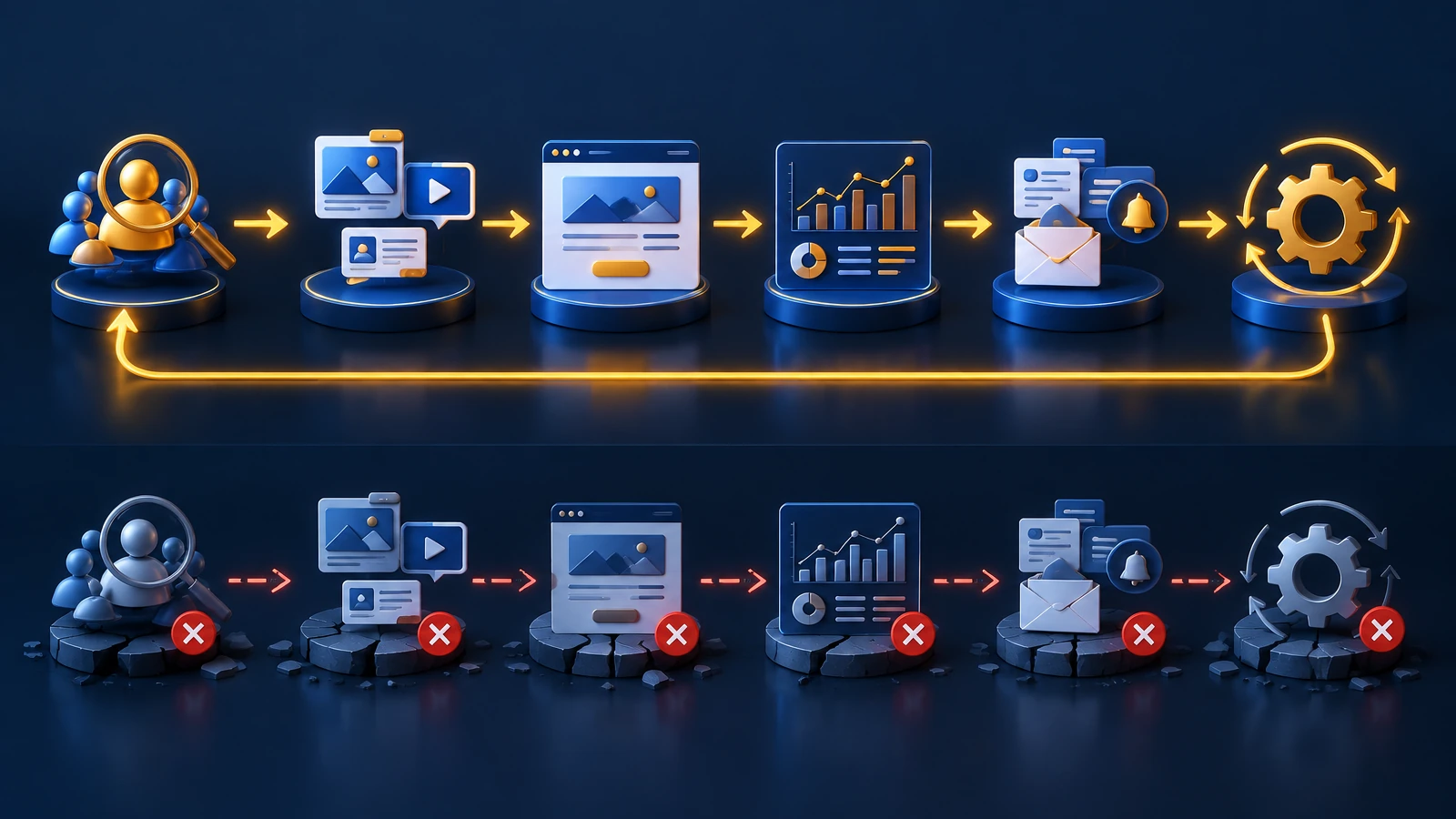
A marketing system is the connected set of paid and organic media, conversion-focused pages, attribution tracking and CRM automation that turns attention into measurable revenue. The word that matters is connected. In a system, each part passes data to the next:
- The ad platform sends a click to a page built for that exact search or audience.
- The page captures a call, form or booking with tracking already attached.
- The tracking layer tells Google and Meta which clicks became real customers.
- The CRM follows up in minutes and reports what closed.
- That closed-revenue data flows back to the ad platforms, and the whole machine gets smarter.
A collection of campaigns is a list of activities. A marketing system is a loop that learns.
Why do marketing campaigns stall without a system?
Campaigns stall because the gaps between vendors leak revenue that no single vendor is accountable for. In audits, the same three leaks appear again and again:
1. Ads without tracking
If calls, forms and bookings are not wired back to the ad platforms, the algorithm optimizes for the cheapest click instead of the most valuable customer. You end up paying for curiosity.
2. Traffic without conversion
Visitors arrive and leave because the page was designed to look good, not to make the next step obvious. Every wasted visit is ad spend you cannot recover.
3. Leads without follow-up
Inquiries sit for hours. By the time someone calls back, the prospect has already booked with a competitor. Speed-to-lead is often the cheapest improvement available and the one most businesses skip.
Campaigns end. Systems learn. When the ad account, landing page, tracking and follow-up are designed together, each layer makes the others cheaper: better tracking trains better bidding, better pages lower cost per lead, and faster follow-up raises close rates.
What are the parts of a marketing system? (The IMPACT framework)
A marketing system has six layers. We use the IMPACT Marketing System™ as the framework: Insight, Media, Pages, Attribution, CRM & Automation, and Tuning. Each layer has a job, a deliverable and a KPI.
Insight
A 40-point audit of ads, tracking, pages and follow-up, plus competitor and market research. The output is a 90-day roadmap tied to revenue targets.
KPI: baseline cost per customerMedia
Google, Meta, YouTube and TikTok ads, SEO and AI-search visibility, prioritized by buyer intent rather than by channel habit.
KPI: qualified inquiries at target costPages
Conversion-built websites and landing pages matched to each ad group and search intent, with a speed budget and a test plan.
KPI: conversion rate and cost per leadAttribution
GA4, GTM, server-side tagging, call tracking, the Conversions API and offline conversion imports, so every customer traces to a source.
KPI: share of revenue attributedCRM & Automation
Speed-to-lead SMS, nurture sequences, appointment reminders, review requests and reactivation in GoHighLevel, HubSpot or Odoo.
KPI: contact, show and close rateTuning
Weekly experiments and monthly reviews against cost per patient, job or order, then budget moves toward what is proven.
KPI: blended CAC and ROASThe layer most businesses are missing is Attribution. Without it, every other layer is guesswork. That is why our operating principle is tracking-first scaling: never raise a budget on data you cannot trust. If you want the technical detail, our guide to server-side tracking explained covers how it works.
See which layer is leaking in your business
Get a recorded walkthrough of where your ads, tracking, website or follow-up are losing revenue, plus the three fixes that will move the numbers fastest.
How is a marketing system different from a channel-only agency?
A channel-only agency runs one piece of the machine and reports on that piece. A marketing system team designs and runs the whole machine and reports on business outcomes. The difference shows up in what gets measured and who is accountable.
| Area | Channel-only agency | Marketing system |
|---|---|---|
| Reports on | Clicks, CTR, cost per lead | Cost per patient, job or order, and revenue |
| Tracking | Platform pixels | GA4 + GTM + server-side + call tracking + offline conversions |
| Website | “Not our job” | Built and tested as part of the system |
| Follow-up | Left to your front desk | Automated in minutes, and measured |
| Who runs it | Account coordinators | The senior operators who designed it |
What does a marketing system look like in practice?
A facial plastic surgery practice in Washington, D.C. came to us running Google Ads for high-value procedures like facelifts. Results were volatile and cost per conversion was too high to scale consultation bookings. Campaigns mixed procedures, and tracking counted low-value actions as wins.
We rebuilt it layer by layer. We audited search terms and conversion actions, rebuilt campaigns around procedure-specific intent, aligned each landing page with the questions patients actually ask, and cleaned conversion tracking so bidding optimized for consultation requests instead of micro-actions.
$141.68 → $61.12
“The account wasn’t short of budget; it was short of signal. Once Google could see which clicks became consultation requests, and each procedure had a page that answered that patient’s real questions, the algorithm stopped buying cheap curiosity and started buying intent. That is the whole idea behind a marketing system: fix the data, then let the machine scale.”
Muhammad Abdullah, Founder & Chief Systems Architect
The full breakdown is in the facial plastic surgery case study.
Is a marketing system right for your business?
A marketing system suits any business where a customer is worth enough to justify measuring. That is typically practices, service companies and online brands spending $5,000 or more a month on media who want every dollar traced to revenue. It scales down to a single location and up to multi-location groups.
It is a good fit if you:
- Spend $5K–$30K+ a month on ads and cannot say which channel produced last month’s customers
- Work with more than one vendor and are tired of each one blaming another
- Sell something where one new customer is worth hundreds or thousands of dollars
- Want reporting in cost per patient, job or order, not cost per click
It is probably not a fit if you:
- Want the cheapest possible ad management
- Need one-off social posts or guaranteed rankings
- Are not yet ready to measure results against revenue
How do you start building a marketing system?
You start with an audit, not a campaign. A first version of a marketing system usually takes 30–45 days: the audit in week one, tracking and pages in weeks two to four, then a phased ad launch. Here is the order that works:
- Audit what you have. Map every step from ad click to closed customer and find where data or people drop out.
- Fix attribution first. Wire calls, forms and bookings back to your ad platforms before you change budgets.
- Rebuild the pages that carry the traffic. Match each page to the intent of the ad or search that sends visitors there.
- Automate the first five minutes. Speed-to-lead text and call-back rules cost little and lift close rates fast.
- Review monthly against revenue. Move budget toward what is proven and cut what is not.
You do not always need to replace your website or CRM. Many clients keep both, and we rebuild only the layers that leak revenue, most often tracking, landing pages and follow-up speed.
Frequently asked questions about marketing systems
What are the parts of a marketing system?
A marketing system has six layers: Insight (audit and strategy), Media (ads, SEO and AI search), Pages (websites and landing pages), Attribution (GA4, GTM, server-side and call tracking), CRM & Automation (follow-up and nurture), and Tuning (testing and reporting on cost per customer).
How long does it take to build a marketing system?
A first version usually takes 30–45 days: audit in week one, tracking and pages in weeks two to four, and a phased ad launch after that. The system then improves through weekly tests and monthly reviews.
Do I need to replace my current website or CRM?
Not always. We audit what you have first. Many clients keep their CRM and website, and we rebuild only the layers that leak revenue, most often tracking, landing pages and follow-up speed.
Is a marketing system only for big companies?
No. It suits any business where a customer is worth enough to justify measuring, typically practices and service companies spending $5,000+ a month on ads. The system scales down to a single location and up to multi-location groups.
What is the difference between a marketing system and a marketing strategy?
A strategy is a plan for what to do. A marketing system is the working machine that does it and measures the result. A strategy can sit in a slide deck; a system runs weekly, reports cost per customer and feeds its own data back into the ad platforms.
Ready to see exactly where your marketing leaks revenue?
Request a free growth audit and get a recorded walkthrough within two business days. No pitch deck. No pressure.
Get my free growth audit →A marketing system is a connected stack of ads, website pages, tracking and CRM automation engineered so data flows between every part. Unlike separate campaigns, a system measures cost per customer, follows up automatically and improves every month, because each layer makes the others cheaper to run.
Most businesses do not have a marketing problem. They have a systems problem. The ad agency blames the website, the web designer blames the ads, and nobody can say which dollar produced which customer. Spend rises, results flatline, and every vendor has a reasonable-sounding excuse.
This guide defines what a marketing system is, breaks down its six layers using the IMPACT framework we build with at Impact Brains, and shows what changes when ads, pages, tracking and follow-up are designed together instead of bought separately.
What is a marketing system, exactly?
A marketing system is the connected set of paid and organic media, conversion-focused pages, attribution tracking and CRM automation that turns attention into measurable revenue. The word that matters is connected. In a system, each part passes data to the next:
- The ad platform sends a click to a page built for that exact search or audience.
- The page captures a call, form or booking with tracking already attached.
- The tracking layer tells Google and Meta which clicks became real customers.
- The CRM follows up in minutes and reports what closed.
- That closed-revenue data flows back to the ad platforms, and the whole machine gets smarter.
A collection of campaigns is a list of activities. A marketing system is a loop that learns.
Why do marketing campaigns stall without a system?
Campaigns stall because the gaps between vendors leak revenue that no single vendor is accountable for. In audits, the same three leaks appear again and again:
1. Ads without tracking
If calls, forms and bookings are not wired back to the ad platforms, the algorithm optimizes for the cheapest click instead of the most valuable customer. You end up paying for curiosity.
2. Traffic without conversion
Visitors arrive and leave because the page was designed to look good, not to make the next step obvious. Every wasted visit is ad spend you cannot recover.
3. Leads without follow-up
Inquiries sit for hours. By the time someone calls back, the prospect has already booked with a competitor. Speed-to-lead is often the cheapest improvement available and the one most businesses skip.
Campaigns end. Systems learn. When the ad account, landing page, tracking and follow-up are designed together, each layer makes the others cheaper: better tracking trains better bidding, better pages lower cost per lead, and faster follow-up raises close rates.
What are the parts of a marketing system? (The IMPACT framework)
A marketing system has six layers. We use the IMPACT Marketing System™ as the framework: Insight, Media, Pages, Attribution, CRM & Automation, and Tuning. Each layer has a job, a deliverable and a KPI.
Insight
A 40-point audit of ads, tracking, pages and follow-up, plus competitor and market research. The output is a 90-day roadmap tied to revenue targets.
KPI: baseline cost per customerMedia
Google, Meta, YouTube and TikTok ads, SEO and AI-search visibility, prioritized by buyer intent rather than by channel habit.
KPI: qualified inquiries at target costPages
Conversion-built websites and landing pages matched to each ad group and search intent, with a speed budget and a test plan.
KPI: conversion rate and cost per leadAttribution
GA4, GTM, server-side tagging, call tracking, the Conversions API and offline conversion imports, so every customer traces to a source.
KPI: share of revenue attributedCRM & Automation
Speed-to-lead SMS, nurture sequences, appointment reminders, review requests and reactivation in GoHighLevel, HubSpot or Odoo.
KPI: contact, show and close rateTuning
Weekly experiments and monthly reviews against cost per patient, job or order, then budget moves toward what is proven.
KPI: blended CAC and ROASThe layer most businesses are missing is Attribution. Without it, every other layer is guesswork. That is why our operating principle is tracking-first scaling: never raise a budget on data you cannot trust. If you want the technical detail, our guide to server-side tracking explained covers how it works.
See which layer is leaking in your business
Get a recorded walkthrough of where your ads, tracking, website or follow-up are losing revenue, plus the three fixes that will move the numbers fastest.
How is a marketing system different from a channel-only agency?
A channel-only agency runs one piece of the machine and reports on that piece. A marketing system team designs and runs the whole machine and reports on business outcomes. The difference shows up in what gets measured and who is accountable.
| Area | Channel-only agency | Marketing system |
|---|---|---|
| Reports on | Clicks, CTR, cost per lead | Cost per patient, job or order, and revenue |
| Tracking | Platform pixels | GA4 + GTM + server-side + call tracking + offline conversions |
| Website | “Not our job” | Built and tested as part of the system |
| Follow-up | Left to your front desk | Automated in minutes, and measured |
| Who runs it | Account coordinators | The senior operators who designed it |
What does a marketing system look like in practice?
A facial plastic surgery practice in Washington, D.C. came to us running Google Ads for high-value procedures like facelifts. Results were volatile and cost per conversion was too high to scale consultation bookings. Campaigns mixed procedures, and tracking counted low-value actions as wins.
We rebuilt it layer by layer. We audited search terms and conversion actions, rebuilt campaigns around procedure-specific intent, aligned each landing page with the questions patients actually ask, and cleaned conversion tracking so bidding optimized for consultation requests instead of micro-actions.
$141.68 → $61.12
“The account wasn’t short of budget; it was short of signal. Once Google could see which clicks became consultation requests, and each procedure had a page that answered that patient’s real questions, the algorithm stopped buying cheap curiosity and started buying intent. That is the whole idea behind a marketing system: fix the data, then let the machine scale.”
Muhammad Abdullah, Founder & Chief Systems Architect
The full breakdown is in the facial plastic surgery case study.
Is a marketing system right for your business?
A marketing system suits any business where a customer is worth enough to justify measuring. That is typically practices, service companies and online brands spending $5,000 or more a month on media who want every dollar traced to revenue. It scales down to a single location and up to multi-location groups.
It is a good fit if you:
- Spend $5K–$30K+ a month on ads and cannot say which channel produced last month’s customers
- Work with more than one vendor and are tired of each one blaming another
- Sell something where one new customer is worth hundreds or thousands of dollars
- Want reporting in cost per patient, job or order, not cost per click
It is probably not a fit if you:
- Want the cheapest possible ad management
- Need one-off social posts or guaranteed rankings
- Are not yet ready to measure results against revenue
How do you start building a marketing system?
You start with an audit, not a campaign. A first version of a marketing system usually takes 30–45 days: the audit in week one, tracking and pages in weeks two to four, then a phased ad launch. Here is the order that works:
- Audit what you have. Map every step from ad click to closed customer and find where data or people drop out.
- Fix attribution first. Wire calls, forms and bookings back to your ad platforms before you change budgets.
- Rebuild the pages that carry the traffic. Match each page to the intent of the ad or search that sends visitors there.
- Automate the first five minutes. Speed-to-lead text and call-back rules cost little and lift close rates fast.
- Review monthly against revenue. Move budget toward what is proven and cut what is not.
You do not always need to replace your website or CRM. Many clients keep both, and we rebuild only the layers that leak revenue, most often tracking, landing pages and follow-up speed.
Frequently asked questions about marketing systems
What are the parts of a marketing system?
A marketing system has six layers: Insight (audit and strategy), Media (ads, SEO and AI search), Pages (websites and landing pages), Attribution (GA4, GTM, server-side and call tracking), CRM & Automation (follow-up and nurture), and Tuning (testing and reporting on cost per customer).
How long does it take to build a marketing system?
A first version usually takes 30–45 days: audit in week one, tracking and pages in weeks two to four, and a phased ad launch after that. The system then improves through weekly tests and monthly reviews.
Do I need to replace my current website or CRM?
Not always. We audit what you have first. Many clients keep their CRM and website, and we rebuild only the layers that leak revenue, most often tracking, landing pages and follow-up speed.
Is a marketing system only for big companies?
No. It suits any business where a customer is worth enough to justify measuring, typically practices and service companies spending $5,000+ a month on ads. The system scales down to a single location and up to multi-location groups.
What is the difference between a marketing system and a marketing strategy?
A strategy is a plan for what to do. A marketing system is the working machine that does it and measures the result. A strategy can sit in a slide deck; a system runs weekly, reports cost per customer and feeds its own data back into the ad platforms.
Ready to see exactly where your marketing leaks revenue?
Request a free growth audit and get a recorded walkthrough within two business days. No pitch deck. No pressure.
Get my free growth audit →