Skip to Content

Dermatology marketing · Patient Acquisition System

Dermatology marketing that grows cosmetic services without crowding medical.

Dermatology SEO, Google Ads, provider pages and follow-up, built as one system for dermatology practices, with medical and cosmetic journeys measured separately.

  • Flat monthly fee, never a % of spend
  • You own every account
  • No PHI in ad platforms
  • $7M+in ad spend managed
  • 50+GTM containers in 9 countries
  • Pharm.D+ MBA leadership on every system
30–45days to a measured first versionAudit, tracking, pages and a phased launch
How Impact Brains measures a dermatology practice: clicks become calls and forms (generate_lead), qualified inquiries, booked consultations, show-ups and new patients, each tracked as its own event without sending protected health information to ad platforms.

How do dermatologists market cosmetic services?

Most dermatology practices have two businesses under one roof: a medical practice with a waiting list and a cosmetic practice with open chairs.

Marketing them together usually means the medical side gets busier and the cosmetic side stays quiet. The fix is to separate the journeys.

The short answer

Dermatologists market cosmetic services best by separating cosmetic from medical dermatology on the website and in campaigns, promoting high-value treatments with dedicated pages and ads, showcasing provider credentials and reviews, and tracking cosmetic bookings as their own service line.

  1. Split the journeys: medical and cosmetic get separate pages, campaigns and booking paths.
  2. Local SEO per provider: profiles and pages for each location and dermatologist.
  3. Ads for cosmetic: Google Ads for treatments with capacity, not for the waiting list.
  4. Credentials up front: board certification, training and reviews on every provider page.
  5. Service-line tracking: cosmetic revenue measured on its own.

Why dermatology practices call us

When one website and one ad account serve both medical and cosmetic patients, the medical side usually wins the traffic, and the cosmetic chairs stay empty.

Separating the journeys lets each side be marketed, booked and measured on its own terms.

  • Cosmetic lost among medical

    Cosmetic treatments are buried under acne, eczema and skin-check pages.

  • Waiting list for medical, empty chairs for cosmetic

    Marketing fills the side that is already full.

  • No service-line reporting

    Nobody can say what a new cosmetic patient costs or earns.

The Dermatology Patient Acquisition System

Two journeys, one system: medical keeps flowing, cosmetic gets the marketing it needs to grow.

  • Separate medical and cosmetic journeys

    Distinct pages, navigation, booking paths and campaigns for medical and cosmetic patients.

  • Local SEO per location and provider

    Google Business Profiles, location pages and provider pages for every dermatologist and PA.

  • Google Ads for cosmetic procedures

    Campaigns for the treatments with capacity and margin, never for services with a waiting list.

  • Provider pages with credentials

    Board certification, training, procedures performed and reviews, with schema for each provider.

  • Tracking by service line

    Cosmetic and medical calls, forms and bookings tracked separately, with no PHI in ad platforms.

  • Dermatology website design

    A fast, accessible site that makes both journeys obvious from the homepage.

Dermatology services we market

Cosmetic treatments get campaigns; medical services get local SEO and clear booking paths.

  • Neurotoxins & fillers
  • Laser resurfacing
  • Chemical peels
  • Microneedling
  • Laser hair removal
  • Body contouring
  • Skin cancer screening
  • Mohs surgery
  • Acne treatment
  • Psoriasis & eczema care
  • Pediatric dermatology
  • Medical-grade skincare

Medical vs. cosmetic dermatology: how should marketing differ?

Medical dermatology is driven by symptoms, insurance and referrals, so local SEO and clear booking paths matter most. Cosmetic dermatology is elective, self-paid and comparison-shopped, so it needs dedicated pages, Google Ads, provider credibility and follow-up. Measure each as its own service line.

Marketing medical and cosmetic dermatology: differences by factor
FactorMedical dermatologyCosmetic dermatology
What triggers the searchA symptom, a referral or a skin checkA wish to change appearance
How patients payUsually insuranceUsually self-pay, often packages
Typical searches“dermatologist near me”, condition namesTreatment names, “cost”, “before and after”
Decision timeDaysWeeks to months, with comparison
Best channelsLocal SEO, Google Business Profile, referralsGoogle Ads, treatment pages, Instagram, nurture
Measure byBooked visits and wait timeCost per new cosmetic patient and revenue

Most practices we audit spend on the left column and need growth in the right one.

Proof you can verify for dermatology practices

We haven’t published a dermatology case study yet, and we won’t invent one. Here is the closest verified proof: the same system, tracking and team, in a neighboring specialty.

−57%
Closest proof · Facial plastic surgery

Facial plastic surgery practice, Washington, D.C.

Procedure-level Google Ads, a dedicated consult page and tracking that separated calls, forms and booked consults cut cost per conversion from $141.68 to $61.12 while conversions grew from 34 to 99.
Read the case study 
50+
Tracking · 12+ industries

50+ Google Tag Manager accounts across 9 countries

Including healthcare and wellness accounts such as a plastic surgery practice and a pharmacy, with 9 server-side containers, Meta Conversions API, call tracking and offline conversions.

Read the case study 

See all case studies 

Compliance notes

Dermatology marketing mixes medical claims, prescription products and before-and-after imagery, so every page and ad is checked against platform health policies and your state’s advertising rules.

Skin conditions are health information. Forms, reviews and tracking are designed so no condition detail reaches an ad platform.

This is how we build. It is not legal advice; confirm your setup with your own counsel.

How HIPAA-aligned tracking works 

How compliance is built into every Patient Acquisition System
Rule or riskWhat we do
Condition-based copyAds describe treatments, never the viewer’s skin condition.
Google Healthcare & medicines policyAd copy, keywords and landing pages reviewed before launch; certification handled for restricted categories.
Meta health & wellness rulesNo targeting by health condition and no copy that implies a viewer’s condition or negative self-perception.
HIPAA and online trackingNo pixels on authenticated pages; a server-side container strips identifiers; offline conversions send click IDs, not PHI.
Forms, chat and bookingHIPAA-eligible tools with a signed Business Associate Agreement, encrypted and access-controlled.
Reviews and testimonialsPatient consent on file, no PHI in replies, and FTC endorsement rules followed for any featured result.
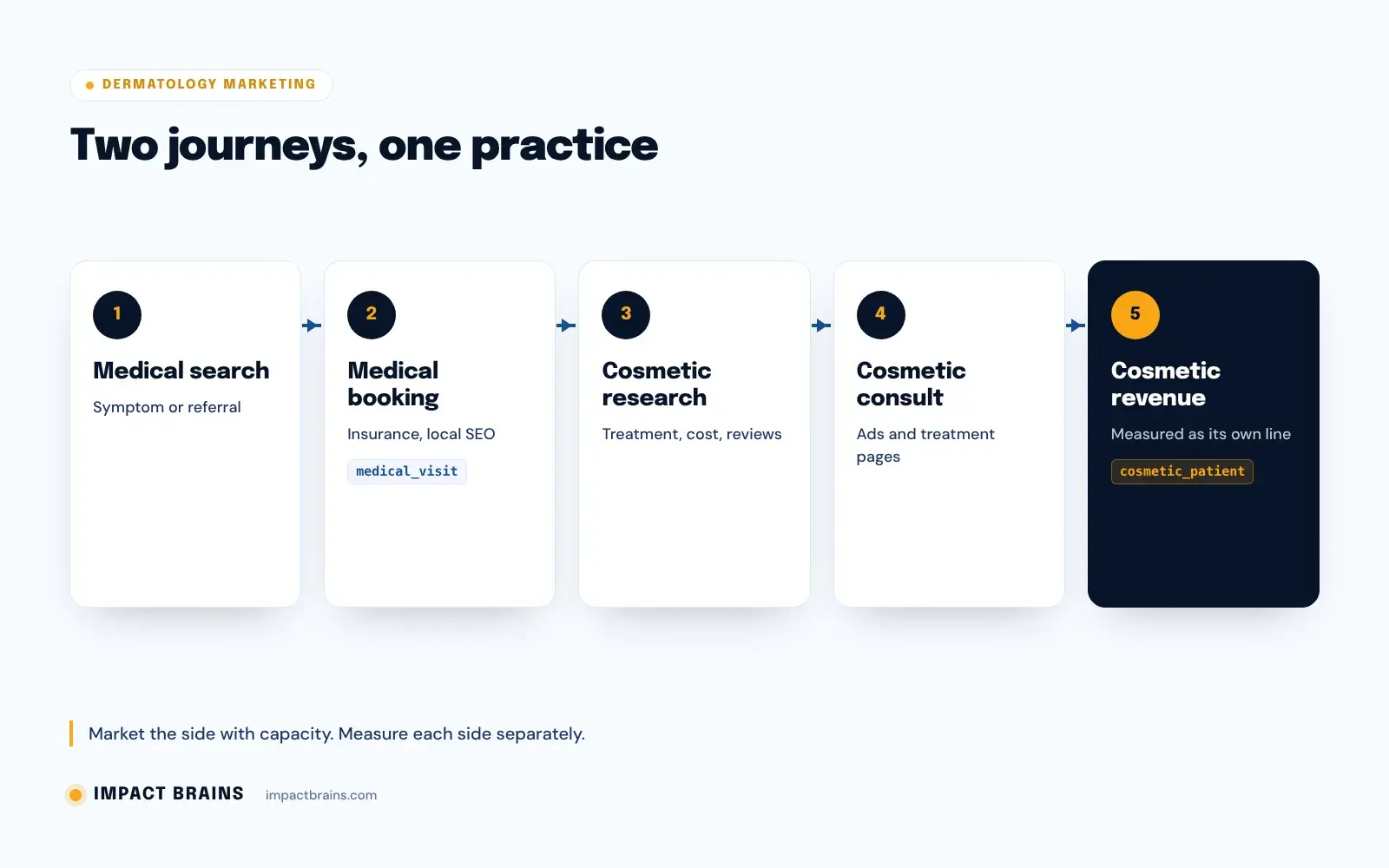
Diagram of two dermatology patient journeys: a medical journey from symptom search to insurance booking, and a cosmetic journey from treatment research to consultation and package purchase
Two journeys, one practice: medical and cosmetic patients search, decide and pay differently.

Your first 90 days with Impact Brains

No dermatology case study yet, so here is the exact plan and the baseline we measure from.

  1. Insight

    Audit & baseline

    Days 1–7

    Recorded audit of your ads, Maps, website, tracking and follow-up; baseline cost per new patient for cosmetic treatments and medical visits.

  2. Attribution

    Tracking

    Days 7–21

    Calls, forms and booked visits tracked server-side, with no PHI sent to ad platforms.

  3. Pages

    Treatment pages

    Days 14–35

    Landing pages for your highest-value treatments, with proof, pricing context and short intake.

  4. Media

    Phased launch

    Days 30–45

    Search and Maps first, then social, with policy checks on every ad and page.

  5. Tuning

    Scale what works

    Days 45–90

    Weekly tests and a monthly review of cost per new patient by treatment; budget follows booked visits.

We set a measurement baseline on day one, so progress is visible every week.

See the full Patient Acquisition System 

Why practices choose Impact Brains

Most agencies sell dermatology practices a channel. We build and run the whole Patient Acquisition System with one senior team, and report cost per new patient.

  • Healthcare-literate leadership

    Dr. Muhammad Abdullah is a Doctor of Pharmacy with an MBA. Health claims, patient data and platform policy get a clinician’s care.

  • Measured to new patients

    Calls, forms, bookings and show-ups are tracked separately, so budget follows patients, not clicks.

  • Flat fee, no lock-in

    A flat monthly retainer, never a percentage of ad spend. A 90-day initial term, then month to month.

  • You own everything

    Ad accounts, analytics, Tag Manager, website and data stay in your name.

Every service shares the same tracking, the same team and the same monthly cost-per-new-patient review.

One dermatology practice per market

We work with one dermatology practice per market, so your cosmetic strategy stays yours. Check whether your area is open.

Check if my market is available 

Dermatology marketing questions, answered

How do dermatologists market cosmetic services?

Separate cosmetic from medical dermatology on the website and in campaigns, promote high-value treatments with dedicated pages and ads, and showcase provider credentials and reviews.

What is dermatology SEO?

Dermatology SEO is search optimization for dermatology practices: Google Business Profiles per location and provider, condition and treatment pages reviewed by your dermatologists, reviews and technical SEO.

What should a dermatology website include?

Separate medical and cosmetic sections, a page per condition and treatment, provider pages with board certification, insurance and pricing information, reviews and online booking for both journeys.

Should a dermatology practice run Google Ads for medical services?

Usually not while there is a waiting list. Ads work best for cosmetic treatments with capacity and margin; medical demand is often better served by local SEO and referrals.

What are good dermatology marketing ideas?

Provider video introductions, treatment-specific landing pages, membership or package offers for cosmetic patients, review requests after visits, and seasonal campaigns such as skin-check reminders.

Free patient growth audit

Get a free patient growth audit, reviewed by our senior team.

Tell us about your practice. Within two business days you’ll get a recorded walkthrough of where your ads, website, tracking or follow-up leak patients, and the three fixes that will move the numbers fastest. No pitch deck. No pressure.

  1. Tell us about your practiceTwo minutes. No patient information, ever.
  2. Get your recorded auditAds, Maps, website, tracking and follow-up, reviewed by our senior team.
  3. Decide with numbersA 90-day plan sized from your target cost per new patient. Keep it either way.
−57%cost per conversion for a Washington, D.C. facial plastic surgery practice in three months

Request your free patient growth audit

Three required fields. We’ll take it from there.

Free and no obligation. See our privacy policy. Please don’t include patient information.

Prefer to talk it through?

Book a 30-minute strategy call with our team, led by Dr. Muhammad Abdullah. Bring your numbers and your goals, and leave with a clear next step.