Skip to Content

Healthcare PPC agency · Patient Acquisition System

Google Ads for medical practices, built to fill your consultation calendar.

Procedure-level campaigns that follow Google’s healthcare policies, with tracking that follows a click to a booked consultation and a new patient, never to a patient’s health information.

  • Flat monthly fee, never a % of spend
  • You own every account
  • No PHI in ad platforms
  • −57%cost per conversion, facial plastic surgery
  • 34 → 99monthly conversions in three months
  • +161%conversion value ($38.2K → $99.8K)
−57%cost per conversionFacial plastic surgery practice, Washington, D.C., in three months
How Impact Brains measures healthcare Google Ads: clicks become calls and forms (generate_lead), qualified inquiries, booked consultations, show-ups and new patients, each tracked as its own event without sending protected health information to ad platforms.

Can doctors advertise on Google Ads?

Healthcare is one of the most valuable and most restricted categories on Google. The rules are knowable, though, and practices that follow them can run Search campaigns profitably.

Our guide to Google Ads healthcare policies is updated as the rules change. This page explains how we build and run healthcare PPC inside them.

The short answer

Yes. Most medical practices can run Google Ads, as long as ads and landing pages follow Google’s Healthcare and medicines policy. Restricted areas such as prescription drugs, addiction services and unproven treatments need certification or are blocked, and health conditions can’t be used for audience targeting.

  1. Choose eligible services: elective procedures, consultations and most clinical services are allowed.
  2. Check restricted categories: addiction treatment in the US requires LegitScript certification.
  3. Write compliant copy: no guaranteed outcomes, no misleading claims, accurate pricing.
  4. Target by search intent: keywords and locations, not health-condition audiences.
  5. Track without PHI: conversions fire on non-identifying events and click IDs.

Healthcare clicks are expensive. Wasted ones are worse.

One loose match type or a missing negative list can spend a month’s budget on job seekers, students and people looking for free clinics. And if your conversion tracking counts every page view or every call over ten seconds as a “lead”, Google’s bidding learns to buy more of the wrong clicks.

In our Washington, D.C. facial plastic surgery account, cost per conversion started at $141.68. Rebuilding around procedure intent and tracking calls, forms and booked consults separately took it to $61.12 in three months.

  • Broad campaigns, vague intent

    One campaign for every treatment means a facelift searcher and a Botox shopper see the same ad and the same page.

  • Leads that aren’t patients

    Calls under 30 seconds, wrong numbers and job inquiries are counted as conversions and teach bidding the wrong lesson.

  • Policy disapprovals

    A single unsupported claim on a landing page can limit or stop ads, usually at the worst possible moment.

What’s included in our healthcare PPC management

Senior specialists build and run your account inside your own Google Ads login, on a flat monthly fee that is never a percentage of spend.

  • Procedure-level campaign architecture

    Separate campaigns or ad groups by treatment, so budget, bids, ads and landing pages match what each patient searched.

  • Healthcare policy review

    Ads, keywords and landing pages checked against Google’s Healthcare and medicines policy before launch and after every change.

  • Certification support

    LegitScript or Google certification handled before launch for categories that require it.

  • Call tracking and HIPAA-safe conversions

    Forwarding numbers, qualified-call rules and form events that never pass health details to Google.

  • Offline conversions

    Consult booked and patient started imported from your CRM with click IDs, so bidding optimizes toward real patients.

  • Dedicated procedure landing pages

    Pages that answer cost, candidacy, recovery and surgeon credentials, built to load fast on mobile.

  • Search-term and negative hygiene

    Weekly search-term reviews and shared negative lists that keep job, education and free-care searches out.

  • Monthly cost-per-patient review

    Spend, consultations, show-ups and new patients by procedure, with the budget moves we recommend.

Which Google Ads campaign types work for medical practices?

Search campaigns organized by procedure are the foundation for almost every practice, because they capture patients who are actively looking. Performance Max and YouTube can add volume once conversion tracking is clean, and remarketing must avoid health-based audiences.

Google Ads campaign types for healthcare practices
Campaign typeBest forWatch out for
Search (by procedure)High-intent searches such as “dental implants near me” or “deep plane facelift cost”Broad match without negatives; one ad group for every treatment
Performance MaxExtra volume for proven treatments once offline conversions flowWeak conversion signals; it optimizes toward whatever you count
Demand Gen and YouTubeSurgeon or provider education video for long decision cyclesMeasuring it on last-click conversions alone
Brand campaignsProtecting your practice name from competitors bidding on itCounting brand leads as new demand
RemarketingNon-sensitive audiences such as general site visitorsGoogle restricts audience targeting based on health conditions

We start with Search, prove cost per new patient, then add campaign types one at a time.

Healthcare Google Ads results that hold up to scrutiny.

We report cost per conversion, conversions and conversion value, before and after.

Facial plastic surgeryGoogle AdsWashington, D.C.

A Washington, D.C. facial plastic surgery practice cut cost per conversion 57% and nearly tripled conversions in three months.

Cost per conversion −57%
Before$141.68
After$61.12
Conversions (three months) 2.9×
Before34
After99
Conversion value +161%
Before$38.2K
After$99.8K
  • Campaigns rebuilt around procedure intent: facelift, mini facelift and deep plane facelift across D.C., Maryland and Virginia
  • Conversion tracking split calls, form fills and booked consultations, so bidding learned from real consults
  • A dedicated consult-booking landing page, built within Google’s healthcare advertising policies

Read the facial plastic surgery case study 

Google Ads dashboard for a Washington, D.C. facial plastic surgery practice after three months of optimization by Impact Brains
Google Ads performance after the three-month rebuild.
50+
Tracking · 12+ industries

50+ Google Tag Manager accounts across 9 countries

Including healthcare and wellness accounts such as a plastic surgery practice and a pharmacy, with 9 server-side containers, Meta Conversions API, call tracking and offline conversions.

Read the case study 

See all case studies 

Healthcare PPC inside the rules

We read Google’s healthcare policies as a build requirement. Ads, keywords and landing pages are reviewed before launch, and restricted categories are certified first.

Measurement is designed so that Google learns from outcomes (a qualified call, a booked consult, a new patient) without ever receiving a diagnosis, a treatment interest tied to a person, or any other protected health information.

This is how we build. It is not legal advice; confirm your setup with your own counsel.

How HIPAA-aligned tracking works 

How compliance is built into every Patient Acquisition System
Rule or riskWhat we do
Restricted categoriesPrescription drugs, addiction services and unproven treatments are certified first or not advertised.
Personalized advertisingNo audiences or remarketing lists built on health conditions.
Google Healthcare & medicines policyAd copy, keywords and landing pages reviewed before launch; certification handled for restricted categories.
Meta health & wellness rulesNo targeting by health condition and no copy that implies a viewer’s condition or negative self-perception.
HIPAA and online trackingNo pixels on authenticated pages; a server-side container strips identifiers; offline conversions send click IDs, not PHI.
Forms, chat and bookingHIPAA-eligible tools with a signed Business Associate Agreement, encrypted and access-controlled.
Reviews and testimonialsPatient consent on file, no PHI in replies, and FTC endorsement rules followed for any featured result.

How we run healthcare PPC

Google Ads is the M, for Media, in the IMPACT system, and it is only as good as the tracking and pages underneath it.

  1. Insight

    Free audit

    Week 1

    A recorded review of structure, search terms, negatives, conversion actions, policy flags and landing pages, with three ranked fixes.

  2. Attribution

    Fix tracking

    Weeks 1–2

    Qualified-call rules, form and booking events, server-side tagging and offline conversion imports.

  3. Pages

    Rebuild

    Weeks 2–4

    Procedure campaigns, fresh ads, shared negatives and dedicated landing pages.

  4. Media

    Launch & test

    Weeks 4–6

    Phased launch with a clean baseline; ad and landing-page tests every week.

  5. Tuning

    Scale

    Ongoing

    Budget moves toward the procedures and locations with the lowest cost per new patient.

Paid search usually produces qualified consultations within two to four weeks of a clean relaunch.

See our Google Ads management service 
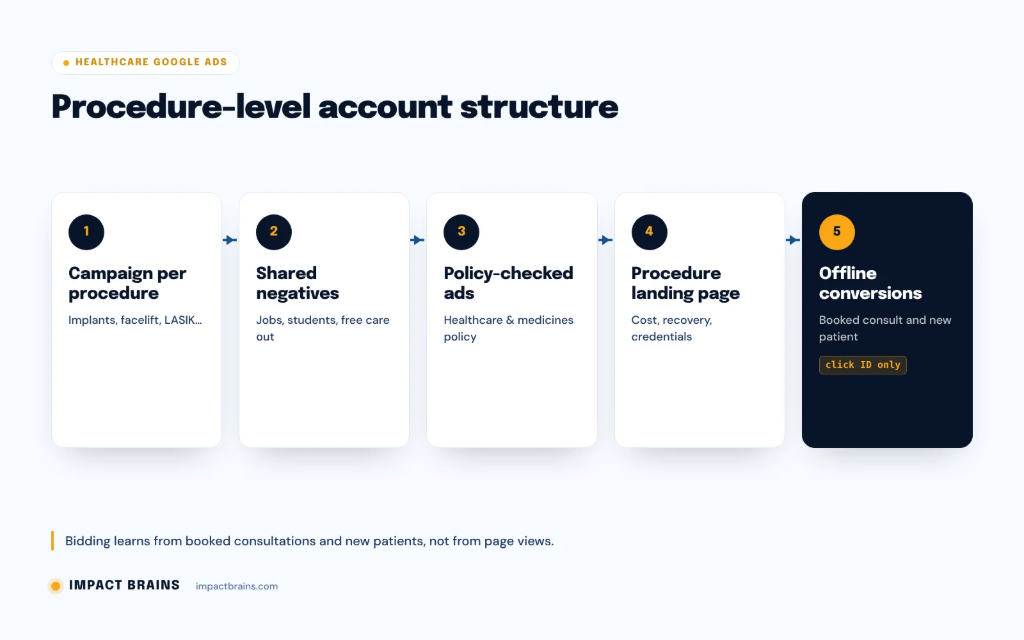
Healthcare Google Ads account structure: separate campaigns per procedure, shared negative keyword lists, dedicated landing pages and offline conversion imports from the CRM
Procedure-level account structure: each treatment gets its own campaign, ads and landing page, and the CRM sends outcomes back to Google.

Why practices choose Impact Brains

Most PPC agencies optimize for cost per click. We optimize for cost per new patient, because the same team runs your tracking, your landing pages and your follow-up.

  • Healthcare-literate leadership

    Dr. Muhammad Abdullah is a Doctor of Pharmacy with an MBA. Health claims and patient data get a clinician’s care.

  • Bidding on real outcomes

    Offline conversions teach Google which clicks became consultations and patients.

  • Flat fee, no lock-in

    A flat monthly retainer, never a percentage of ad spend. A 90-day initial term, then month to month.

  • You own everything

    Ad accounts, analytics, Tag Manager, website and data stay in your name.

Each specialty gets its own keywords, landing pages, compliance notes and reporting.

Healthcare PPC questions, answered

Can doctors advertise on Google Ads?

Yes. Most medical practices can run Google Ads, as long as ads and landing pages follow Google’s Healthcare and medicines policy. Restricted areas such as prescription drugs and addiction services require certification, and health conditions can’t be used for audience targeting.

What is a good cost per lead for a medical practice?

It varies widely by specialty and market. Elective procedures often justify $100–$300+ per consultation request, while general practice leads are cheaper. We set targets from your cost per new patient and patient lifetime value, not from an industry average.

How much should a medical practice spend on Google Ads?

Work backward from the number of new patients you want. Divide your target patients by your booking and show rates to get the leads you need, then multiply by your expected cost per lead. Practices we work with typically spend $5,000–$30,000+ a month in media.

Why use a dedicated landing page for each procedure?

Because a facelift prospect and an injectables prospect have different questions. In our facial plastic surgery case, procedure-specific pages and tighter tracking helped cut cost per conversion by 57%.

Can medical practices use remarketing on Google?

Only carefully. Google’s personalized advertising policy restricts audiences and remarketing based on health conditions. We use non-sensitive audiences, such as general site visitors, and rely on search intent instead.

Do you charge a percentage of ad spend?

No. Management is a flat monthly retainer based on account complexity, never a percentage of spend. You own the Google Ads account and every conversion action we create.

How do you track Google Ads conversions without violating HIPAA?

Conversions fire on non-identifying events, a server-side container strips sensitive fields, and booked consultations are imported as offline conversions using click IDs and timestamps only. No diagnosis or treatment detail tied to a person is sent to Google.

Free patient growth audit

Get a free patient growth audit, reviewed by our senior team.

Tell us about your practice. Within two business days you’ll get a recorded walkthrough of where your ads, website, tracking or follow-up leak patients, and the three fixes that will move the numbers fastest. No pitch deck. No pressure.

  1. Tell us about your practiceTwo minutes. No patient information, ever.
  2. Get your recorded auditAds, Maps, website, tracking and follow-up, reviewed by our senior team.
  3. Decide with numbersA 90-day plan sized from your target cost per new patient. Keep it either way.
−57%cost per conversion for a Washington, D.C. facial plastic surgery practice in three months

Request your free patient growth audit

Three required fields. We’ll take it from there.

Free and no obligation. See our privacy policy. Please don’t include patient information.

Prefer to talk it through?

Book a 30-minute strategy call with our team, led by Dr. Muhammad Abdullah. Bring your numbers and your goals, and leave with a clear next step.