Skip to Content

HIPAA-aligned tracking · Patient Acquisition System

Market boldly. Keep patient data out of ad platforms.

HIPAA-aligned intake, server-side tracking and CRM configuration, so your practice can run ads and measure results without exposing protected health information.

  • Flat monthly fee, never a % of spend
  • You own every account
  • No PHI in ad platforms
  • 3HIPAA-aligned telehealth builds
  • 9server-side containers deployed
  • 0PHI fields sent to ad platforms by design
0PHI fields to ad platformsOutcomes, not identities: click IDs and timestamps only
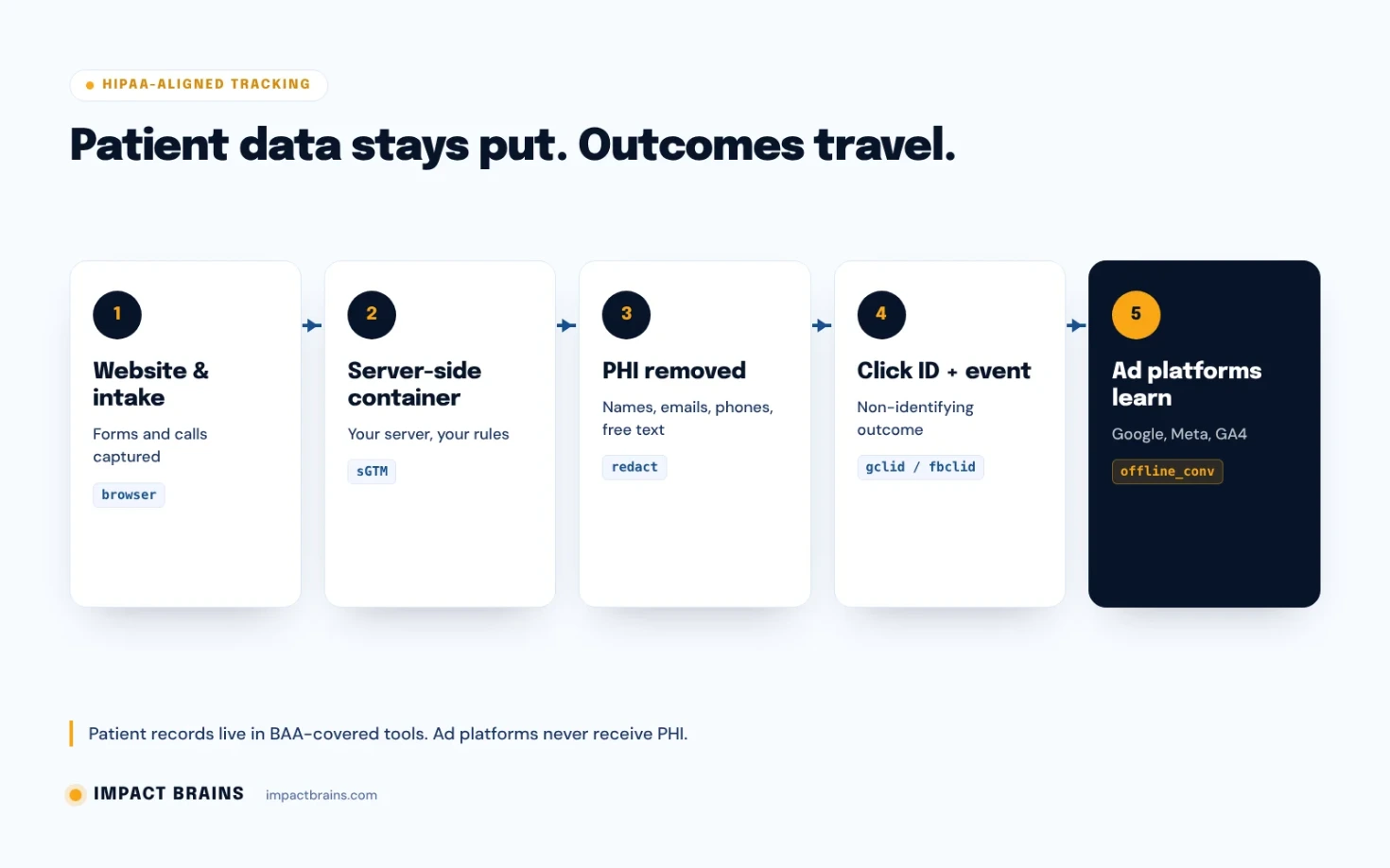
How HIPAA-aligned tracking works: a form or call is captured, routed through a server-side container that removes protected health information, and only a click ID and a non-identifying event reach Google or Meta.

Can healthcare websites use the Meta Pixel or Google Analytics?

Since the U.S. Department of Health and Human Services published guidance on online tracking technologies, many practices either removed tracking and lost the ability to optimize ads, or kept it and took on risk.

There is a third option: rebuild measurement so it works and stays privacy-safe. Our complete guide to HIPAA-compliant websites covers forms and hosting; this page covers marketing and tracking.

The short answer

Only with great care. A federal court narrowed HHS’s tracking guidance in 2024 for unauthenticated pages, but tracking on authenticated pages such as patient portals and booking flows can still involve PHI. Safer setups keep pixels off those pages, strip identifiers server-side and never send health information to vendors without a BAA.

  1. Map every tag: which pixels and scripts fire on which pages, and what they send.
  2. Separate page types: public marketing pages versus intake, booking and portal pages.
  3. Move tracking server-side: remove names, emails, phones and free-text before forwarding events.
  4. Sign BAAs: with every vendor that touches PHI, or don’t send it to them.
  5. Confirm with counsel: your facts decide the answer, not a blog post.

Pixels and patient data don’t mix

A standard ad pixel sends the page URL, the visitor’s IP address and browser identifiers to the ad platform. On an appointment-request page for a specific condition, that combination can describe a patient’s health.

Regulators have acted on exactly this. The fix is not to stop measuring; it is to change what gets measured and where it travels.

  • Pixels on intake pages

    Booking, intake and portal pages send URLs and identifiers to ad platforms by default.

  • Free form tools without a BAA

    Contact and intake forms stored in tools that won’t sign a Business Associate Agreement.

  • Measurement switched off

    Practices that removed tracking can’t tell which ads produce patients, so budgets drift.

What changed in healthcare tracking rules since 2022?

Three things: HHS warned that tracking technologies can disclose PHI, a federal court narrowed that guidance for unauthenticated pages in 2024, and regulators and ad platforms kept tightening how health data can be shared for advertising. The direction is consistent: less health data in ad platforms.

Healthcare tracking and advertising privacy timeline
WhenWhat happenedWhat it means for practices
Dec 2022HHS issues its bulletin on online tracking technologiesPixels on healthcare websites can disclose PHI to vendors
Feb–Mar 2023FTC actions against GoodRx ($1.5M) and BetterHelp ($7.8M) for sharing health data with advertisersHealth apps and telehealth brands outside HIPAA are also accountable
Mar 2024HHS revises the tracking bulletinGuidance on unauthenticated pages clarified, not withdrawn
Jun 2024AHA v. Becerra: court vacates part of the guidance for unauthenticated pagesPublic pages carry less HIPAA risk; authenticated pages still do
Aug 2024HHS withdraws its appealThe ruling stands, but state laws and FTC rules still apply
Jan 2025Meta restricts lower-funnel data for many health and wellness advertisersConversion optimization must rely on safer, server-side outcome data

Summary for marketing planning, not legal advice. State health-privacy laws (for example Washington’s My Health My Data Act) can add obligations; confirm with counsel.

What’s included in HIPAA-aligned marketing setup

We rebuild measurement so your ads can optimize on real outcomes, and nothing that identifies a patient’s health reaches an ad platform.

  • Tracking audit for PHI exposure

    Every tag, pixel and script mapped by page type, with what it sends and to whom.

  • Server-side container with redaction

    A server-side Google Tag Manager container that strips names, emails, phones, IPs and free text before forwarding events.

  • HIPAA-eligible forms and booking

    Intake and booking on tools that sign a Business Associate Agreement, encrypted and access-controlled.

  • Consent and privacy notice review

    Cookie consent and privacy notices aligned with your tracking, reviewed with your counsel.

  • HIPAA-ready CRM configuration

    GoHighLevel on its HIPAA-enabled plan, HubSpot or Odoo, configured with role-based access and audit trails.

  • Offline conversions without PHI

    Booked consultations and new patients sent to Google and Meta with click IDs and timestamps only.

HIPAA-aligned builds you can inspect

Three Premier Metabolic & Men’s Health Care pages where compliance was the blocker, plus the tracking portfolio behind every system we run.

HIPAA
Telehealth · Landing page

Premier Metabolic & Men’s Health Care: GLP-1 + ED bundle

The old site couldn’t collect patient intake safely, which blocked paid ads. We rebuilt the page around HIPAA-aligned intake and physician-led consent, so compliant ad spend could launch.

Read the case study 
100%
Telehealth · GLP-1 program

GLP-1 weight-loss program with fully online intake

A HIPAA-aligned landing page with 100% online patient intake, transparent pricing and physician-led positioning, built so the program could advertise without the compliance risk that had blocked it.

Read the case study 
Async
Telehealth · Men’s health

Discretion-first men’s health landing page

Compliant intake architecture with trust markers at the point of submission and messaging built around the confidentiality this buyer needs before converting.

Read the case study 
50+
Tracking · 12+ industries

50+ Google Tag Manager accounts across 9 countries

Including healthcare and wellness accounts such as a plastic surgery practice and a pharmacy, with 9 server-side containers, Meta Conversions API, call tracking and offline conversions.

Read the case study 

See all case studies 

How compliance is built into every layer

HIPAA alignment is not a plugin. It is a set of design decisions about which pages carry tracking, which tools hold data, and what each vendor is allowed to receive.

Dr. Muhammad Abdullah’s pharmacy training shows up here: patient data is handled with a clinician’s care, and every design is documented so your counsel can review it.

This is how we build. It is not legal advice; confirm your setup with your own counsel.

How compliance is built into every Patient Acquisition System
Rule or riskWhat we do
Google Healthcare & medicines policyAd copy, keywords and landing pages reviewed before launch; certification handled for restricted categories.
Meta health & wellness rulesNo targeting by health condition and no copy that implies a viewer’s condition or negative self-perception.
HIPAA and online trackingNo pixels on authenticated pages; a server-side container strips identifiers; offline conversions send click IDs, not PHI.
Forms, chat and bookingHIPAA-eligible tools with a signed Business Associate Agreement, encrypted and access-controlled.
Reviews and testimonialsPatient consent on file, no PHI in replies, and FTC endorsement rules followed for any featured result.

How we make your marketing HIPAA-aligned

Attribution is the A in the IMPACT system. Done right, it is both privacy-safe and more accurate than browser pixels.

  1. Insight

    Audit

    Week 1

    Tag-by-tag review of what leaves your site, mapped against public, intake and portal pages.

  2. Attribution

    Redesign

    Week 2

    A tracking plan your counsel can read: events, fields, vendors and BAAs.

  3. Pages

    Rebuild intake

    Weeks 2–4

    HIPAA-eligible forms and booking, with pixels removed from authenticated pages.

  4. Attribution

    Go server-side

    Weeks 3–5

    Server-side container, redaction rules and offline conversion imports.

  5. Tuning

    Monitor

    Quarterly

    Re-audits when tools, pages or rules change, with a written change log.

Most practices have a HIPAA-aligned tracking setup live in four to six weeks.

See our GA4, GTM & tracking service 
HIPAA-aligned tracking architecture: website and intake forms send events to a server-side container that strips PHI, then forwards click IDs and non-identifying events to Google Ads, Meta and GA4, while patient data stays in a BAA-covered CRM
HIPAA-aligned tracking: patient data stays in BAA-covered tools; ad platforms receive outcomes, not identities.

Why practices choose Impact Brains

Most agencies either ignore HIPAA or use it as a reason not to measure. We build measurement that is privacy-safe and still tells you what each patient cost.

  • Healthcare-literate leadership

    Dr. Muhammad Abdullah is a Doctor of Pharmacy with an MBA. Patient privacy is treated as a clinical duty, not a checkbox.

  • Documented for counsel

    Every tracking plan lists events, fields, vendors and BAAs, so your lawyer can review it.

  • Server-side by default

    9 server-side containers deployed across our portfolio, with redaction rules standard.

  • You own everything

    Ad accounts, analytics, Tag Manager, website and data stay in your name.

Each specialty gets its own keywords, landing pages, compliance notes and reporting.

HIPAA marketing questions, answered

Can healthcare websites use the Meta Pixel or Google Analytics?

Only with great care. HHS guidance on online tracking technologies, partly vacated by a federal court in 2024 for unauthenticated pages, still treats tracking on authenticated pages such as portals and booking flows as potentially involving PHI. Safer setups avoid pixels there, strip identifiers server-side and never send health information to vendors without a BAA. Confirm your setup with counsel.

What is HIPAA-compliant marketing?

HIPAA-compliant marketing means promoting a healthcare practice without using or disclosing protected health information in ways HIPAA doesn’t allow: no PHI in ad platforms, patient authorization before using testimonials, BAAs with vendors that handle PHI, and tracking designed around those limits.

Is Impact Brains a HIPAA business associate?

When our work requires access to PHI, we sign a Business Associate Agreement. Most of our tracking designs avoid handling PHI entirely, so ad and analytics vendors receive only non-identifying events and click IDs.

Is GoHighLevel HIPAA compliant?

GoHighLevel offers a HIPAA-enabled plan with a Business Associate Agreement. The plan alone isn’t enough: forms, user permissions, integrations and automations must be configured so PHI stays inside the covered account.

What is server-side tracking and why does it help with HIPAA?

Server-side tracking sends events from your own server container instead of the visitor’s browser. Because the data passes through a server you control, sensitive fields can be removed before anything reaches Google, Meta or analytics tools.

Do we need a BAA with Google or Meta?

Google and Meta generally do not sign BAAs for their advertising products, which is why PHI must not be sent to them. Design tracking so those platforms receive only non-identifying events and click IDs.

Can we still measure which ads produce patients?

Yes. Offline conversion imports send booked consultations and new patients back to the ad platforms using click IDs and timestamps, so bidding learns from real outcomes without receiving health information.

Free patient growth audit

Get a free patient growth audit, reviewed by our senior team.

Tell us about your practice. Within two business days you’ll get a recorded walkthrough of where your ads, website, tracking or follow-up leak patients, and the three fixes that will move the numbers fastest. No pitch deck. No pressure.

  1. Tell us about your practiceTwo minutes. No patient information, ever.
  2. Get your recorded auditAds, Maps, website, tracking and follow-up, reviewed by our senior team.
  3. Decide with numbersA 90-day plan sized from your target cost per new patient. Keep it either way.
−57%cost per conversion for a Washington, D.C. facial plastic surgery practice in three months
Request your free patient growth audit

Three required fields. We’ll take it from there.

Free and no obligation. See our privacy policy. Please don’t include patient information.

Prefer to talk it through?

Book a 30-minute strategy call with our team, led by Dr. Muhammad Abdullah. Bring your numbers and your goals, and leave with a clear next step.

Loading the booking calendar…
If it doesn’t appear, open the calendar in a new tab.