Skip to Content

Facebook & Instagram ads · Patient Acquisition System

Meta ads for practices, within the rules and built to book.

Creative, audiences and privacy-safe tracking for Facebook and Instagram campaigns that respect Meta’s health policies and still produce booked consultations.

  • Flat monthly fee, never a % of spend
  • You own every account
  • No PHI in ad platforms
  • −97.8%cost per lead, health & wellness summit
  • 249qualified leads in under 90 days
  • 9.75%click-through rate
−97.8%cost per lead on MetaHealth & wellness summit, $223 → $4.89 in under 90 days
A Meta funnel for a practice: video views and engaged visitors become lead-form or booking inquiries, qualified by logistics questions, then booked consultations and new patients, measured with the Conversions API and no PHI.

Can medical practices advertise on Facebook and Instagram?

Meta is where many patients first discover an aesthetic treatment, a new dentist or a telehealth program, usually long before they search for it.

It is also the platform with the tightest health-ad rules. Our approach starts with Meta’s Advertising Standards, then builds creative and tracking that work inside them.

The short answer

Yes. Practices can advertise on Facebook and Instagram if ads don’t imply a viewer’s health condition, avoid restricted before-and-after imagery, target adults where required, and hold LegitScript certification for prescription or addiction-treatment offers. Since 2025, many health advertisers also face limits on the conversion data they can share.

  1. Talk about the treatment, not the viewer’s condition (“Back pain treatment in Austin”, not “Is your back killing you?”).
  2. Respect imagery rules: no idealized body images or before-and-after shots where restricted.
  3. Target broadly: health-condition targeting options were removed in 2022.
  4. Certify first: prescription, telehealth and addiction offers need LegitScript where required.
  5. Measure safely: the Conversions API with outcomes only, never PHI.

Why Meta ads stall for so many practices

Most practices hit the same three walls: ads rejected for policy reasons, cheap leads that never book, and shrinking conversion data.

In January 2025 Meta began restricting lower-funnel data for many health and wellness advertisers. Practices that relied on the browser pixel lost much of their optimization signal. Server-side outcome data is now the difference between a campaign that learns and one that guesses.

  • Rejected ads

    Copy that addresses the viewer’s condition, or imagery that implies a negative self-image, gets disapproved.

  • Cheap leads, no bookings

    Instant forms with no qualifying questions fill your CRM with people who never answer the phone.

  • Less data to optimize on

    Pixel restrictions and iOS privacy changes leave Meta optimizing for clicks instead of patients.

What’s included in our healthcare Meta ads management

Creative, audiences, lead handling and measurement, run in your own Business Manager on a flat monthly fee.

  • Health-policy-safe creative and copy

    Procedure education, provider introductions and patient-journey video that pass review the first time.

  • Lead forms with qualification questions

    Higher-intent forms with logistics questions (location, timing, budget), never questions about a health condition.

  • Retargeting of site and video audiences

    Non-sensitive audiences built from video views and general site visits, not condition pages.

  • Conversions API without PHI

    Server-side events with outcomes only, deduplicated with the pixel where the pixel is still appropriate.

  • Before-and-after and testimonial checks

    Consent on file, no idealized results, and FTC endorsement rules followed.

  • Speed-to-lead follow-up

    New Meta leads get a text and a call within minutes, because form leads go cold fast.

What’s allowed in healthcare Facebook ads?

Ads can promote treatments, providers and outcomes in general terms. They can’t imply the viewer has a condition, use restricted before-and-after or idealized body imagery, target by health condition, or promote prescription and addiction-treatment offers without certification.

Healthcare Facebook and Instagram ads: what to use and what to avoid
Ad elementUseAvoid
Headline and copy“Dental implants in Denver, with financing”“Embarrassed by your missing teeth?”
ImageryProvider at work, clinic interior, patient-journey videoIdealized bodies, zoomed-in problem areas, restricted before-and-after
TargetingLocation, age where required, broad interests, lookalikes of booked patientsHealth-condition audiences (removed in 2022)
Lead form questionsPreferred location, timing, budget rangeDiagnoses, symptoms or medications
OffersConsultations, transparent pricing, financingGuaranteed results; prescription offers without certification
TrackingConversions API with outcomes and click IDsPixel events on intake or condition pages

Based on Meta’s Advertising Standards. Platforms review ads case by case; rules change, so we re-check before every launch.

Meta results that hold up to scrutiny.

Our strongest Meta result is in health and wellness: an event, not a clinic. We show it for the method, alongside a telehealth build where compliance was the blocker.

Health & wellness eventMeta Ads90 days

A health & wellness summit cut cost per lead 97.8% on Meta in under 90 days.

Cost per lead −97.8%
Before$223
After$4.89
  • 249 qualified leads in under 90 days, at a cost that made scaling profitable
  • Audience research and lookalike expansion replaced broad, generic targeting
  • Ad copy rewritten for urgency and relevance; click-through rate reached 9.75%
  • Conversion tracking fixed so Meta optimized toward real registrations

Read the Summit case study 

Meta Ads results for a health and wellness summit after optimization by Impact Brains: cost per lead down 97.8%
Meta Ads results after the rebuild. An event, not a clinic: shown for the Meta method.
HIPAA
Telehealth · Landing page

Premier Metabolic & Men’s Health Care: GLP-1 + ED bundle

The old site couldn’t collect patient intake safely, which blocked paid ads. We rebuilt the page around HIPAA-aligned intake and physician-led consent, so compliant ad spend could launch.

Read the case study 
50+
Tracking · 12+ industries

50+ Google Tag Manager accounts across 9 countries

Including healthcare and wellness accounts such as a plastic surgery practice and a pharmacy, with 9 server-side containers, Meta Conversions API, call tracking and offline conversions.

Read the case study 

See all case studies 

Meta ads within the rules

Meta reviews health ads more strictly than almost any other category. We write and design to pass review the first time, and keep a log of every rejection and appeal.

Measurement follows the same rule as everywhere in our healthcare work: outcomes go to Meta through the Conversions API, tied to click IDs, never to a patient’s health information.

This is how we build. It is not legal advice; confirm your setup with your own counsel.

How HIPAA-aligned tracking works 

How compliance is built into every Patient Acquisition System
Rule or riskWhat we do
Personal attributesCopy never asserts or implies the viewer’s health condition, weight or appearance.
Cosmetic and weight-loss offersAge restrictions applied; no idealized or before-and-after imagery where restricted.
Google Healthcare & medicines policyAd copy, keywords and landing pages reviewed before launch; certification handled for restricted categories.
Meta health & wellness rulesNo targeting by health condition and no copy that implies a viewer’s condition or negative self-perception.
HIPAA and online trackingNo pixels on authenticated pages; a server-side container strips identifiers; offline conversions send click IDs, not PHI.
Forms, chat and bookingHIPAA-eligible tools with a signed Business Associate Agreement, encrypted and access-controlled.
Reviews and testimonialsPatient consent on file, no PHI in replies, and FTC endorsement rules followed for any featured result.

How we run Meta ads for practices

Meta is part of the Media layer in the IMPACT system: it creates demand that search and follow-up then convert.

  1. Insight

    Audit

    Week 1

    Account, creative, audiences, policy history and tracking reviewed; three ranked fixes.

  2. Attribution

    Tracking

    Weeks 1–2

    Conversions API with outcomes only; pixel removed from sensitive pages.

  3. Media

    Creative

    Weeks 2–3

    Compliant concepts: provider video, procedure education, offers and patient journeys.

  4. CRM

    Lead handling

    Weeks 2–4

    Qualifying forms routed to your CRM with instant text and call follow-up.

  5. Tuning

    Test & scale

    Ongoing

    Weekly creative tests; budget moves to the ads that produce booked consultations.

Meta campaigns typically stabilize in 30–60 days.

See our Meta Ads management service 
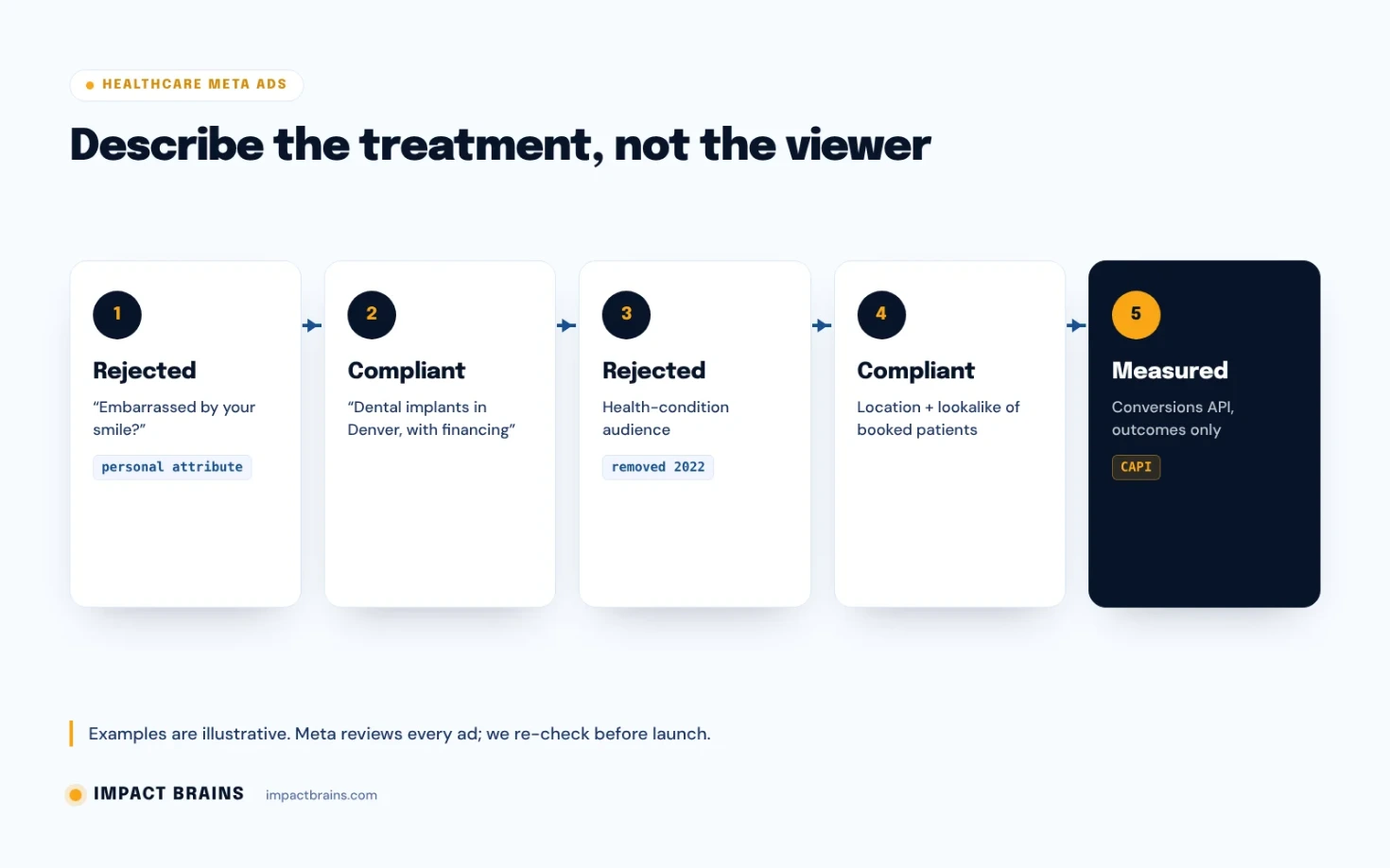
Side-by-side examples of healthcare Facebook ad copy: a rejected ad that implies the viewer’s condition next to a compliant ad that describes the treatment, location and financing
Rejected versus compliant: describe the treatment, not the viewer.

Why practices choose Impact Brains

Most social media agencies chase likes. We run Meta as part of a Patient Acquisition System, so success is measured in booked consultations.

  • Healthcare-literate leadership

    Dr. Muhammad Abdullah is a Doctor of Pharmacy with an MBA. Claims and patient data get a clinician’s care.

  • Leads that book

    Qualifying forms plus speed-to-lead automation turn Meta leads into consultations.

  • Flat fee, no lock-in

    A flat monthly retainer, never a percentage of ad spend. A 90-day initial term, then month to month.

  • You own everything

    Your Business Manager, your pixel, your creative and your data.

Each specialty gets its own keywords, landing pages, compliance notes and reporting.

Healthcare Meta ads questions, answered

Can doctors run Facebook ads?

Yes. Doctors and practices can run Facebook and Instagram ads that promote treatments and providers, as long as ads don’t imply the viewer’s health condition, avoid restricted imagery and follow Meta’s Advertising Standards. Prescription and addiction-treatment offers need certification.

Can plastic surgeons run before-and-after ads on Instagram?

Meta restricts before-and-after imagery for weight loss and certain cosmetic procedures and bans content implying negative self-perception. We use compliant formats such as procedure education, surgeon introductions and patient-journey video.

Why do Meta leads for practices often not book?

Instant forms make submitting easy, including for people with low intent. Adding qualifying questions about location, timing and budget, then calling or texting within minutes, turns more of those leads into consultations.

How did Meta’s 2025 health data restrictions affect practices?

Starting in January 2025, Meta restricted many health and wellness advertisers from sharing lower-funnel conversion data through its business tools. Campaigns that relied on the pixel lost optimization signal; server-side outcome data with no PHI is the safer replacement.

Can medical practices target people by health condition on Facebook?

No. Meta removed detailed targeting options based on health causes and conditions in 2022, and ads can’t imply a viewer has a condition. Practices reach patients through location, broad audiences, video engagement and lookalikes of booked patients.

Is Facebook or Google Ads better for a medical practice?

They do different jobs. Google Ads captures patients already searching for a treatment; Meta creates demand and nurtures long decisions. Most elective practices use both, with shared tracking to compare cost per new patient.

Free patient growth audit

Get a free patient growth audit, reviewed by our senior team.

Tell us about your practice. Within two business days you’ll get a recorded walkthrough of where your ads, website, tracking or follow-up leak patients, and the three fixes that will move the numbers fastest. No pitch deck. No pressure.

  1. Tell us about your practiceTwo minutes. No patient information, ever.
  2. Get your recorded auditAds, Maps, website, tracking and follow-up, reviewed by our senior team.
  3. Decide with numbersA 90-day plan sized from your target cost per new patient. Keep it either way.
−57%cost per conversion for a Washington, D.C. facial plastic surgery practice in three months

Request your free patient growth audit

Three required fields. We’ll take it from there.

Free and no obligation. See our privacy policy. Please don’t include patient information.

Prefer to talk it through?

Book a 30-minute strategy call with our team, led by Dr. Muhammad Abdullah. Bring your numbers and your goals, and leave with a clear next step.

Loading the booking calendar…
If it doesn’t appear, open the calendar in a new tab.