Skip to Content

Our core system for healthcare

The Patient Acquisition System: from ad spend to new patients.

We measure what matters to a practice (cost per qualified inquiry, per appointment and per new patient), then build and tune the whole funnel: ads, pages, tracking and follow-up, run by one senior team.

  • Flat monthly fee, never a % of spend
  • You own every account
  • No PHI in ad platforms
  • −57%cost per conversion, facial plastic surgery
  • 34 → 99monthly conversions in three months
  • +161%conversion value ($38.2K → $99.8K)
−57%cost per conversionFacial plastic surgery practice, Washington, D.C., in three months
How Impact Brains measures the Patient Acquisition System: clicks become calls and forms (generate_lead), qualified inquiries, booked consultations, show-ups and new patients, each tracked as its own event without sending protected health information to ad platforms.

What is a patient acquisition system?

Most practices buy marketing in pieces: an SEO vendor, an ads agency, a web designer and a CRM nobody configured. Each reports its own number, and nobody can say what a new patient costs.

A patient acquisition system replaces the pieces with one measured machine, built on the IMPACT framework and run by one accountable team.

The short answer

A patient acquisition system is the connected set of ads, website pages, tracking and follow-up automation that turns ad spend into booked consultations and new patients. Every stage is measured, so a practice knows its cost per new patient and can move budget to the channels that actually produce patients.

  1. Attract: Google Ads, Meta, medical SEO and AI-search visibility aimed at ready-to-book patients.
  2. Convert: procedure pages and short, HIPAA-aligned intake.
  3. Track: calls, forms, bookings, show-ups and new patients, without PHI in ad platforms.
  4. Follow up: speed-to-lead texts, reminders and no-show recovery.
  5. Tune: weekly tests and a monthly cost-per-new-patient review.

How do you calculate patient acquisition cost?

Patient acquisition cost (PAC) is total marketing spend divided by the number of new patients it produced in the same period. It is more useful than cost per lead because it includes lead quality, booking rate and show rate, the three stages where most practices quietly lose patients.

Worked example: how one follow-up fix changes patient acquisition cost (illustrative numbers)
Funnel stageBeforeAfter a speed-to-lead fix
Monthly ad spend$10,000$10,000
Calls and forms (at $50 per lead)200200
Qualified inquiries (60%)120120
Booked consultations60 (50% booking rate)78 (65% booking rate)
Patients who showed (80%)4862
New patients (62.5% of shows)3039
Patient acquisition cost$333$256 (−23%)

Illustrative numbers, not a client result. The point: the same ad spend and the same leads produce 30% more patients when follow-up improves, which no cost-per-lead report would show.

Where practices lose patients they already paid for

A click is only the start. Between the ad and the treatment chair there are five more stages, and each one leaks.

We measure every stage separately, so the fix goes where the leak is. Often that is not the ads at all, but speed to lead or reminders. Read the patient follow-up system every clinic needs for the playbook.

  • Unqualified inquiries

    Price-shoppers, job seekers and out-of-area callers counted as leads, so bidding buys more of them.

  • Slow follow-up

    An inquiry that waits hours for a callback books with the practice that answered first.

  • No-shows

    Booked consultations that never arrive, with no reminder or rebooking sequence to recover them.

How the Patient Acquisition System is built

Each step maps to a layer of the IMPACT framework, so your ads, pages, tracking and follow-up launch as one system.

  1. Insight

    Audit & plan

    Week 1

    A recorded audit of your ads, site, tracking and follow-up, then a 90-day plan built from your target cost per new patient.

  2. Attribution

    Track

    Weeks 1–2

    Calls, forms and bookings tracked through a server-side container that strips sensitive fields before any data reaches an ad platform.

  3. Pages

    Build

    Weeks 2–4

    Procedure and treatment pages with proof before the ask, HIPAA-aligned intake and a speed budget on mobile.

  4. Media

    Launch

    Weeks 4–6

    Search, Maps and social campaigns launched in phases, with ad copy and landing pages checked against Google and Meta health policies.

  5. CRM & Tuning

    Follow up & scale

    Ongoing

    Speed-to-lead and no-show automation, weekly tests, and a monthly review of cost per new patient by channel.

Most practices have a measured first version live in 30–45 days.

See the IMPACT Marketing System 

What’s included in the Patient Acquisition System

The full IMPACT build for your practice, plus the operational pieces most agencies leave to your front desk.

  • A full IMPACT build

    Insight, Media, Pages, Attribution, CRM and Tuning, designed together for your specialty and market.

  • Call and form qualification rules

    Clear definitions of a qualified inquiry, applied to calls and forms, so you stop paying for the wrong leads.

  • Front-desk scorecard

    Speed to first response and booking rate by staff member and channel, reviewed monthly.

  • No-show recovery automation

    Reminders, confirmations and rebooking sequences that recover consultations you already paid for.

  • Offline conversion feedback

    Booked consultations and new patients sent back to Google and Meta with click IDs only, so bidding learns from outcomes.

  • Monthly revenue attribution review

    Cost per new patient by channel, procedure and location, with the budget moves we recommend.

What the system produced for real practices

Numbers from the case studies we can verify, before and after.

Facial plastic surgeryGoogle AdsWashington, D.C.

A Washington, D.C. facial plastic surgery practice cut cost per conversion 57% and nearly tripled conversions in three months.

Cost per conversion −57%
Before$141.68
After$61.12
Conversions (three months) 2.9×
Before34
After99
Conversion value +161%
Before$38.2K
After$99.8K
  • Campaigns rebuilt around procedure intent: facelift, mini facelift and deep plane facelift across D.C., Maryland and Virginia
  • Conversion tracking split calls, form fills and booked consultations, so bidding learned from real consults
  • A dedicated consult-booking landing page, built within Google’s healthcare advertising policies

Read the facial plastic surgery case study 

Google Ads dashboard for a Washington, D.C. facial plastic surgery practice after three months of optimization by Impact Brains
Google Ads performance after the three-month rebuild.
HIPAA
Telehealth · Landing page

Premier Metabolic & Men’s Health Care: GLP-1 + ED bundle

The old site couldn’t collect patient intake safely, which blocked paid ads. We rebuilt the page around HIPAA-aligned intake and physician-led consent, so compliant ad spend could launch.

Read the case study 
−97.8%
Health & wellness event · Meta Ads

Health & wellness summit: cost per lead $223 → $4.89

Audience research, sharper ad copy, lookalike expansion and fixed conversion tracking cut cost per lead 97.8% on Meta in under 90 days, with 249 qualified leads.

Read the case study 
50+
Tracking · 12+ industries

50+ Google Tag Manager accounts across 9 countries

Including healthcare and wellness accounts such as a plastic surgery practice and a pharmacy, with 9 server-side containers, Meta Conversions API, call tracking and offline conversions.

Read the case study 

See all case studies 

Compliance notes

A patient acquisition system touches every part of patient privacy: forms, calls, CRM records and ad-platform data. Compliance is designed in at each layer, not reviewed at the end.

Ad platforms receive outcomes (a qualified inquiry, a booked consultation, a new patient) tied to click IDs and timestamps, never names, conditions or treatment details.

This is how we build. It is not legal advice; confirm your setup with your own counsel.

How HIPAA-aligned tracking works 

How compliance is built into every Patient Acquisition System
Rule or riskWhat we do
Google Healthcare & medicines policyAd copy, keywords and landing pages reviewed before launch; certification handled for restricted categories.
Meta health & wellness rulesNo targeting by health condition and no copy that implies a viewer’s condition or negative self-perception.
HIPAA and online trackingNo pixels on authenticated pages; a server-side container strips identifiers; offline conversions send click IDs, not PHI.
Forms, chat and bookingHIPAA-eligible tools with a signed Business Associate Agreement, encrypted and access-controlled.
Reviews and testimonialsPatient consent on file, no PHI in replies, and FTC endorsement rules followed for any featured result.
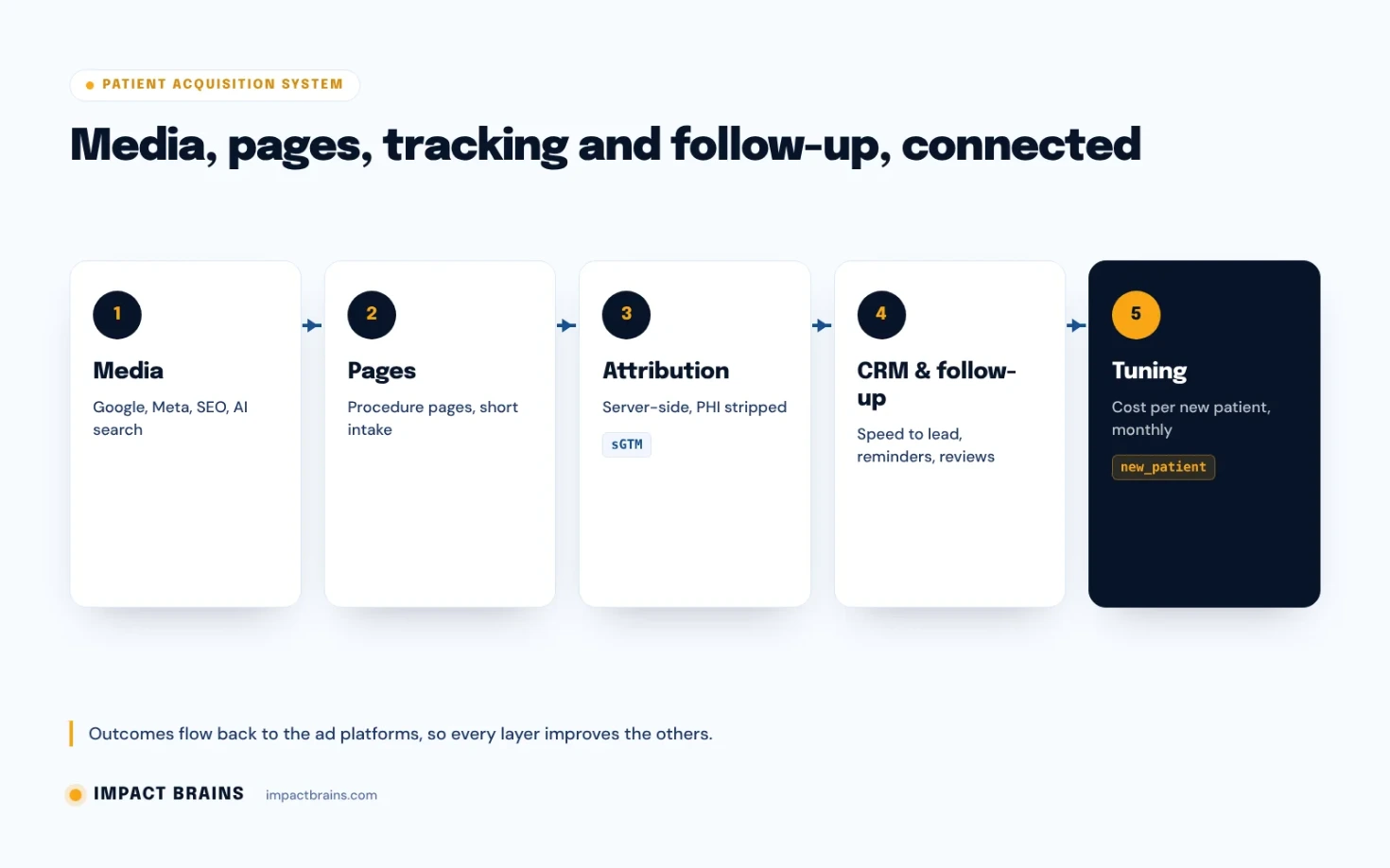
The Patient Acquisition System diagram: ads and SEO feed procedure pages, a server-side tracking layer sends outcomes back to Google and Meta, and CRM automation handles follow-up, reminders and reviews
The Patient Acquisition System: media, pages, tracking and follow-up connected, with outcomes flowing back to the ad platforms.

Why practices choose Impact Brains

Most agencies stop at cost per lead. We take responsibility for the whole path to a new patient, because one senior team builds and runs every layer.

  • Healthcare-literate leadership

    Dr. Muhammad Abdullah is a Doctor of Pharmacy with an MBA. Clinical care with data, business discipline with budgets.

  • One accountable team

    Ads, pages, tracking and CRM are designed together, so no vendor can blame another.

  • Flat fee, no lock-in

    A flat monthly retainer, never a percentage of ad spend. A 90-day initial term, then month to month.

  • You own everything

    Ad accounts, analytics, Tag Manager, website and data stay in your name.

Every service shares the same tracking, the same team and the same monthly cost-per-new-patient review.

Each specialty gets its own keywords, landing pages, compliance notes and reporting.

Patient acquisition questions, answered

What is patient acquisition cost?

Patient acquisition cost (PAC) is your total marketing spend divided by the number of new patients it produced in a period. It is more useful than cost per lead because it includes lead quality, booking rate and show rate.

What is a good patient acquisition cost?

It depends on patient lifetime value. Many elective practices can afford a higher PAC because one procedure is worth thousands; a practice with lower-value visits needs a lower PAC. We set targets from your lifetime value and margin.

How is a patient acquisition system different from hiring an ads agency?

An ads agency optimizes the ads. A patient acquisition system also owns the landing pages, tracking, follow-up and reporting, so the team is accountable for new patients, not clicks.

How long does it take to build a patient acquisition system?

A first version usually takes 30–45 days: audit in week one, tracking and pages in weeks two to four, and a phased ad launch after that. Paid search typically produces qualified inquiries within two to four weeks of launch.

Do we need to replace our website or CRM?

Not always. We audit what you have first and rebuild only the layers that leak patients, most often tracking, landing pages and follow-up speed.

What is the best way for a clinic to get new patients?

Combine high-intent search (Google Ads and local SEO) with procedure pages that answer patients’ questions, respond to every inquiry within minutes, and measure cost per new patient so budget follows the channels that produce patients.

Is the Patient Acquisition System HIPAA compliant?

It is built to be HIPAA-aligned: intake on HIPAA-eligible tools with a BAA, no pixels on authenticated pages, server-side tracking that strips identifiers, and offline conversions without PHI. Confirm your specific setup with your own counsel.

Free patient growth audit

Get a free patient growth audit, reviewed by our senior team.

Tell us about your practice. Within two business days you’ll get a recorded walkthrough of where your ads, website, tracking or follow-up leak patients, and the three fixes that will move the numbers fastest. No pitch deck. No pressure.

  1. Tell us about your practiceTwo minutes. No patient information, ever.
  2. Get your recorded auditAds, Maps, website, tracking and follow-up, reviewed by our senior team.
  3. Decide with numbersA 90-day plan sized from your target cost per new patient. Keep it either way.
−57%cost per conversion for a Washington, D.C. facial plastic surgery practice in three months

Request your free patient growth audit

Three required fields. We’ll take it from there.

Free and no obligation. See our privacy policy. Please don’t include patient information.

Prefer to talk it through?

Book a 30-minute strategy call with our team, led by Dr. Muhammad Abdullah. Bring your numbers and your goals, and leave with a clear next step.