Skip to Content

Plastic surgery marketing · Patient Acquisition System

Plastic surgery marketing that fills your consultation calendar.

Procedure-level Google Ads, SEO, consultation landing pages and nurture for long decisions, built as one system for plastic and cosmetic surgery practices and measured to surgeries.

  • Flat monthly fee, never a % of spend
  • You own every account
  • No PHI in ad platforms
  • −57%cost per conversion, facial plastic surgery
  • 34 → 99monthly conversions in three months
  • +161%conversion value ($38.2K → $99.8K)
−57%cost per conversionFacial plastic surgery practice, Washington, D.C., in three months
How Impact Brains measures a plastic surgery practice: clicks become calls and forms (generate_lead), qualified inquiries, booked consultations, show-ups and new patients, each tracked as its own event without sending protected health information to ad platforms.

How do plastic surgeons get more patients?

Cosmetic surgery patients rarely book on a first visit. They research for weeks or months, compare surgeons, watch video and read reviews, then book a consultation with the practice that answered their questions best.

Our guide to how cosmetic surgery patients choose a surgeon maps that journey. This page shows the system we build around it.

The short answer

Plastic surgeons get more patients by being visible for procedure-specific searches, earning trust with surgeon-led education and reviews, converting on dedicated procedure landing pages, and nurturing research-mode patients by email and text until they are ready to book a consultation.

  1. Be found: Google Ads and SEO for each procedure, not one “plastic surgery” campaign.
  2. Be trusted: surgeon credentials, video and reviews on every page.
  3. Convert: a consultation page per procedure that answers cost, recovery and candidacy.
  4. Nurture: sequences that keep research-mode patients warm for months.
  5. Measure: cost per consultation and per surgery, not cost per lead.

Why plastic surgery practices call us

Elective surgery has the longest decision cycle in healthcare and some of the strictest ad rules. Practices that treat it like any other lead-gen business pay for it.

Read why plastic surgery practices pay too much for leads for the full diagnosis.

  • Price-shoppers, not patients

    Consult requests come from people comparing prices who never book, while real candidates bounce.

  • Months between first click and consult

    Research-mode patients take months to decide, and most practices lose them in between.

  • Ad policy limits

    Before-and-after rules and restrictions on personal attributes make social marketing tricky.

The Plastic Surgery Patient Acquisition System

The same system that cut a D.C. practice’s cost per conversion by 57%, adapted to your procedures and market.

  • Procedure-specific Google Ads

    Facelift, rhinoplasty, blepharoplasty, breast and body contouring each get their own campaign, ads and budget.

  • A consultation page per procedure

    Cost context, recovery, candidacy and surgeon credentials on one page. See why facelift patients rarely convert on service pages.

  • Nurture for long consideration cycles

    Email and text sequences with surgeon video, financing and recovery guides for patients who aren’t ready yet.

  • Surgeon-led video and education

    Procedure explainers and surgeon introductions that build trust before the consultation.

  • Tracking that separates calls, forms and consults

    So bidding learns from booked consultations, using offline conversions without PHI.

  • Cost per consultation and per surgery

    Monthly reporting by procedure, so budget follows the surgeries that pay.

Procedures we market

Each procedure gets its own keywords, ads, landing page and reporting line.

  • Facelift & deep plane facelift
  • Mini facelift
  • Rhinoplasty
  • Blepharoplasty
  • Neck lift
  • Brow lift
  • Breast augmentation
  • Breast lift & reduction
  • Tummy tuck
  • Liposuction & body contouring
  • Mommy makeover
  • BBL

Which marketing channels generate surgical patients?

Google Search by procedure generates the most ready-to-book consultations; SEO and surgeon video win the long research phase; Meta builds awareness within its health rules; and email or text nurture converts the patients who weren’t ready yet. Each channel should be measured by consultations and surgeries, not leads.

Plastic surgery marketing channels: role and how to measure each
ChannelRole in the patient journeyMeasure it by
Google Search ads by procedureCapture patients actively comparing surgeonsCost per booked consultation
SEO and procedure pagesWin cost, recovery and “near me” researchOrganic consultations and surgeries
Surgeon video (YouTube, site)Build trust before the consultationAssisted consultations, view-through
Meta and InstagramAwareness and retargeting within health-ad rulesCost per qualified lead, consult rate
Email and text nurtureConvert research-mode patients over monthsConsults booked from nurture
Reviews and referralsSocial proof at the decision pointReview velocity, referral consults

Our plastic surgery marketing ROI blueprint compares these channels in depth.

Plastic surgery results that hold up to scrutiny.

Cost per conversion, conversions and conversion value, before and after a procedure-level rebuild.

Facial plastic surgeryGoogle AdsWashington, D.C.

A Washington, D.C. facial plastic surgery practice cut cost per conversion 57% and nearly tripled conversions in three months.

Cost per conversion −57%
Before$141.68
After$61.12
Conversions (three months) 2.9×
Before34
After99
Conversion value +161%
Before$38.2K
After$99.8K
  • Campaigns rebuilt around procedure intent: facelift, mini facelift and deep plane facelift across D.C., Maryland and Virginia
  • Conversion tracking split calls, form fills and booked consultations, so bidding learned from real consults
  • A dedicated consult-booking landing page, built within Google’s healthcare advertising policies

Read the facial plastic surgery case study 

Google Ads dashboard for a Washington, D.C. facial plastic surgery practice after three months of optimization by Impact Brains
Google Ads performance after the three-month rebuild.
−97.8%
Health & wellness event · Meta Ads

Health & wellness summit: cost per lead $223 → $4.89

Audience research, sharper ad copy, lookalike expansion and fixed conversion tracking cut cost per lead 97.8% on Meta in under 90 days, with 249 qualified leads.

Read the case study 
50+
Tracking · 12+ industries

50+ Google Tag Manager accounts across 9 countries

Including healthcare and wellness accounts such as a plastic surgery practice and a pharmacy, with 9 server-side containers, Meta Conversions API, call tracking and offline conversions.

Read the case study 

See all case studies 

Compliance notes

Cosmetic surgery marketing sits under three sets of rules: Google’s and Meta’s health-ad policies, your state medical board’s advertising rules, and the FTC’s rules on endorsements and testimonials.

Before-and-after galleries use consented, unretouched photos with consistent angles, and no ad implies a viewer’s appearance is a problem.

This is how we build. It is not legal advice; confirm your setup with your own counsel.

How HIPAA-aligned tracking works 

How compliance is built into every Patient Acquisition System
Rule or riskWhat we do
Before-and-after imageryConsent on file, no retouching, typical results stated; restricted formats kept off Meta.
Board certification claimsCertifying board named exactly as required by your state.
Google Healthcare & medicines policyAd copy, keywords and landing pages reviewed before launch; certification handled for restricted categories.
Meta health & wellness rulesNo targeting by health condition and no copy that implies a viewer’s condition or negative self-perception.
HIPAA and online trackingNo pixels on authenticated pages; a server-side container strips identifiers; offline conversions send click IDs, not PHI.
Forms, chat and bookingHIPAA-eligible tools with a signed Business Associate Agreement, encrypted and access-controlled.
Reviews and testimonialsPatient consent on file, no PHI in replies, and FTC endorsement rules followed for any featured result.
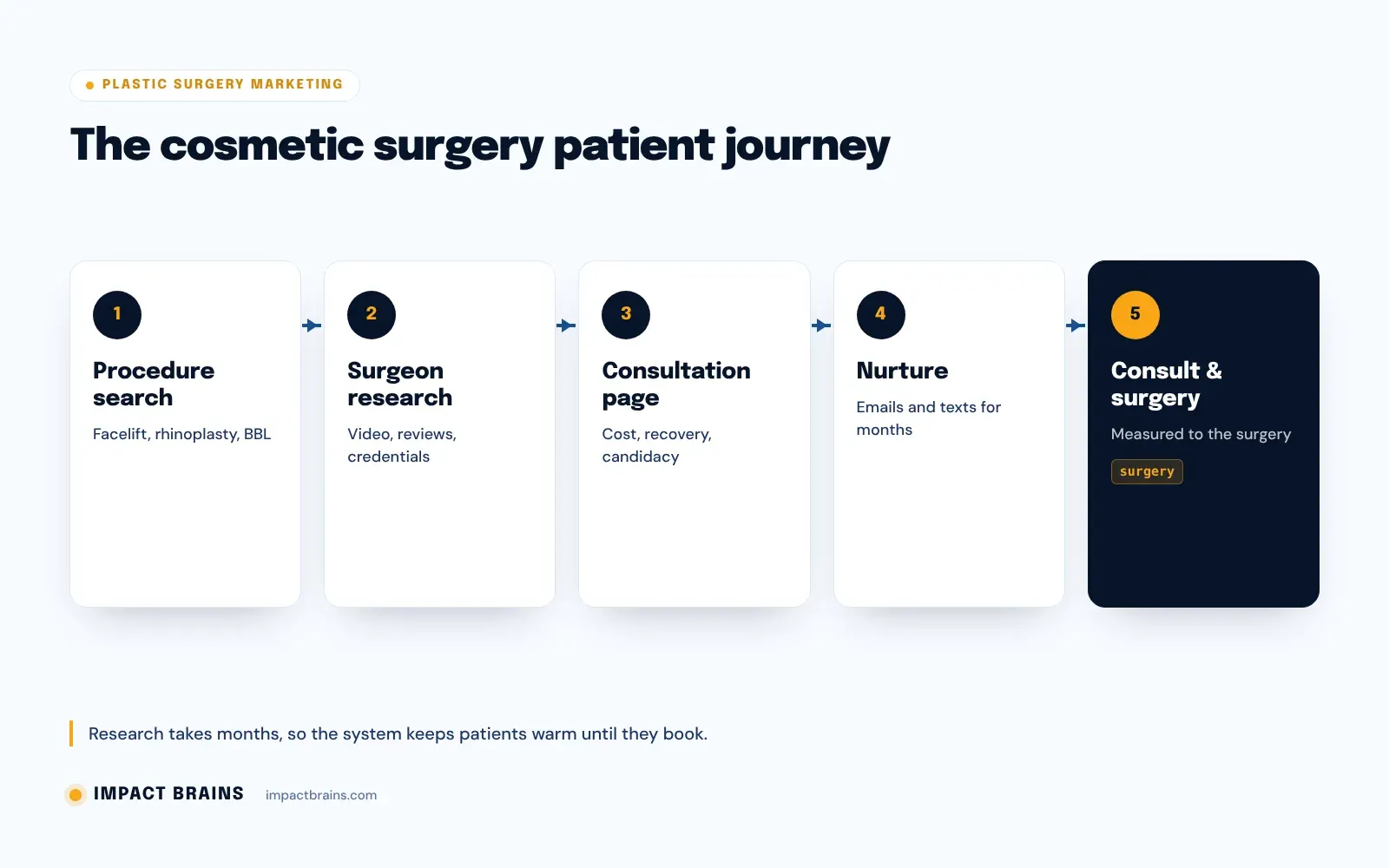
Plastic surgery patient journey: procedure search, surgeon research and video, consultation landing page, nurture emails and texts, booked consultation and surgery
The cosmetic surgery patient journey: research takes months, so the system keeps patients warm until they book.

Why practices choose Impact Brains

Most agencies sell plastic surgery practices a channel. We build and run the whole Patient Acquisition System with one senior team, and report cost per new patient.

  • Healthcare-literate leadership

    Dr. Muhammad Abdullah is a Doctor of Pharmacy with an MBA. Health claims, patient data and platform policy get a clinician’s care.

  • Measured to new patients

    Calls, forms, bookings and show-ups are tracked separately, so budget follows patients, not clicks.

  • Flat fee, no lock-in

    A flat monthly retainer, never a percentage of ad spend. A 90-day initial term, then month to month.

  • You own everything

    Ad accounts, analytics, Tag Manager, website and data stay in your name.

Every service shares the same tracking, the same team and the same monthly cost-per-new-patient review.

One plastic surgery practice per market

We work with one plastic surgery practice per market, so your procedures, keywords and creative stay yours. Check whether your city is open.

Check if my market is available 

Plastic surgery marketing questions, answered

How do plastic surgeons get more patients?

By being visible for procedure-specific searches, earning trust with surgeon-led education and reviews, converting on procedure landing pages, and nurturing research-mode patients until they are ready to book a consultation.

What is a good cost per consultation for plastic surgery?

It depends on procedure value and market. In our Washington, D.C. facial plastic surgery case, cost per conversion fell from $141.68 to $61.12 after a procedure-level rebuild.

Should a plastic surgeon use a landing page instead of the website?

For paid traffic, yes. Facelift prospects rarely convert on general service pages; a dedicated page answering cost, recovery and surgeon credentials converts better.

Does PPC work for plastic surgeons?

Yes, when campaigns are built by procedure, tracking separates calls, forms and booked consultations, and landing pages follow Google’s healthcare policies. That combination cut cost per conversion 57% in our D.C. case.

What should a plastic surgery marketing plan include?

Procedure priorities by value, a channel mix (search, SEO, video, Meta, nurture), a consultation page per procedure, tracking to booked consultations and surgeries, and a monthly review of cost per surgery.

Can plastic surgeons use before-and-after photos in ads?

On their own websites, with patient consent and honest presentation, yes. In social ads, Meta restricts before-and-after imagery for certain cosmetic procedures, so we use compliant formats such as surgeon education and patient-journey video.

Free patient growth audit

Get a free patient growth audit, reviewed by our senior team.

Tell us about your practice. Within two business days you’ll get a recorded walkthrough of where your ads, website, tracking or follow-up leak patients, and the three fixes that will move the numbers fastest. No pitch deck. No pressure.

  1. Tell us about your practiceTwo minutes. No patient information, ever.
  2. Get your recorded auditAds, Maps, website, tracking and follow-up, reviewed by our senior team.
  3. Decide with numbersA 90-day plan sized from your target cost per new patient. Keep it either way.
−57%cost per conversion for a Washington, D.C. facial plastic surgery practice in three months

Request your free patient growth audit

Three required fields. We’ll take it from there.

Free and no obligation. See our privacy policy. Please don’t include patient information.

Prefer to talk it through?

Book a 30-minute strategy call with our team, led by Dr. Muhammad Abdullah. Bring your numbers and your goals, and leave with a clear next step.