Skip to Content

Medical SEO · Patient Acquisition System

Medical SEO that brings patients, not just traffic.

Local map-pack rankings, procedure and condition pages, E-E-A-T content and AI-search visibility for doctors and practices, measured in calls, booking requests and new patients.

  • Flat monthly fee, never a % of spend
  • You own every account
  • No PHI in ad platforms
  • $7M+in ad spend managed
  • 50+GTM containers in 9 countries
  • Pharm.D+ MBA leadership on every system
60–120days to first ranking movementTypical for local and specialty terms, compounding over 6–12 months
How Impact Brains measures medical SEO: clicks become calls and forms (generate_lead), qualified inquiries, booked consultations, show-ups and new patients, each tracked as its own event without sending protected health information to ad platforms.

What is medical SEO?

Medical SEO, also called healthcare SEO or SEO for doctors, decides whether a patient who searches for your treatment finds your practice or the one down the street.

It now covers three surfaces: the classic results, the Google Maps pack and AI answers such as Google’s AI Overviews and ChatGPT. Our complete guide to medical SEO goes deeper; this page explains how we deliver it.

The short answer

Medical SEO is search engine optimization for healthcare providers. It improves a practice’s visibility in Google search, Google Maps and AI answers for the procedures and conditions it treats, using content that meets medical accuracy and E-E-A-T standards, so more patients find and book the practice.

  1. Local: Google Business Profile, reviews and location pages for “near me” searches.
  2. Content: procedure and condition pages written for patients and reviewed by your clinicians.
  3. Trust: author credentials, medical review dates and citations (E-E-A-T).
  4. Technical: speed, mobile usability, crawlability and medical schema.
  5. Measurement: organic calls, forms and bookings, tracked without PHI.

Patients research before they call

They compare practices on Google Maps, read reviews, ask AI assistants and watch videos before they book. Each step is a chance to be chosen, or skipped.

Most practice websites lose at the first step. The profile is incomplete, the procedure page is a paragraph, and nothing on the site tells Google or an AI assistant who reviewed the content.

  • Missing from the map pack

    Patients search “[treatment] near me” and see three competitors before they ever see your website.

  • Thin procedure pages

    One paragraph per treatment can’t answer cost, recovery and candidacy questions, so patients and Google look elsewhere.

  • Invisible to AI answers

    AI Overviews and ChatGPT cite practices with clear entity data, reviews and structured answers. Most sites have none.

What’s included in our healthcare SEO services

One senior team runs your local, content and technical SEO together, on a fixed monthly scope, and reports results in calls, booking requests and new patients.

  • Technical SEO and site speed

    Crawl and index fixes, mobile usability and Core Web Vitals so pages load fast on a patient’s phone.

  • Google Business Profile and map pack

    Categories, services, photos, posts and Q&A set up within Google’s profile guidelines, for the practice and each provider where eligible.

  • Procedure and condition pages

    Pages that answer cost, candidacy, recovery and risk questions in plain language, drafted by healthcare writers and reviewed by your clinicians.

  • E-E-A-T and medical review

    Author and reviewer boxes, credentials, review dates and citations, following Google’s helpful-content guidance.

  • Medical schema markup

    MedicalClinic or Dentist, Physician, MedicalProcedure, FAQ and VideoObject structured data so search engines understand who you are.

  • Review generation system

    Automated, compliant review requests after visits, with replies that never confirm a patient relationship.

  • AI Overview and ChatGPT visibility

    We track the prompts patients ask and whether AI answers cite your practice, then fix the gaps.

  • Monthly patient reporting

    Organic calls, forms and bookings by page and location, not just rankings and sessions.

Medical SEO vs. Google Ads: which should a practice start with?

Most practices need both, in sequence. Google Ads produce booked consultations within weeks while SEO builds; SEO then lowers your blended cost per new patient over six to twelve months as organic calls replace some paid clicks.

Medical SEO compared with healthcare Google Ads
FactorMedical SEOGoogle Ads
Speed to first results60–120 days for local and specialty termsTwo to four weeks after a clean launch
How you payFixed monthly retainerRetainer plus a cost per click
What happens if you stopRankings and pages keep working for monthsLeads stop the day spend stops
Best forMap pack, procedure research, AI answersHigh-value treatments and fast-filling calendars
Policy limitsContent must be accurate and reviewedAds and landing pages must follow Google’s healthcare policy
How we measure itOrganic calls, forms and bookingsCost per consultation and per new patient

Both channels report into the same tracking, so you can compare cost per new patient side by side.

Proof you can verify

We haven’t published a healthcare SEO case study yet, and we won’t invent one. Here is the closest verified proof: the same measurement stack every SEO engagement reports through.

50+
Closest proof · Measurement

50+ Google Tag Manager accounts across 9 countries

Including healthcare and wellness accounts such as a plastic surgery practice and a pharmacy, with 9 server-side containers, Meta Conversions API, call tracking and offline conversions.

Read the case study 
−57%
Closest proof · Facial plastic surgery

Facial plastic surgery practice, Washington, D.C.

Procedure-level Google Ads, a dedicated consult page and tracking that separated calls, forms and booked consults cut cost per conversion from $141.68 to $61.12 while conversions grew from 34 to 99.

Read the case study 

See all case studies 

Medical SEO done within the rules

Health content is YMYL: “your money or your life” information that Google holds to a higher standard. Every page we publish names its author and clinical reviewer, shows a review date and cites primary sources.

Reviews and local SEO carry privacy risk too. Review requests never include health details, and replies never confirm that a reviewer is a patient.

This is how we build. It is not legal advice; confirm your setup with your own counsel.

How HIPAA-aligned tracking works 

How compliance is built into every Patient Acquisition System
Rule or riskWhat we do
Medical accuracy (E-E-A-T)Clinician review before publishing; reviewer name and date on every procedure page.
Google Healthcare & medicines policyAd copy, keywords and landing pages reviewed before launch; certification handled for restricted categories.
Meta health & wellness rulesNo targeting by health condition and no copy that implies a viewer’s condition or negative self-perception.
HIPAA and online trackingNo pixels on authenticated pages; a server-side container strips identifiers; offline conversions send click IDs, not PHI.
Forms, chat and bookingHIPAA-eligible tools with a signed Business Associate Agreement, encrypted and access-controlled.
Reviews and testimonialsPatient consent on file, no PHI in replies, and FTC endorsement rules followed for any featured result.

How our medical SEO works, step by step

SEO is the M, for Media, in the IMPACT system, and it ships connected to your Pages and Attribution layers from day one.

  1. Insight

    Audit

    Weeks 1–2

    Technical crawl, Google Business Profile review, competitor map-pack analysis and a keyword map by treatment and location.

  2. Media

    Local foundation

    Weeks 2–4

    Profile categories, services, photos and citations fixed; review requests automated.

  3. Pages

    Procedure pages

    Months 1–3

    The highest-value treatment and condition pages rewritten or created, with clinician review and schema.

  4. Media

    Authority

    Months 2–6

    Digital PR, local partnerships and expert content that earn links and citations.

  5. Tuning

    AI visibility & reporting

    Monthly

    AI-answer tracking, content refreshes and a report of organic calls, bookings and new patients.

Most practices see meaningful ranking movement in 60–120 days, then compounding returns over six to twelve months.

See the full Patient Acquisition System 
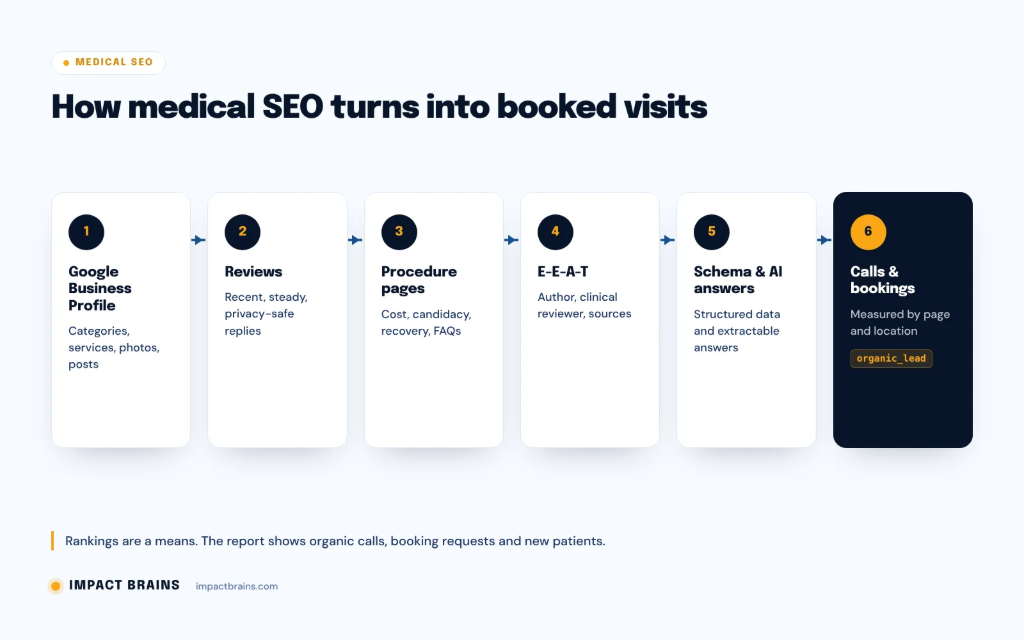
Diagram of the medical SEO system: Google Business Profile, reviews, procedure pages, E-E-A-T signals, medical schema and AI answers feeding calls and bookings
How medical SEO turns into booked visits: profile, reviews, procedure pages, trust signals and schema working together.

Why practices choose Impact Brains

Most SEO companies for doctors report rankings. We report patients, because the same team runs your tracking, your pages and your follow-up.

  • Healthcare-literate leadership

    Dr. Muhammad Abdullah is a Doctor of Pharmacy with an MBA, so clinical accuracy and patient privacy are part of the brief, not an afterthought.

  • Measured to patients

    Organic calls, forms and bookings are tracked by page and location, so SEO is judged on new patients.

  • Flat fee, no lock-in

    A flat monthly retainer, never a percentage of ad spend. A 90-day initial term, then month to month.

  • You own everything

    Ad accounts, analytics, Tag Manager, website and data stay in your name.

Each specialty gets its own keywords, landing pages, compliance notes and reporting.

Medical SEO questions, answered

What is medical SEO?

Medical SEO is search engine optimization for healthcare providers: improving a practice’s visibility in Google search, Google Maps and AI answers for the procedures and conditions it treats, with content that meets medical accuracy and E-E-A-T standards.

How much does SEO for doctors cost?

Medical SEO retainers vary with the number of locations, procedures and how competitive your market is. Most single-location practices invest a fixed monthly fee for six to twelve months. We quote a fixed scope after a free audit, never a percentage of anything.

How long does healthcare SEO take to work?

Most practices see meaningful movement in 60–120 days for local and specialty terms, with compounding returns over six to twelve months. Google Business Profile fixes and procedure pages usually move first; competitive cities take longer.

Do you write medical content?

Yes. Writers with healthcare experience draft patient-friendly content, and your clinicians review it for accuracy before publishing. Every page shows the author, the reviewer and the review date.

Is local SEO or content SEO more important for a medical practice?

For most practices, local SEO comes first, because “near me” and city searches convert fastest. Content SEO then wins the research stage, where patients compare treatments, costs and recovery before choosing a provider.

How do you get a practice into Google’s AI Overviews and ChatGPT?

AI answers cite sources that are easy to extract and trust: clear direct answers, consistent practice details across the web, reviews, author credentials and structured data. We build those signals and track which prompts mention your practice.

Can medical SEO work alongside Google Ads?

Yes, and it should. Ads fill the calendar while SEO builds, and shared tracking shows which search terms deserve paid budget and which you already win organically.

Do you guarantee first-page rankings?

No. No one controls Google’s rankings, and guarantees are a warning sign. We commit to a fixed scope, transparent reporting and measurable movement in calls and bookings.

Free patient growth audit

Get a free patient growth audit, reviewed by our senior team.

Tell us about your practice. Within two business days you’ll get a recorded walkthrough of where your ads, website, tracking or follow-up leak patients, and the three fixes that will move the numbers fastest. No pitch deck. No pressure.

  1. Tell us about your practiceTwo minutes. No patient information, ever.
  2. Get your recorded auditAds, Maps, website, tracking and follow-up, reviewed by our senior team.
  3. Decide with numbersA 90-day plan sized from your target cost per new patient. Keep it either way.
−57%cost per conversion for a Washington, D.C. facial plastic surgery practice in three months
Request your free patient growth audit

Three required fields. We’ll take it from there.

Free and no obligation. See our privacy policy. Please don’t include patient information.

Prefer to talk it through?

Book a 30-minute strategy call with our team, led by Dr. Muhammad Abdullah. Bring your numbers and your goals, and leave with a clear next step.

Loading the booking calendar…
If it doesn’t appear, open the calendar in a new tab.