Skip to Content

Telehealth & D2C health marketing · Patient Acquisition System

Telehealth marketing built on compliance, then scaled.

HIPAA-aligned intake and landing pages, server-side tracking without PHI, policy-safe creative and subscription retention, built as one system for telehealth and D2C health programs.

  • Flat monthly fee, never a % of spend
  • You own every account
  • No PHI in ad platforms
  • 3HIPAA-aligned telehealth builds
  • 100%online intake, GLP-1 program
  • 0PHI fields sent to ad platforms by design
100%online intakeGLP-1 weight-loss program, HIPAA-aligned landing page
A telehealth acquisition funnel: clicks become started and completed intakes, provider approvals, first orders and retained subscribers, each measured with server-side events that carry no protected health information.

Can telehealth companies advertise on Google and Meta?

Telehealth acquisition fails in a predictable order: the ad account gets restricted, the intake form leaks data into a pixel, or the unit economics collapse because nobody tracked retention.

We build the compliance layer first, because every dollar of ad spend depends on it.

The short answer

Yes, but prescription-drug offers usually require LegitScript certification and platform approval, ads cannot target by health condition, and intake flows must keep PHI out of ad-platform pixels. Telehealth brands outside HIPAA can still fall under the FTC’s Health Breach Notification Rule.

  1. Certify first: LegitScript and platform approval for prescription and pharmacy offers.
  2. Build compliant intake: HIPAA-aligned forms, consent and eligibility steps.
  3. Track without PHI: server-side events and click IDs only.
  4. Write policy-safe creative: no condition targeting, no unsupported claims.
  5. Retain subscribers: onboarding and refill flows that protect lifetime value.

Why telehealth and D2C health brands call us

Telehealth is crowded, regulated and fast-moving. Most programs we audit are stuck at one of three blockers, and none of them is the ad creative.

Premier Metabolic & Men’s Health Care came to us with the first blocker. We rebuilt three landing pages around HIPAA-aligned intake so they could advertise.

  • Compliance blocks ad spend

    Accounts are restricted or disapproved before campaigns can learn.

  • Intake forms leak PHI

    Pixels on eligibility and intake pages send health details to ad platforms.

  • Acquisition costs keep rising

    Competitors flood the category; without retention data, scaling looks unprofitable.

The Telehealth Patient Acquisition System

Compliance infrastructure first, then performance creative and retention.

  • HIPAA-aligned intake and landing pages

    Eligibility, consent and intake built on HIPAA-eligible tools, with physician-led positioning.

  • Policy review and certification

    LegitScript and platform approvals handled where required before any spend.

  • Server-side tracking without PHI

    Server-side events with redaction, plus offline conversions for approvals and first orders.

  • Performance creative for Meta and Google

    Discretion-first, policy-safe concepts tested weekly.

  • Subscription retention flows

    Onboarding, refill reminders and win-back sequences that protect lifetime value.

  • AI-search visibility (AEO)

    Structured answers and entity data so assistants such as ChatGPT can find and cite your program (what AEO means).

Telehealth programs we market

Each program gets its own compliance review, intake design and creative.

  • GLP-1 & medical weight loss
  • Men’s health & ED
  • Hair loss
  • Women’s health & hormones
  • Testosterone therapy
  • Dermatology & skincare
  • Mental health
  • Sleep
  • Primary & urgent virtual care
  • Longevity & wellness
  • Lab testing
  • Subscriptions & bundles

What does a telehealth company need before running ads?

Before spending on ads, a telehealth program needs the certifications its offer requires, a HIPAA-aligned intake flow, tracking that never sends PHI to ad platforms, reviewed claims, and clear pricing and subscription terms. Skipping any of these is the most common reason accounts get restricted.

Telehealth launch requirements before paid advertising
RequirementWhy it mattersWho needs it
LegitScript certificationRequired by Google and Meta for many prescription and addiction-treatment offersPrograms prescribing or dispensing medication
HIPAA-aligned intakeIntake collects PHI; tools need a BAA and encryptionCovered entities and their business associates
PHI-free trackingPixels on intake pages can disclose health dataEvery telehealth program that advertises
Health Breach Notification RuleThe FTC rule covers many health apps outside HIPAAD2C health brands not covered by HIPAA
Claims reviewCompounded medications are not FDA-approved; claims must not imply they areGLP-1 and compounded-medication programs
Pricing and subscription termsClear pricing and cancellation reduce complaints and chargebacksSubscription and membership programs

Summary for marketing planning, not legal advice. Confirm your program’s obligations with counsel.

Telehealth builds you can inspect

Three Premier Metabolic & Men’s Health Care landing pages where compliance was the blocker, plus the tracking portfolio behind them.

HIPAA
Telehealth · Landing page

Premier Metabolic & Men’s Health Care: GLP-1 + ED bundle

The old site couldn’t collect patient intake safely, which blocked paid ads. We rebuilt the page around HIPAA-aligned intake and physician-led consent, so compliant ad spend could launch.
Read the case study 
100%
Telehealth · GLP-1 program

GLP-1 weight-loss program with fully online intake

A HIPAA-aligned landing page with 100% online patient intake, transparent pricing and physician-led positioning, built so the program could advertise without the compliance risk that had blocked it.

Read the case study 
Async
Telehealth · Men’s health

Discretion-first men’s health landing page

Compliant intake architecture with trust markers at the point of submission and messaging built around the confidentiality this buyer needs before converting.

Read the case study 
50+
Tracking · 12+ industries

50+ Google Tag Manager accounts across 9 countries

Including healthcare and wellness accounts such as a plastic surgery practice and a pharmacy, with 9 server-side containers, Meta Conversions API, call tracking and offline conversions.

Read the case study 

See all case studies 

Compliance notes

Telehealth sits at the intersection of HIPAA, FTC rules, state licensure, prescription-drug advertising and platform policy. We design for all of them before launch.

We also screen programs before taking them on. If an offer can’t be advertised compliantly, we will tell you, and we won’t run it.

This is how we build. It is not legal advice; confirm your setup with your own counsel.

How HIPAA-aligned tracking works 

How compliance is built into every Patient Acquisition System
Rule or riskWhat we do
Prescription offersLegitScript certification and platform approval before launch.
State licensureAvailability messaging matches the states where providers are licensed.
Google Healthcare & medicines policyAd copy, keywords and landing pages reviewed before launch; certification handled for restricted categories.
Meta health & wellness rulesNo targeting by health condition and no copy that implies a viewer’s condition or negative self-perception.
HIPAA and online trackingNo pixels on authenticated pages; a server-side container strips identifiers; offline conversions send click IDs, not PHI.
Forms, chat and bookingHIPAA-eligible tools with a signed Business Associate Agreement, encrypted and access-controlled.
Reviews and testimonialsPatient consent on file, no PHI in replies, and FTC endorsement rules followed for any featured result.
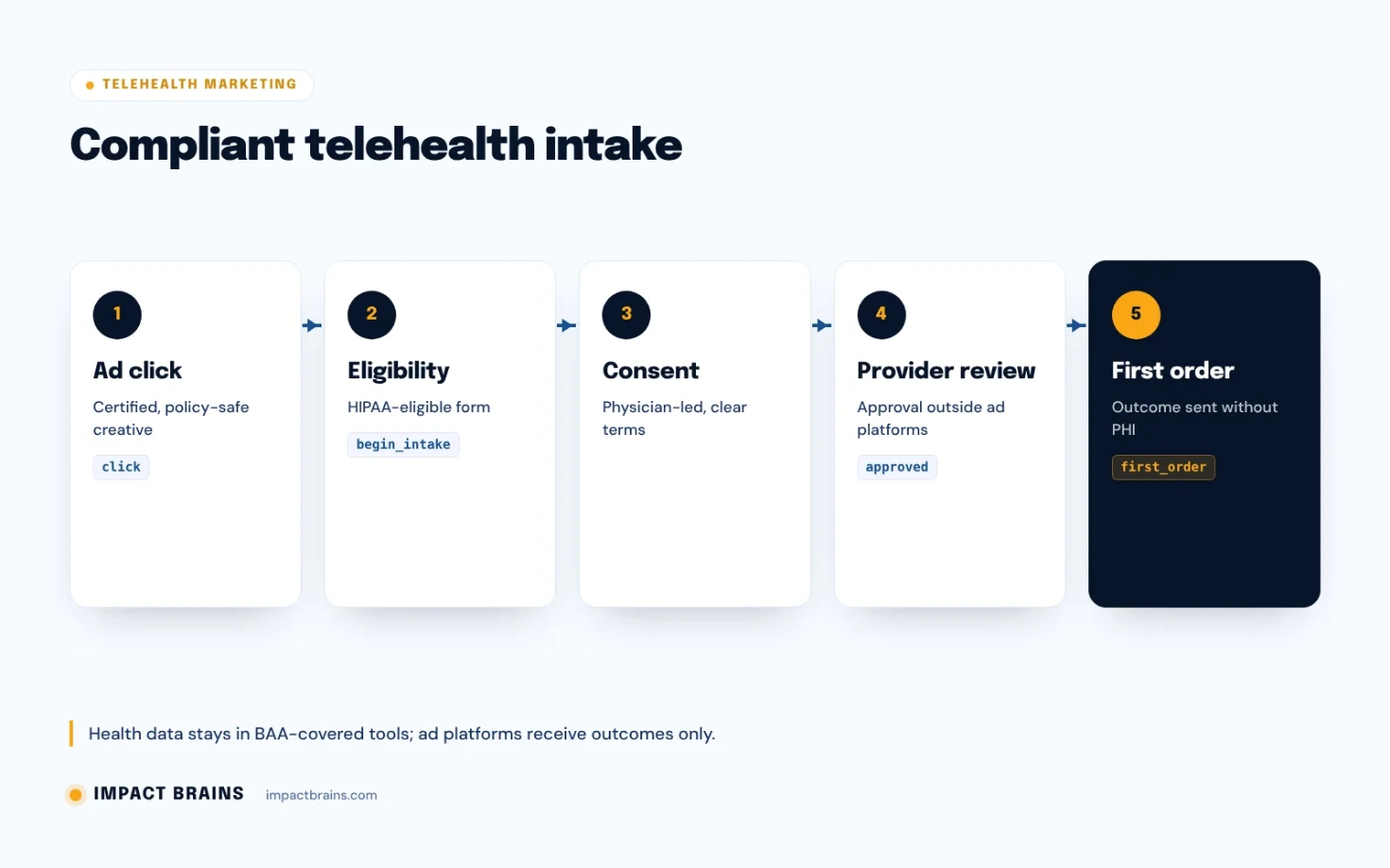
Telehealth compliant intake flow: ad click, landing page, eligibility questions on a HIPAA-eligible form, consent, provider review and first order, with server-side events that exclude PHI
Compliant telehealth intake: health data stays in BAA-covered tools; ad platforms receive outcomes only.

Why practices choose Impact Brains

Most agencies sell telehealth practices a channel. We build and run the whole Patient Acquisition System with one senior team, and report cost per new patient.

  • Healthcare-literate leadership

    Dr. Muhammad Abdullah is a Doctor of Pharmacy with an MBA. Health claims, patient data and platform policy get a clinician’s care.

  • Measured to new patients

    Calls, forms, bookings and show-ups are tracked separately, so budget follows patients, not clicks.

  • Flat fee, no lock-in

    A flat monthly retainer, never a percentage of ad spend. A 90-day initial term, then month to month.

  • You own everything

    Ad accounts, analytics, Tag Manager, website and data stay in your name.

Every service shares the same tracking, the same team and the same monthly cost-per-new-patient review.

One telehealth program per treatment category

We work with one telehealth program per treatment category, so your creative and funnels stay yours. Check availability for your category.

Check if my market is available 

Telehealth marketing questions, answered

Can telehealth companies advertise on Google and Meta?

Yes, but prescription-drug offers usually require LegitScript certification and platform approval, and ads cannot target by health condition. Intake flows must keep PHI out of ad-platform pixels.

What is a telehealth marketing agency?

A telehealth marketing agency builds and runs patient acquisition for virtual care programs: compliant landing pages and intake, paid search and social, tracking without PHI, and retention flows for subscription programs.

Does HIPAA apply to D2C health brands?

It depends on whether the brand is a covered entity or business associate. Many D2C health apps aren’t covered by HIPAA but fall under the FTC’s Health Breach Notification Rule and state health-privacy laws.

How do you track telehealth conversions without PHI?

Through server-side tracking that removes identifiers and health details, and offline conversions that send approvals and first orders to ad platforms with click IDs and timestamps only.

What makes a telehealth website design convert?

A clear eligibility path, physician-led positioning, transparent pricing, discretion where the treatment is sensitive, trust markers at the point of submission and a short, HIPAA-aligned intake.

Can you market compounded GLP-1 programs?

Only with careful claims review. Compounded medications are not FDA-approved, so ads and pages must not imply they are, and prescription offers need the certifications each platform requires. We screen these programs before taking them on.

Free patient growth audit

Get a free patient growth audit, reviewed by our senior team.

Tell us about your practice. Within two business days you’ll get a recorded walkthrough of where your ads, website, tracking or follow-up leak patients, and the three fixes that will move the numbers fastest. No pitch deck. No pressure.

  1. Tell us about your practiceTwo minutes. No patient information, ever.
  2. Get your recorded auditAds, Maps, website, tracking and follow-up, reviewed by our senior team.
  3. Decide with numbersA 90-day plan sized from your target cost per new patient. Keep it either way.
3HIPAA-aligned telehealth landing pages built for Premier Metabolic & Men’s Health Care

Request your free patient growth audit

Three required fields. We’ll take it from there.

Free and no obligation. See our privacy policy. Please don’t include patient information.

Prefer to talk it through?

Book a 30-minute strategy call with our team, led by Dr. Muhammad Abdullah. Bring your numbers and your goals, and leave with a clear next step.

Loading the booking calendar…
If it doesn’t appear, open the calendar in a new tab.