Premier Metabolic & Men’s Health Care: GLP-1 + ED bundle
The old site couldn’t collect patient intake safely, which blocked paid ads. We rebuilt the page around HIPAA-aligned intake and physician-led consent, so compliant ad spend could launch.
Medical website design · Patient Acquisition System
Trust-first design, procedure and provider pages, HIPAA-aligned booking and intake, and a mobile speed budget, built for patients, for Google and for the ads that send them.
Patients decide in seconds. If your site is slow, generic or hard to book on a phone, they go back to Google and pick the next practice.
Healthcare website design is not decoration. It is the Pages layer of your Patient Acquisition System: the place where search, ads and referrals either become appointments or leak away.
A medical website needs a clear homepage, provider bios with credentials, one page per procedure or condition, insurance and financing information, location pages, reviews, patient resources and an easy booking or contact path on every page, all fast, accessible and secure on mobile.
Most medical websites are built to look finished, not to make the next step obvious. They load slowly on mobile, bury the booking path and collect intake details on tools that were never meant to hold patient information.
The next page in our launch standard fixes each one. For the deeper version, read why clinic websites get traffic but no appointments.
A slow first screen sends patients straight back to the search results, and it raises what you pay per click.
Stock photos and copy that could belong to any practice give patients no reason to trust you over the next one.
Free form tools without a BAA, ten required fields and no phone option lose patients and add risk.
Every build covers strategy, design, development, SEO, tracking and launch, on a fixed scope agreed before work starts. You own the site, the code and every account.
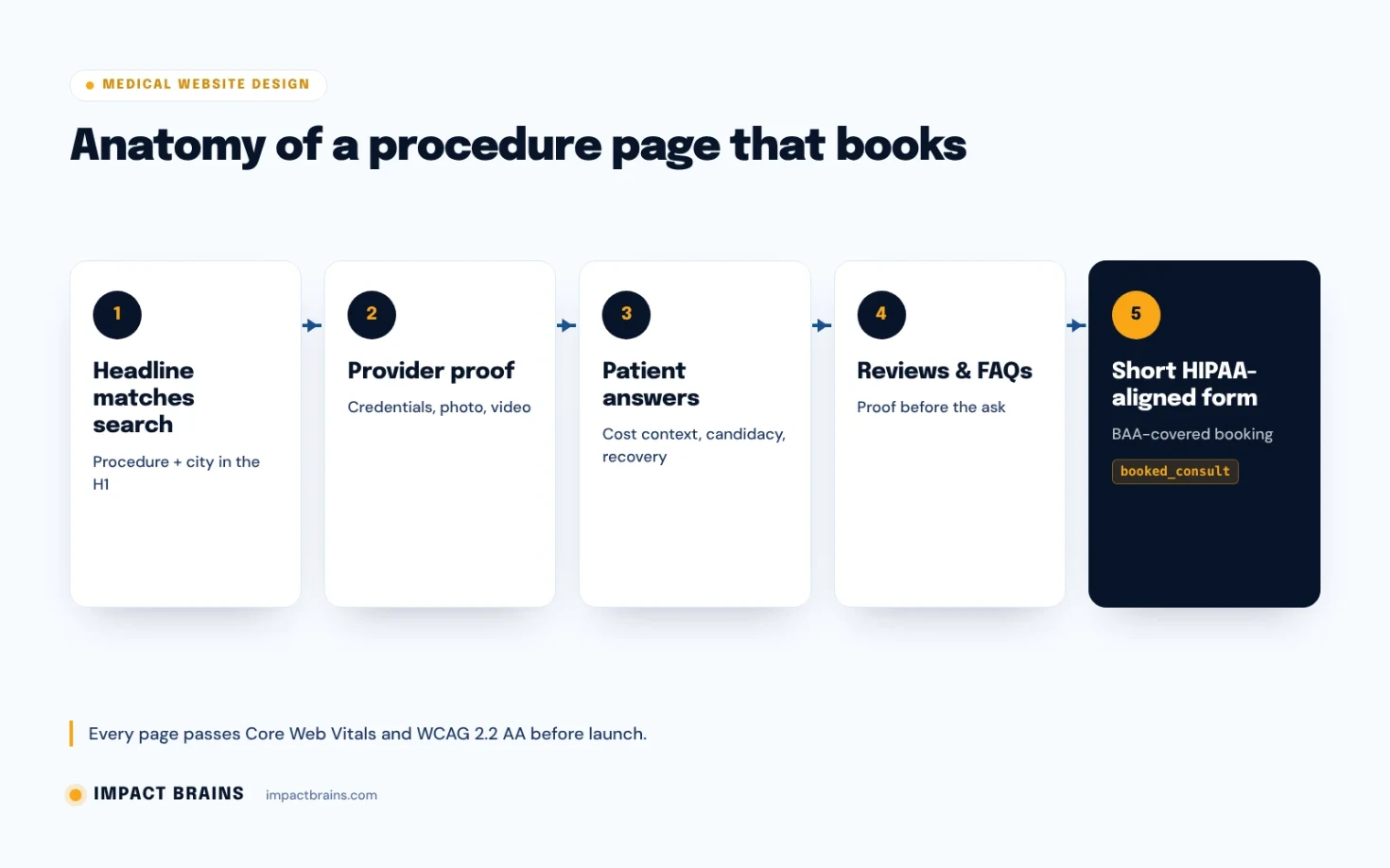
Pages planned around three moves (find, trust, book) for each treatment you want more of.
Structured to answer cost, candidacy and recovery questions, with clinician review and credentials.
Booking and intake on HIPAA-eligible tools with a signed Business Associate Agreement.
WCAG 2.2 AA as our build standard: contrast, focus states, labels, captions and heading order.
Every page must pass Google’s Core Web Vitals on mobile before launch.
MedicalClinic, Physician and FAQ schema, plus a 301 map for every old URL so rankings carry over.
Patient consent on file, consistent lighting and angles, and no promised outcomes.
Calls, forms and bookings tracked as conversions, without sending health information to ad platforms.
A professionally built medical practice website typically ranges from a few thousand dollars for a template-based build to $15,000+ for a custom, multi-location or telehealth site. Cost depends on page count, integrations such as booking and intake, and how much content needs writing and clinical review.
| Project type | Typical investment | Timeline | Best for |
|---|---|---|---|
| Template-based practice site | From $1,000; booking and intake integrations quoted separately | 3–4 weeks | Single-location practices that need a fast, credible site |
| Custom practice website | Fixed quote within 48 hours of discovery | 5–8 weeks | Practices competing on elective procedures and SEO |
| Multi-location or telehealth platform | Scoped per project | 8–12 weeks | Groups, DSOs and online-first programs with intake flows |
Every quote is fixed scope and fixed price. Content writing, photography and clinical review are itemized, never hidden.
“Fast”, “accessible” and “HIPAA-aligned” mean nothing without numbers. These are the checks every Impact Brains healthcare build must pass before it goes live.
Accessibility is also a compliance issue. HHS’s Section 504 rule requires recipients of HHS federal financial assistance to meet WCAG 2.1 AA; an interim final rule in May 2026 moved the deadline to May 11, 2027 for organizations with 15 or more employees and May 10, 2028 for smaller ones.
Speed thresholds follow Google’s Core Web Vitals “good” ratings at the 75th percentile.
| Check | Launch requirement |
|---|---|
| Largest Contentful Paint (LCP) | Under 2.5 s on mobile; our target is under 2.0 s |
| Interaction to Next Paint (INP) | Under 200 ms |
| Cumulative Layout Shift (CLS) | Under 0.1 |
| Accessibility | WCAG 2.2 AA: contrast, focus states, form labels, captions, heading order |
| Forms and booking | HIPAA-eligible tools with a signed BAA; encryption in transit and at rest |
| Tracking | No ad pixels on intake or patient-portal pages; server-side events without PHI |
| Structured data | Medical schema that passes Google’s Rich Results Test |
| SEO migration | Every old URL 301-redirected; titles, metadata and schema preserved |
Three HIPAA-aligned telehealth pages for Premier Metabolic & Men’s Health Care, plus our strongest landing-page result outside healthcare.
The old site couldn’t collect patient intake safely, which blocked paid ads. We rebuilt the page around HIPAA-aligned intake and physician-led consent, so compliant ad spend could launch.
A HIPAA-aligned landing page with 100% online patient intake, transparent pricing and physician-led positioning, built so the program could advertise without the compliance risk that had blocked it.
Compliant intake architecture with trust markers at the point of submission and messaging built around the confidentiality this buyer needs before converting.
Outside healthcare, but the same build standard: a dedicated page with authority-first proof and a qualifying form cut cost per conversion from $74.55 to $8.05 and lifted conversion rate more than 6×.
Website design is the P, for Pages, in the IMPACT system, so your site launches already connected to your ads, tracking and follow-up.
Current-site, analytics and competitor review; the treatments and locations that matter most.
Wireframes for the patient journey, then high-fidelity design you approve page by page.
Fast, accessible development with booking and HIPAA-aligned intake integrated.
QA against the launch standard, tracking, schema, 301 redirects and handover.
Heatmaps and A/B tests on booking pages, reviewed against appointments, not pageviews.
Template-based sites launch in 3–4 weeks; custom practice sites in 5–8; multi-location and telehealth platforms in 8–12.
See our web design & development service
Most web design companies hand over a site. We hand over a site that is already connected to your ads, tracking and follow-up, and measured in appointments.
Your site ships wired to Google Ads, GA4 and your CRM, so every page is judged by bookings.
Dr. Muhammad Abdullah is a Doctor of Pharmacy with an MBA, so claims, consent and privacy are designed in.
A fixed quote within 48 hours of discovery and a launch date you can plan around.
Ad accounts, analytics, Tag Manager, website and data stay in your name.
Each specialty gets its own keywords, landing pages, compliance notes and reporting.
Facelift, rhinoplasty, blepharoplasty and body contouring.
Plastic surgery marketingCompliant acquisition for GLP-1, men’s health and subscriptions.
Telehealth marketingTrust-first marketing for families making long decisions.
Home care marketingCentral strategy with cost per new patient by location.
Multi-location marketingLegitScript-first launch plans and ethical admissions marketing.
Behavioral health marketingA professionally built medical practice website typically ranges from a few thousand dollars for a template-based build to $15,000+ for a custom, multi-location or telehealth site. Cost depends on pages, integrations like booking and intake, and content. We send a fixed quote within 48 hours of a discovery call.
If the site collects protected health information through forms, chat or booking, those tools must be HIPAA-eligible with a signed BAA, and the data must be encrypted and access-controlled. A brochure page alone doesn’t hold PHI, but tracking on intake pages can still expose it.
A homepage, provider bios with credentials, a page per procedure or condition, insurance and financing, locations, reviews, patient resources and an easy booking or contact path on every page.
Template-based practice sites launch in three to four weeks, custom practice websites in five to eight weeks, and multi-location or telehealth platforms in eight to twelve weeks, depending on content and integrations.
Accessibility is expected of healthcare websites, and organizations that receive HHS federal financial assistance must meet WCAG 2.1 AA under the Section 504 rule, with deadlines in 2027 and 2028 depending on size. We build to WCAG 2.2 AA by default.
The one your team can run after launch. WordPress or Webflow suit content-led practice sites, Odoo suits practices that run Odoo for operations, and multi-location or telehealth platforms often need a custom build. HIPAA-eligible booking and intake matter more than the builder.
Not if the migration is planned. We map every existing URL to its new home with 301 redirects and preserve titles, metadata and structured data, then monitor rankings and Search Console after launch.
Free patient growth audit
Tell us about your practice. Within two business days you’ll get a recorded walkthrough of where your ads, website, tracking or follow-up leak patients, and the three fixes that will move the numbers fastest. No pitch deck. No pressure.
Three required fields. We’ll take it from there.
Free and no obligation. See our privacy policy. Please don’t include patient information.
Book a 30-minute strategy call with our team, led by Dr. Muhammad Abdullah. Bring your numbers and your goals, and leave with a clear next step.
Loading the booking calendar…
If it doesn’t appear, open the calendar in a new tab.