The Essential Email Flows Every Store Needs in 2026
70% of shopping carts are abandoned. $4 trillion in potential e-commerce revenue evaporates globally every year. The stores recovering that lost revenue aren't doing anything magical — they've just set up the right automated email flows. This is your complete implementation guide.
Why Email Flows Outperform Broadcasts
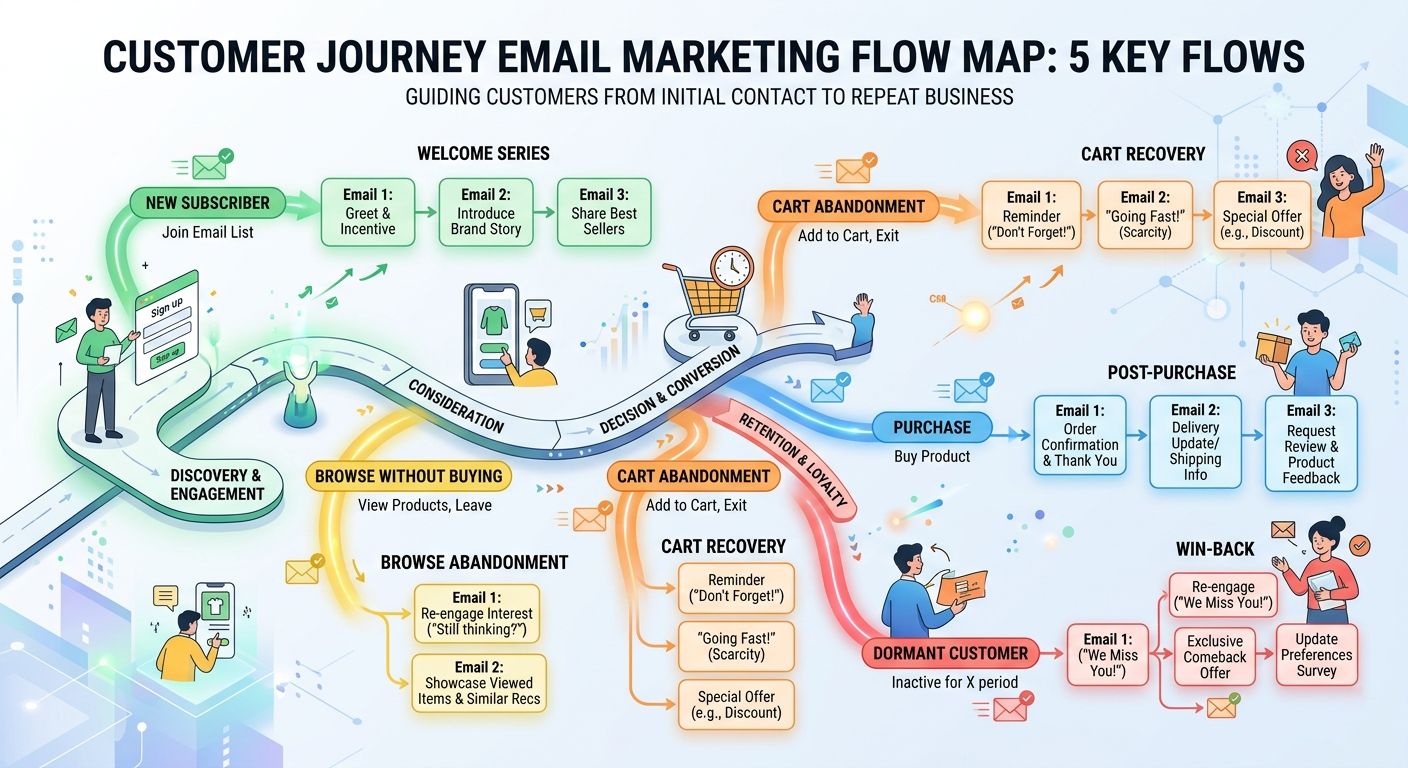
Most e-commerce stores think about email marketing as "sending campaigns" — newsletters, promos, product launches. These are valuable, but they're broadcast messages sent to everyone at once. Email flows are different: they're triggered by a specific action the customer takes, delivered at the moment of highest intent.
A welcome email sent the instant someone subscribes converts at 5–10× the rate of a promotional blast sent the following week. Why? Because intent is perishable. Timing is everything.
Flows (Automations): Triggered by customer behaviour — subscription, cart addition, purchase, inactivity. Always-on, always relevant, always personalised. Campaigns: Manually scheduled broadcasts — newsletters, sale announcements, product launches. Valuable but untargeted by comparison.
📧 Got a store but no email flows set up? Let's audit what you're leaving on the table.
Get a Free Email Audit →Flow 1 — The Welcome Series
Triggered the moment someone joins your list or creates an account. This is your virtual handshake — your first and best opportunity to set expectations, build trust, and guide your new subscriber toward their first purchase. Welcome emails generate the highest open rates of any email type, often exceeding 50%.
Subject Line Examples That Work
If your signup form captures how the subscriber found you (Instagram, Google, referral) — use that data to personalise Email 1. Someone who came from an Instagram ad about skincare products should not get the same Email 1 as someone who signed up from a homepage pop-up.
Flow 2 — The Abandoned Cart Recovery
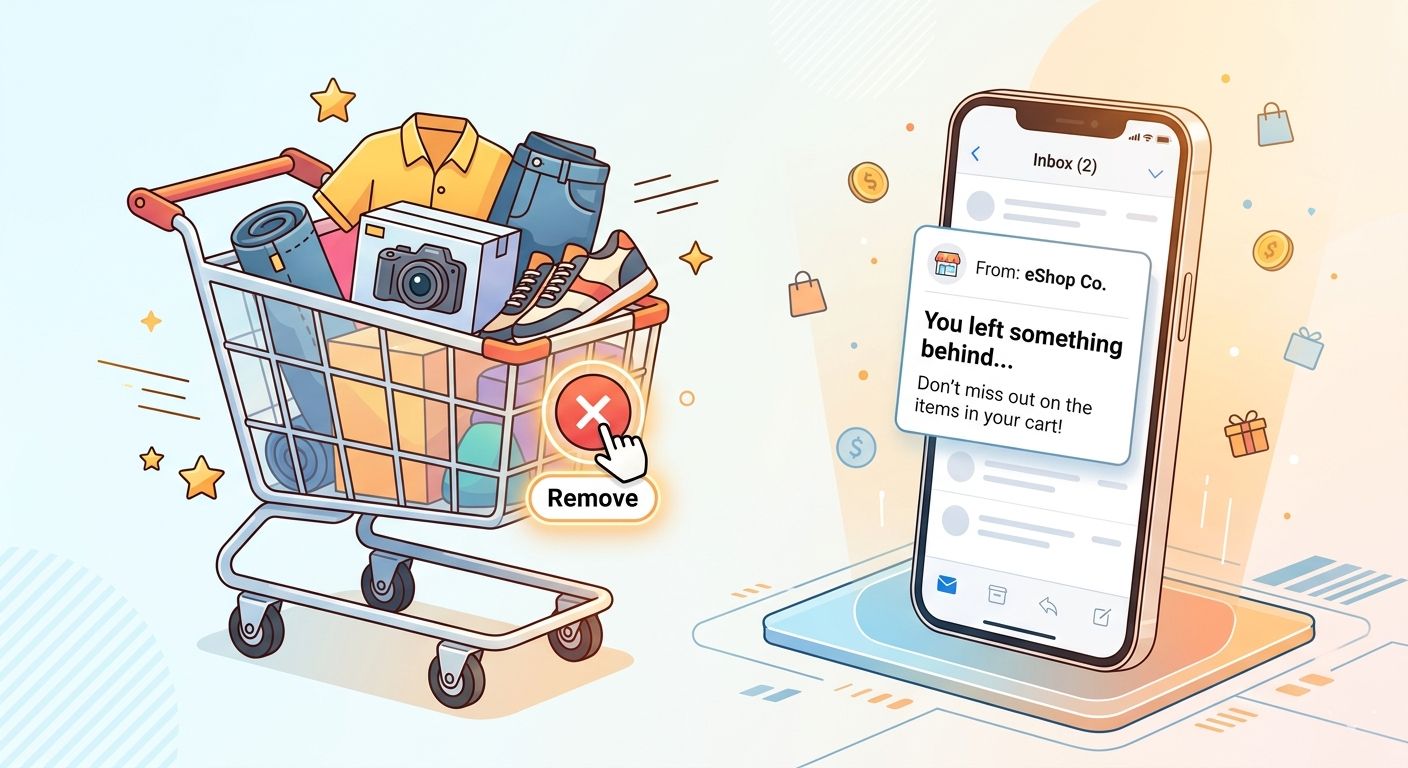
Abandoned cart emails recover the highest revenue of any email flow — earning back 3.33% of all lost sales with an average revenue per recipient of $3.65. Multiply that across thousands of abandoned carts per year and the numbers become significant. A three-email sequence is the industry standard, timed strategically to catch the customer at different decision points.
What Makes Each Email Work
- Email 1 (1 hour): Show the exact product image + name. Address the shopper by first name. One CTA: "Complete Your Order". No discount — you don't know why they left yet.
- Email 2 (24 hours): Lead with social proof — "2,400 customers trust [Product Name]" + star ratings. Address common objections (returns policy, delivery speed).
- Email 3 (72 hours): Create urgency: "Only 3 left in stock" or a time-limited 10% discount. Make it clear this is the final reminder.
70% of Your Shoppers Are Leaving Without Buying
We'll build your abandoned cart flow from scratch — copy, design, segmentation, and platform setup included. Most clients see positive ROI within the first 30 days.
Set Up My Cart Recovery →Flow 3 — The Post-Purchase Experience
The transaction doesn't end at purchase. The post-purchase window (the first 7–14 days after buying) is the highest-trust moment in the entire customer relationship. Use it to reduce buyer's remorse, set expectations, deliver value, and plant the seed for a repeat purchase — because your second sale is 60–70% cheaper to acquire than the first.
- Order confirmation: More than a receipt — reaffirm their excellent decision. Show what to expect next. Include a "refer a friend" link for a bonus credit.
- Shipping/usage: Tracking info + 2–3 tips to get the best result from their purchase. This reduces "where is my order?" support tickets.
- Education email: A piece of genuinely useful content about the product — this builds brand authority and emotional connection.
- Review + upsell: Ask for a review (with a direct link to your review platform) and recommend a complementary product they're likely to love based on what they bought.
Flow 4 — The Browse Abandonment Flow
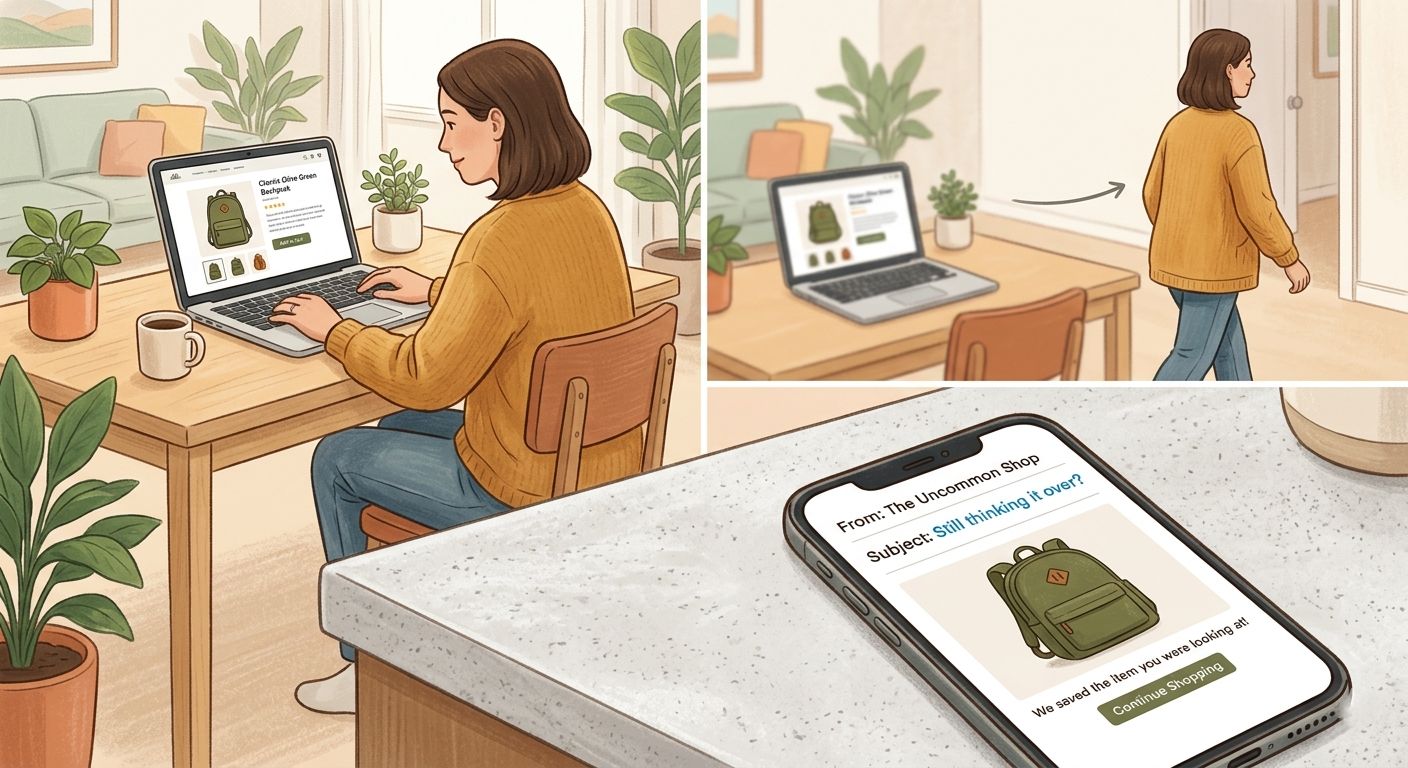
Most stores focus entirely on cart abandonment and miss the earlier stage: customers who viewed a product page with clear intent but never added to cart. These are warm leads who showed genuine interest. Browse abandonment emails are less urgent than cart recovery but far better than silence — and they have the advantage of zero purchase commitment to overcome.
Your Email 1 should include the exact product image, name, and price they viewed. Adding 2–3 "you might also like" recommendations based on that product's category significantly lifts click rates. Klaviyo and Omnisend both support this natively with dynamic product blocks.
🔥 Ready to turn window shoppers into buyers? We'll build your browse abandonment flow this week.
Get Started →Flow 5 — The Win-Back Campaign
Subscribers who haven't engaged in 90–180 days aren't just lost revenue — they're also hurting your sender reputation and deliverability. A win-back flow has two goals: re-engage the customers worth keeping, and gracefully sunset the rest to protect your list quality and inbox placement rates.
If a subscriber doesn't open or click after all three win-back emails, remove them from your main list (or move to a suppression list). Emailing unengaged contacts tanks your deliverability and can get your domain flagged as spam — costing you inbox placement with your active subscribers.
Platform Comparison: Which Tool to Use
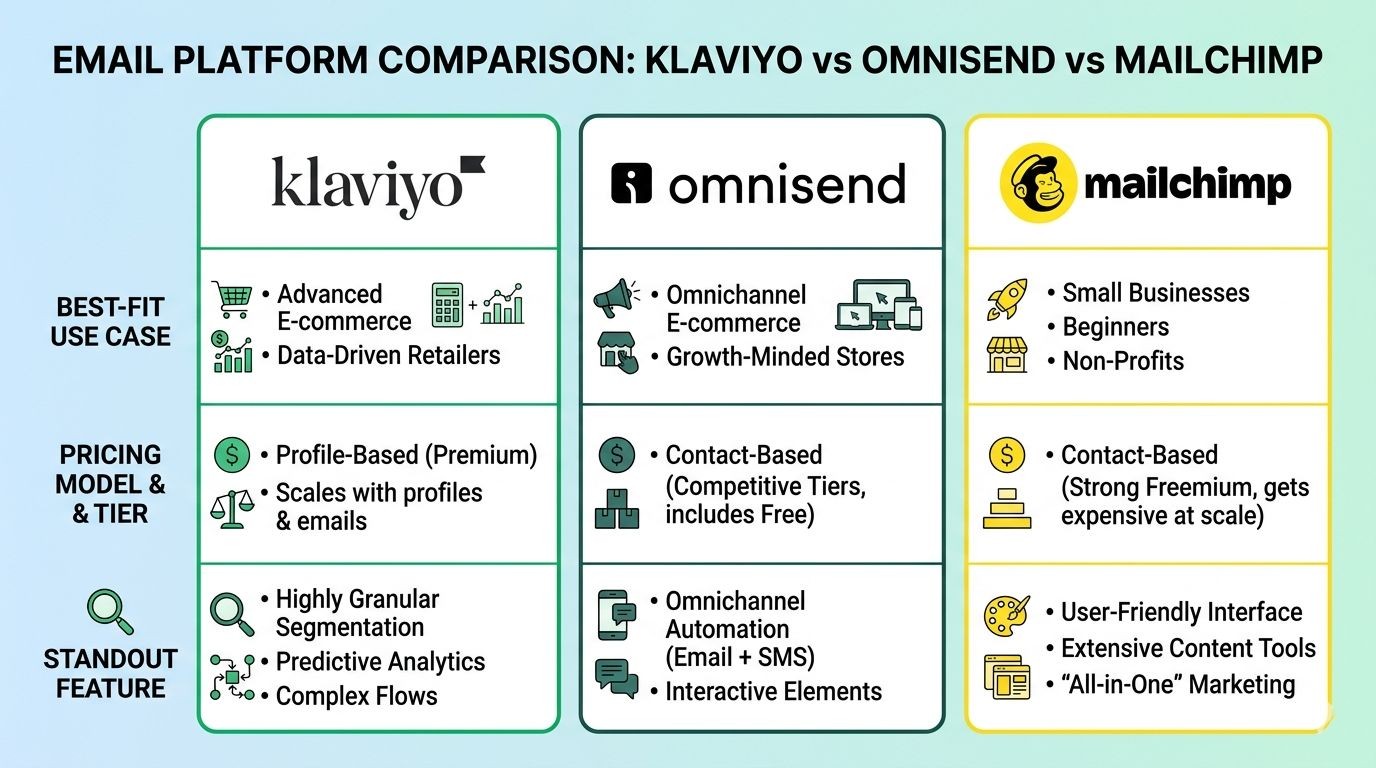
| Platform | Best For | Key Strength | Starting Price |
|---|---|---|---|
| Klaviyo | Mid-to-large e-commerce stores ($50K+ annual revenue) | Deep Shopify/WooCommerce integration, predictive analytics, best-in-class segmentation | Free up to 500 contacts, then ~$20/mo |
| Omnisend | Growing stores wanting SMS + email in one platform | SMS + email + push notifications combined, simpler UI than Klaviyo | Free up to 500 emails/mo, then ~$16/mo |
| Mailchimp | Brand-new stores with a very limited budget | Widely known, very easy to set up, decent free tier | Free up to 500 contacts, then ~$13/mo |
| ActiveCampaign | Service businesses or stores with complex automations | Most powerful automation builder, CRM integration, lead scoring | From ~$15/mo |
If you're on Shopify and generating more than $10K/month — go Klaviyo. The depth of customer data and segmentation capabilities available pays for itself within the first automated flow. For stores below that threshold or needing SMS built-in from day one — Omnisend is the better value play.
Flow Implementation Checklist
Use this to track your email automation build-out. Set it up in priority order — flows 1 and 2 generate the majority of automated revenue.
Click each item as you complete it.
Frequently Asked Questions
Your Flows Should Be Earning While You Sleep
ImpactBrains builds and manages email automation for e-commerce stores — from platform setup and flow architecture to copy, design, and ongoing A/B testing. Most clients see positive ROI from their flows within the first month.
The Essential Email Flows Every Store Needs in 2026
70% of shopping carts are abandoned. $4 trillion in potential e-commerce revenue evaporates globally every year. The stores recovering that lost revenue aren't doing anything magical — they've just set up the right automated email flows. This is your complete implementation guide.
Why Email Flows Outperform Broadcasts
Most e-commerce stores think about email marketing as "sending campaigns" — newsletters, promos, product launches. These are valuable, but they're broadcast messages sent to everyone at once. Email flows are different: they're triggered by a specific action the customer takes, delivered at the moment of highest intent.
A welcome email sent the instant someone subscribes converts at 5–10× the rate of a promotional blast sent the following week. Why? Because intent is perishable. Timing is everything.
Flows (Automations): Triggered by customer behaviour — subscription, cart addition, purchase, inactivity. Always-on, always relevant, always personalised. Campaigns: Manually scheduled broadcasts — newsletters, sale announcements, product launches. Valuable but untargeted by comparison.
📧 Got a store but no email flows set up? Let's audit what you're leaving on the table.
Get a Free Email Audit →Flow 1 — The Welcome Series
Triggered the moment someone joins your list or creates an account. This is your virtual handshake — your first and best opportunity to set expectations, build trust, and guide your new subscriber toward their first purchase. Welcome emails generate the highest open rates of any email type, often exceeding 50%.
Subject Line Examples That Work
If your signup form captures how the subscriber found you (Instagram, Google, referral) — use that data to personalise Email 1. Someone who came from an Instagram ad about skincare products should not get the same Email 1 as someone who signed up from a homepage pop-up.
Flow 2 — The Abandoned Cart Recovery
Abandoned cart emails recover the highest revenue of any email flow — earning back 3.33% of all lost sales with an average revenue per recipient of $3.65. Multiply that across thousands of abandoned carts per year and the numbers become significant. A three-email sequence is the industry standard, timed strategically to catch the customer at different decision points.
What Makes Each Email Work
- Email 1 (1 hour): Show the exact product image + name. Address the shopper by first name. One CTA: "Complete Your Order". No discount — you don't know why they left yet.
- Email 2 (24 hours): Lead with social proof — "2,400 customers trust [Product Name]" + star ratings. Address common objections (returns policy, delivery speed).
- Email 3 (72 hours): Create urgency: "Only 3 left in stock" or a time-limited 10% discount. Make it clear this is the final reminder.
70% of Your Shoppers Are Leaving Without Buying
We'll build your abandoned cart flow from scratch — copy, design, segmentation, and platform setup included. Most clients see positive ROI within the first 30 days.
Set Up My Cart Recovery →Flow 3 — The Post-Purchase Experience
The transaction doesn't end at purchase. The post-purchase window (the first 7–14 days after buying) is the highest-trust moment in the entire customer relationship. Use it to reduce buyer's remorse, set expectations, deliver value, and plant the seed for a repeat purchase — because your second sale is 60–70% cheaper to acquire than the first.
- Order confirmation: More than a receipt — reaffirm their excellent decision. Show what to expect next. Include a "refer a friend" link for a bonus credit.
- Shipping/usage: Tracking info + 2–3 tips to get the best result from their purchase. This reduces "where is my order?" support tickets.
- Education email: A piece of genuinely useful content about the product — this builds brand authority and emotional connection.
- Review + upsell: Ask for a review (with a direct link to your review platform) and recommend a complementary product they're likely to love based on what they bought.
Flow 4 — The Browse Abandonment Flow
Most stores focus entirely on cart abandonment and miss the earlier stage: customers who viewed a product page with clear intent but never added to cart. These are warm leads who showed genuine interest. Browse abandonment emails are less urgent than cart recovery but far better than silence — and they have the advantage of zero purchase commitment to overcome.
Your Email 1 should include the exact product image, name, and price they viewed. Adding 2–3 "you might also like" recommendations based on that product's category significantly lifts click rates. Klaviyo and Omnisend both support this natively with dynamic product blocks.
🔥 Ready to turn window shoppers into buyers? We'll build your browse abandonment flow this week.
Get Started →Flow 5 — The Win-Back Campaign
Subscribers who haven't engaged in 90–180 days aren't just lost revenue — they're also hurting your sender reputation and deliverability. A win-back flow has two goals: re-engage the customers worth keeping, and gracefully sunset the rest to protect your list quality and inbox placement rates.
If a subscriber doesn't open or click after all three win-back emails, remove them from your main list (or move to a suppression list). Emailing unengaged contacts tanks your deliverability and can get your domain flagged as spam — costing you inbox placement with your active subscribers.
Platform Comparison: Which Tool to Use
| Platform | Best For | Key Strength | Starting Price |
|---|---|---|---|
| Klaviyo | Mid-to-large e-commerce stores ($50K+ annual revenue) | Deep Shopify/WooCommerce integration, predictive analytics, best-in-class segmentation | Free up to 500 contacts, then ~$20/mo |
| Omnisend | Growing stores wanting SMS + email in one platform | SMS + email + push notifications combined, simpler UI than Klaviyo | Free up to 500 emails/mo, then ~$16/mo |
| Mailchimp | Brand-new stores with a very limited budget | Widely known, very easy to set up, decent free tier | Free up to 500 contacts, then ~$13/mo |
| ActiveCampaign | Service businesses or stores with complex automations | Most powerful automation builder, CRM integration, lead scoring | From ~$15/mo |
If you're on Shopify and generating more than $10K/month — go Klaviyo. The depth of customer data and segmentation capabilities available pays for itself within the first automated flow. For stores below that threshold or needing SMS built-in from day one — Omnisend is the better value play.
Flow Implementation Checklist
Use this to track your email automation build-out. Set it up in priority order — flows 1 and 2 generate the majority of automated revenue.
Click each item as you complete it.
Frequently Asked Questions
Your Flows Should Be Earning While You Sleep
ImpactBrains builds and manages email automation for e-commerce stores — from platform setup and flow architecture to copy, design, and ongoing A/B testing. Most clients see positive ROI from their flows within the first month.