How to Rank a Medical Practice in Google's Local Pack — The 2026 Playbook
The Local 3-Pack gets 42% of all local search clicks. If your practice isn't in it, your competitors are filling their waiting rooms with patients who should be yours. Here's exactly how to fix that — step by step.
- How Google's Local Pack Algorithm Works
- Step 1 — Fully Optimise Your Google Business Profile
- Step 2 — Build a Review Engine That Runs Itself
- Step 3 — Fix Your Website's Local SEO Signals
- Step 4 — Citations & NAP Consistency
- Step 5 — Local Content That Attracts Patients
- Interactive GBP Audit Checklist
- FAQs
How Google's Local Pack Algorithm Works
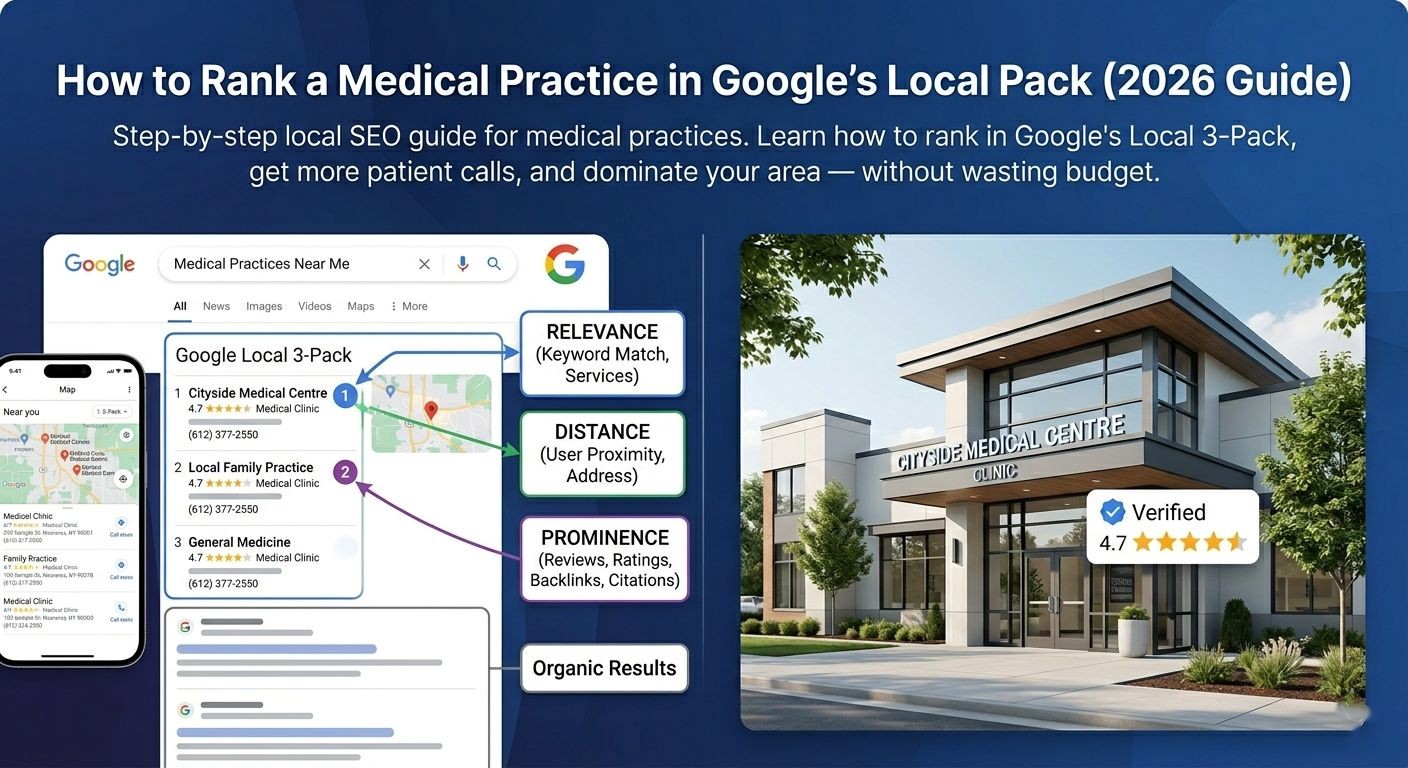
The Local 3-Pack — the three business cards that appear at the very top of local search results — is the most valuable piece of digital real estate a medical practice can occupy. For searches like "GP near me" or "paediatrician in [city]," this is where patient decisions are made.
Google uses three core pillars to decide who earns a spot:
How closely your listing matches what the patient searched for. Category selection, services listed, keywords in your description, and your website content all feed this signal.
How far your practice is from the searcher. You can't move your building — but you can expand your footprint through correct service-area settings and location-specific landing pages.
How well-known and trusted your practice is online. Reviews, backlinks, citations, website authority, and click-through rates all feed prominence — and this is the factor you control most.
"Businesses in the top 3 Local Pack spots capture over 60% of all local search clicks. Missing it means losing most prospective patients before they ever hear your name."
🩺 Is your practice invisible on Google Maps? Find out for free — no commitment.
Get Free Local SEO Audit →Step 1 — Fully Optimise Your Google Business Profile
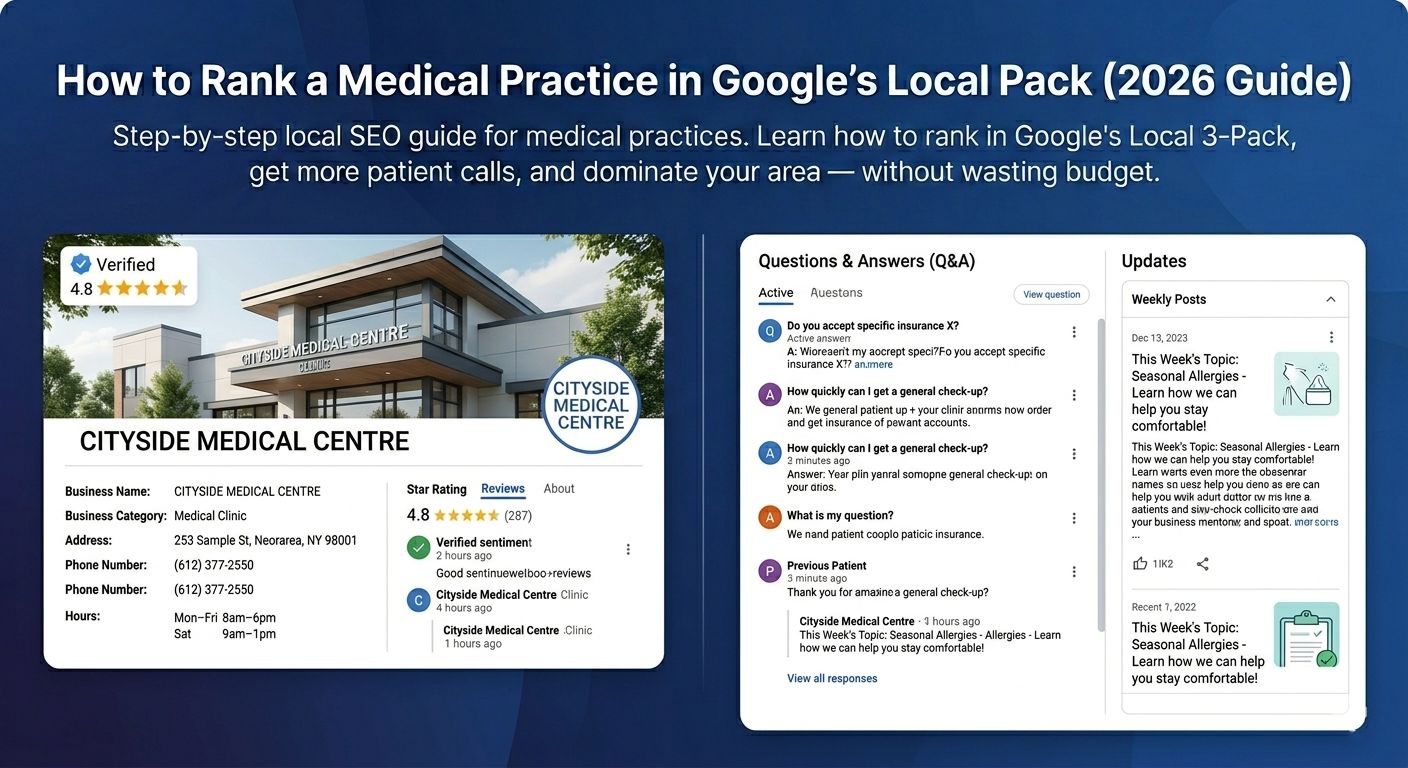
Your GBP is the single highest-leverage thing you can work on. An incomplete or unverified profile is an immediate disqualifier. Here's how to make yours bulletproof:
Business Name, Category & Description
- Use your exact legal business name — never stuff keywords into it (Google can suspend listings for this)
- Select the most specific primary category possible — "Cardiologist" beats "Doctor"
- Add all relevant secondary categories (e.g. "Internal Medicine Clinic", "General Practitioner")
- Write a full 750-character description including your city, key services, and primary specialty — written naturally, not stuffed
Services, Hours & Attributes
- List every service with its own name and description — Google surfaces individual services in search results
- Keep opening hours 100% accurate and update for public holidays — stale hours kill trust
- Enable all relevant attributes: "Wheelchair accessible", "Online appointments", "Accepts new patients"
- Add your booking link under "Appointment links" — reduces friction to zero for new patients
Photos — The Most Overlooked Ranking Signal
Practices with 100+ photos consistently get more direction requests and website clicks than those with fewer. Upload these categories:
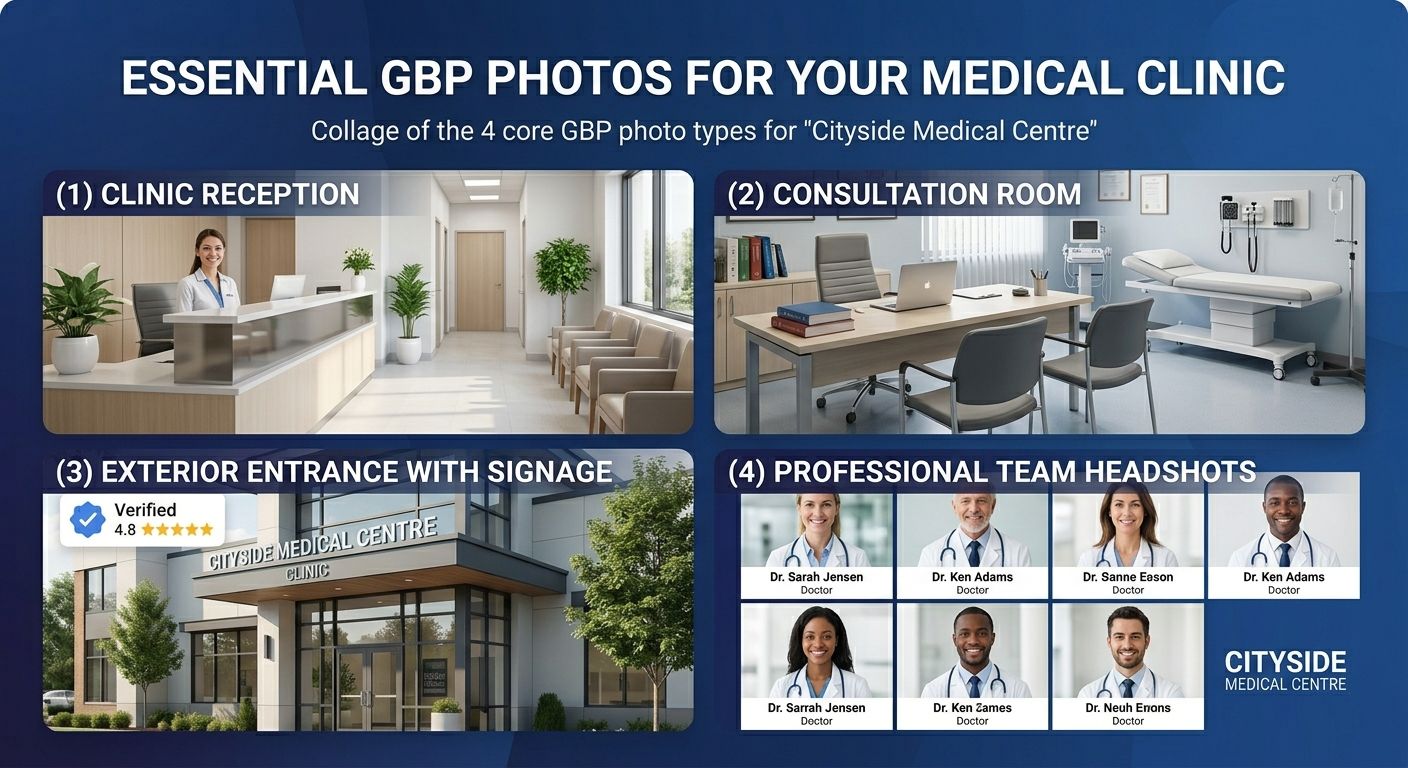
- Exterior — both daytime and evening, with all signage clearly visible
- Reception and waiting area — clean, bright, welcoming
- Consulting rooms — sterile, professional, well-lit
- Team headshots — doctors and nursing staff (with consent; no patient photos)
- Specialised equipment or facilities that differentiate your practice
Google Business Profile posts (offers, updates, events) signal active management and freshness. Post at least once per week — a health tip, service spotlight, or seasonal reminder — with a CTA linking to your booking page.
Step 2 — Build a Review Engine That Runs Itself
Reviews are both a ranking signal and a conversion lever. Practices with more 5-star reviews don't just rank higher — they get more clicks even when they rank third. You need a system, not just hope.
The 3-Part Review System
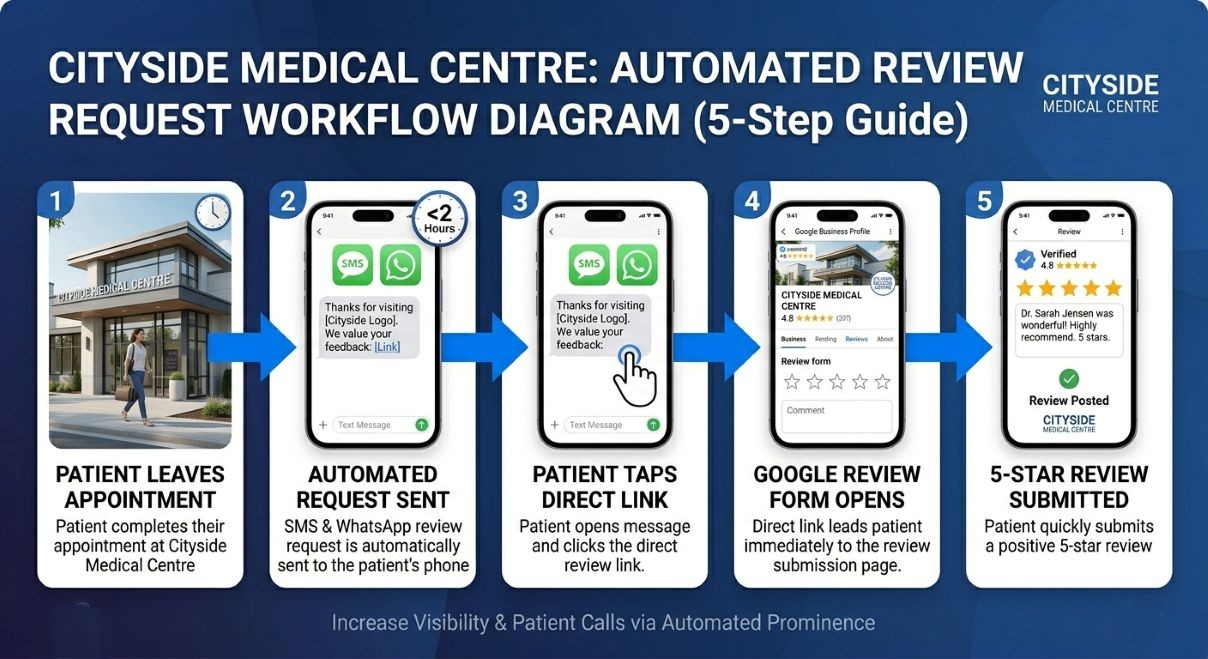
Ask within 2 hours of a positive appointment. Patient satisfaction peaks immediately after — the longer you wait, the less likely they are to act on your request.
Send a direct SMS or WhatsApp message with a one-tap link straight to your GBP review form. Email works but has lower open rates. QR code cards at reception and check-out are a solid backup.
Respond to every review — positive and negative — within 48 hours. Google factors response rate into your prominence score. For negative reviews: acknowledge, apologise, and invite the patient to call directly.
Google's spam detection is sophisticated and constantly improving. Fake reviews can result in your listing being suspended entirely — wiping all local rankings overnight. Build genuine reviews systematically.
Want a Ready-Made Review Request Template?
We'll set up an automated review request workflow tailored to your practice — no tech skills needed on your end.
Set It Up For Me →Step 3 — Fix Your Website's Local SEO Signals
Your website is the authority anchor behind your GBP listing. Google uses it to verify your business is legitimate, consistent, and locally relevant. These are the fixes that move the needle most:
- NAP in every page footer — Name, Address, Phone matching GBP character-for-character
- LocalBusiness Schema markup — structured JSON-LD data declaring your hours, location, and specialties to Google
- Location-specific title tags — "Paediatrician in [City] | [Practice Name]" on every relevant service page
- Embedded Google Map on your contact page — a trust signal Google actively looks for
- Mobile-first design — over 70% of local healthcare searches happen on smartphones in 2026
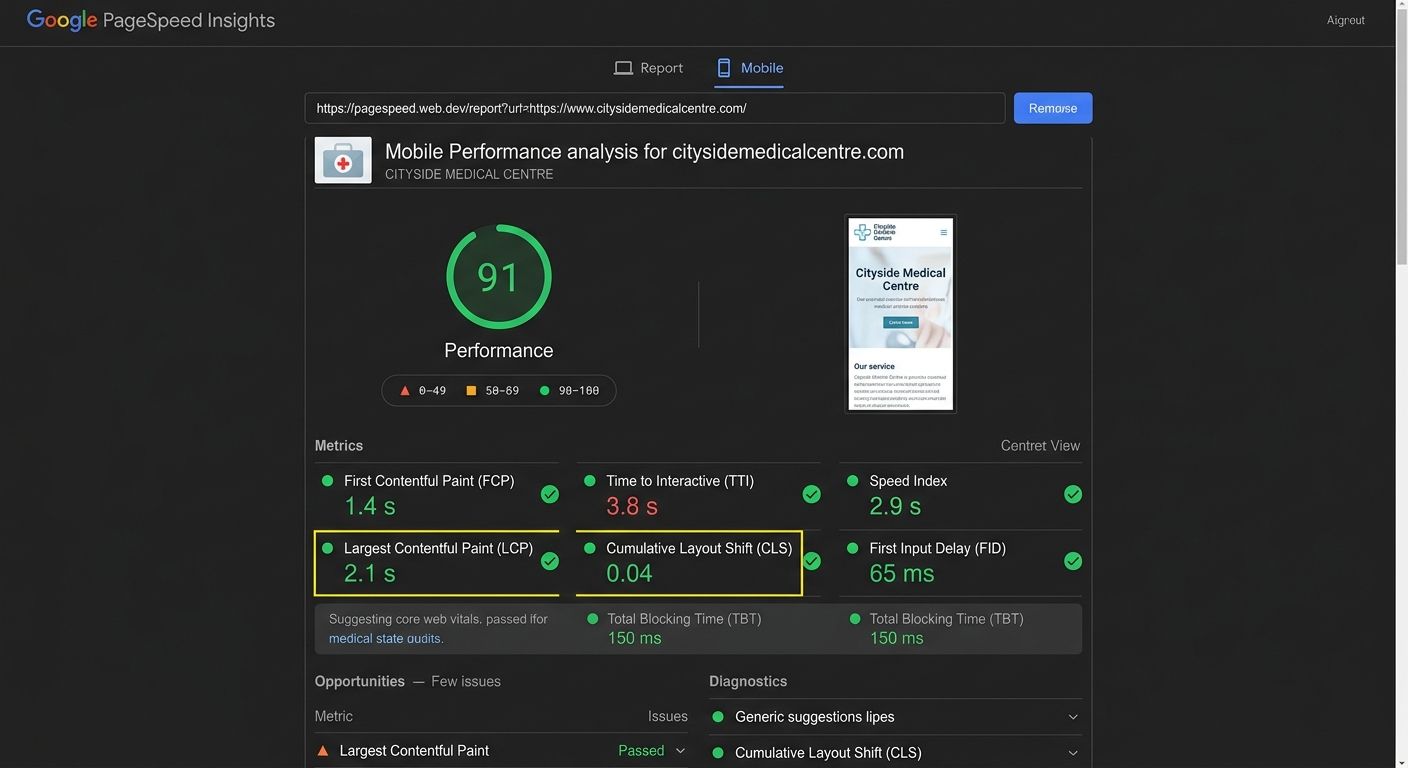
- Core Web Vitals passing — LCP under 2.5s, CLS under 0.1; slow sites lose rankings and lose patients
Step 4 — Citations & NAP Consistency
A citation is any online mention of your Name, Address, and Phone number (NAP). Google cross-references these across the web to verify your business is real and correctly located. Inconsistencies actively hurt your rankings.
If your GBP says "Suite 3, 14 Medical Road" but Healthgrades says "14 Medical Rd, Unit 3" — that's a mismatch. Google gets confused and your prominence score drops. Audit every directory you're listed on.
Priority Citation Sources for Medical Practices
- Google Business Profile — always your primary citation, the foundation of everything
- Bing Places for Business — frequently overlooked; worth ~15% of GBP-equivalent traffic
- Apple Maps — critical for iOS users using Siri or Apple Maps navigation
- Healthgrades, WebMD, Zocdoc — healthcare-specific directories with high domain authority
- Local Chamber of Commerce — geo-relevant backlinks Google values highly for prominence
- Facebook Business — indexed by Google and treated as a trust signal
📋 Need someone to audit and fix all your citations? We handle the full cleanup.
Talk to Our Team →Step 5 — Local Content That Attracts Patients
Most medical practice websites have the same five pages: Home, About, Services, Team, Contact. The practices dominating local SEO go further — they create content that answers the questions patients are actually typing into Google.
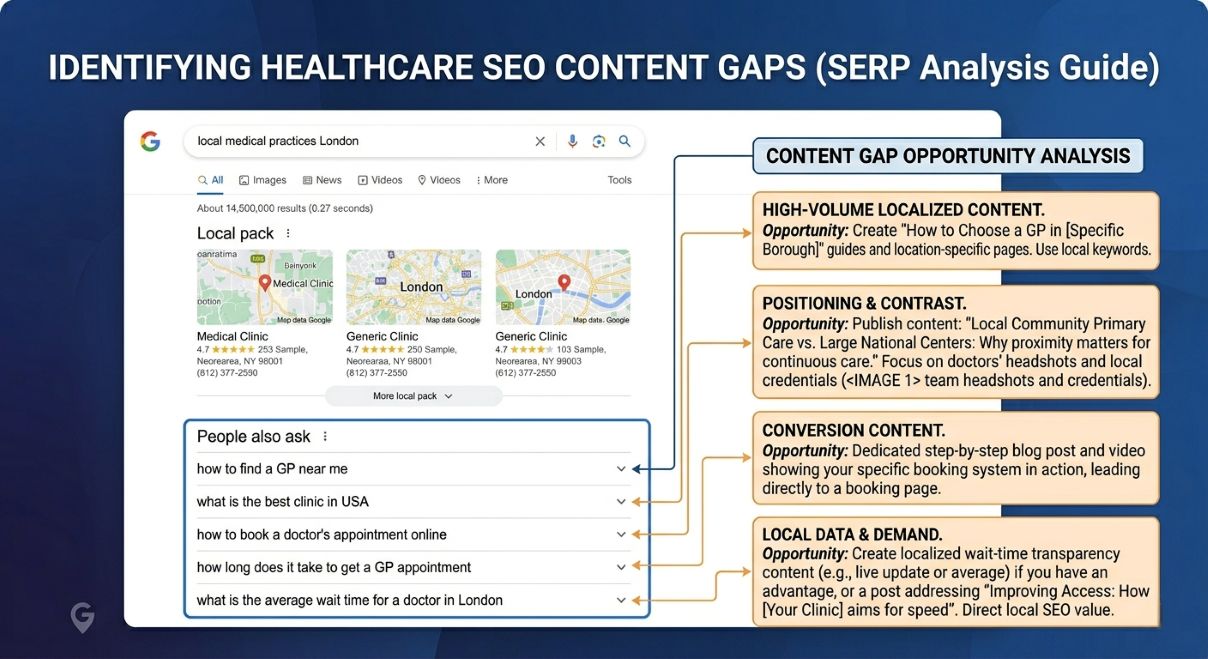
Content Types That Drive Local Rankings in 2026
- Service + Location pages — "Diabetes Management in [Neighbourhood]" — one focused page per key service per area you serve
- Condition explainers — "What is hypertension and when should you see a doctor?" — targets patients in the early awareness stage
- FAQ pages — answers to "does [practice] accept insurance?" or "how to book a same-day appointment in [city]"
- Doctor bio pages — structured with E-E-A-T signals: credentials, specialties, affiliations, publications
- Seasonal health content — "Flu Season 2026: When to See a Doctor in [City]" — time-relevant and location-targeted
You don't need to literally write "near me" on your pages. Use "in [City]", "in [Neighbourhood]", and "[Specialty] [City]" patterns throughout your content. Google understands location intent — your job is to reinforce relevance through specificity.
Your Interactive GBP Audit Checklist
Tick every item you've completed. Use this as your monthly optimisation reference.
Click each item to mark it done — track your completion score below.
Frequently Asked Questions
Ready to Fill Your Waiting Room?
ImpactBrains specialises in digital marketing for healthcare practices — from GBP optimisation to full local SEO campaigns. We get your practice in front of patients who are actively searching right now.
How to Rank a Medical Practice in Google's Local Pack — The 2026 Playbook
The Local 3-Pack gets 42% of all local search clicks. If your practice isn't in it, your competitors are filling their waiting rooms with patients who should be yours. Here's exactly how to fix that — step by step.
- How Google's Local Pack Algorithm Works
- Step 1 — Fully Optimise Your Google Business Profile
- Step 2 — Build a Review Engine That Runs Itself
- Step 3 — Fix Your Website's Local SEO Signals
- Step 4 — Citations & NAP Consistency
- Step 5 — Local Content That Attracts Patients
- Interactive GBP Audit Checklist
- FAQs
How Google's Local Pack Algorithm Works
The Local 3-Pack — the three business cards that appear at the very top of local search results — is the most valuable piece of digital real estate a medical practice can occupy. For searches like "GP near me" or "paediatrician in [city]," this is where patient decisions are made.
Google uses three core pillars to decide who earns a spot:
How closely your listing matches what the patient searched for. Category selection, services listed, keywords in your description, and your website content all feed this signal.
How far your practice is from the searcher. You can't move your building — but you can expand your footprint through correct service-area settings and location-specific landing pages.
How well-known and trusted your practice is online. Reviews, backlinks, citations, website authority, and click-through rates all feed prominence — and this is the factor you control most.
"Businesses in the top 3 Local Pack spots capture over 60% of all local search clicks. Missing it means losing most prospective patients before they ever hear your name."
🩺 Is your practice invisible on Google Maps? Find out for free — no commitment.
Get Free Local SEO Audit →Step 1 — Fully Optimise Your Google Business Profile
Your GBP is the single highest-leverage thing you can work on. An incomplete or unverified profile is an immediate disqualifier. Here's how to make yours bulletproof:
Business Name, Category & Description
- Use your exact legal business name — never stuff keywords into it (Google can suspend listings for this)
- Select the most specific primary category possible — "Cardiologist" beats "Doctor"
- Add all relevant secondary categories (e.g. "Internal Medicine Clinic", "General Practitioner")
- Write a full 750-character description including your city, key services, and primary specialty — written naturally, not stuffed
Services, Hours & Attributes
- List every service with its own name and description — Google surfaces individual services in search results
- Keep opening hours 100% accurate and update for public holidays — stale hours kill trust
- Enable all relevant attributes: "Wheelchair accessible", "Online appointments", "Accepts new patients"
- Add your booking link under "Appointment links" — reduces friction to zero for new patients
Photos — The Most Overlooked Ranking Signal
Practices with 100+ photos consistently get more direction requests and website clicks than those with fewer. Upload these categories:
- Exterior — both daytime and evening, with all signage clearly visible
- Reception and waiting area — clean, bright, welcoming
- Consulting rooms — sterile, professional, well-lit
- Team headshots — doctors and nursing staff (with consent; no patient photos)
- Specialised equipment or facilities that differentiate your practice
Google Business Profile posts (offers, updates, events) signal active management and freshness. Post at least once per week — a health tip, service spotlight, or seasonal reminder — with a CTA linking to your booking page.
Step 2 — Build a Review Engine That Runs Itself
Reviews are both a ranking signal and a conversion lever. Practices with more 5-star reviews don't just rank higher — they get more clicks even when they rank third. You need a system, not just hope.
The 3-Part Review System
Ask within 2 hours of a positive appointment. Patient satisfaction peaks immediately after — the longer you wait, the less likely they are to act on your request.
Send a direct SMS or WhatsApp message with a one-tap link straight to your GBP review form. Email works but has lower open rates. QR code cards at reception and check-out are a solid backup.
Respond to every review — positive and negative — within 48 hours. Google factors response rate into your prominence score. For negative reviews: acknowledge, apologise, and invite the patient to call directly.
Google's spam detection is sophisticated and constantly improving. Fake reviews can result in your listing being suspended entirely — wiping all local rankings overnight. Build genuine reviews systematically.
Want a Ready-Made Review Request Template?
We'll set up an automated review request workflow tailored to your practice — no tech skills needed on your end.
Set It Up For Me →Step 3 — Fix Your Website's Local SEO Signals
Your website is the authority anchor behind your GBP listing. Google uses it to verify your business is legitimate, consistent, and locally relevant. These are the fixes that move the needle most:
- NAP in every page footer — Name, Address, Phone matching GBP character-for-character
- LocalBusiness Schema markup — structured JSON-LD data declaring your hours, location, and specialties to Google
- Location-specific title tags — "Paediatrician in [City] | [Practice Name]" on every relevant service page
- Embedded Google Map on your contact page — a trust signal Google actively looks for
- Mobile-first design — over 70% of local healthcare searches happen on smartphones in 2026
- Core Web Vitals passing — LCP under 2.5s, CLS under 0.1; slow sites lose rankings and lose patients
Step 4 — Citations & NAP Consistency
A citation is any online mention of your Name, Address, and Phone number (NAP). Google cross-references these across the web to verify your business is real and correctly located. Inconsistencies actively hurt your rankings.
If your GBP says "Suite 3, 14 Medical Road" but Healthgrades says "14 Medical Rd, Unit 3" — that's a mismatch. Google gets confused and your prominence score drops. Audit every directory you're listed on.
Priority Citation Sources for Medical Practices
- Google Business Profile — always your primary citation, the foundation of everything
- Bing Places for Business — frequently overlooked; worth ~15% of GBP-equivalent traffic
- Apple Maps — critical for iOS users using Siri or Apple Maps navigation
- Healthgrades, WebMD, Zocdoc — healthcare-specific directories with high domain authority
- Local Chamber of Commerce — geo-relevant backlinks Google values highly for prominence
- Facebook Business — indexed by Google and treated as a trust signal
📋 Need someone to audit and fix all your citations? We handle the full cleanup.
Talk to Our Team →Step 5 — Local Content That Attracts Patients
Most medical practice websites have the same five pages: Home, About, Services, Team, Contact. The practices dominating local SEO go further — they create content that answers the questions patients are actually typing into Google.
Content Types That Drive Local Rankings in 2026
- Service + Location pages — "Diabetes Management in [Neighbourhood]" — one focused page per key service per area you serve
- Condition explainers — "What is hypertension and when should you see a doctor?" — targets patients in the early awareness stage
- FAQ pages — answers to "does [practice] accept insurance?" or "how to book a same-day appointment in [city]"
- Doctor bio pages — structured with E-E-A-T signals: credentials, specialties, affiliations, publications
- Seasonal health content — "Flu Season 2026: When to See a Doctor in [City]" — time-relevant and location-targeted
You don't need to literally write "near me" on your pages. Use "in [City]", "in [Neighbourhood]", and "[Specialty] [City]" patterns throughout your content. Google understands location intent — your job is to reinforce relevance through specificity.
Your Interactive GBP Audit Checklist
Tick every item you've completed. Use this as your monthly optimisation reference.
Click each item to mark it done — track your completion score below.
Frequently Asked Questions
Ready to Fill Your Waiting Room?
ImpactBrains specialises in digital marketing for healthcare practices — from GBP optimisation to full local SEO campaigns. We get your practice in front of patients who are actively searching right now.