Whether you're advertising facelifts, rhinoplasties, blepharoplasties, or any other facial procedure — this is the strategy shift that most plastic surgery practices are missing.
The Real Reason Facelift Patients Don't Convert on Service Pages
Before we talk about what to do, let's talk about why this problem exists in the first place.
When someone searches "facelift surgeon near me" or "best facelift in [city]" on Google, they are not in a casual browsing mindset. They are in a decision mindset. They've already done some research. They're comparing providers. They want to take a next step — they just need to be guided to it clearly and quickly.
Now imagine they click your Google Ad and land on your standard facelift service page. Here's what typically happens:
Your service page has a full website header with 8 navigation links. There's a menu with "About," "Procedures," "Gallery," "Blog," "Contact," and probably a dropdown or two. There are links to other procedures scattered throughout the content. Maybe there's a sidebar. There are internal links every other paragraph. There's a footer with even more links.
Every single one of those elements is a distraction and an exit ramp for someone who came with the intention to book a consultation.
The research on this is consistent: every additional link on a landing page reduces your conversion rate. A homepage or service page might have 50+ clickable elements. A well-built dedicated landing page should have exactly one: your CTA.
Your website service page is designed to help someone explore your practice. A facelift patient searching on Google doesn't need exploration — they need a clear, confident, frictionless path to booking.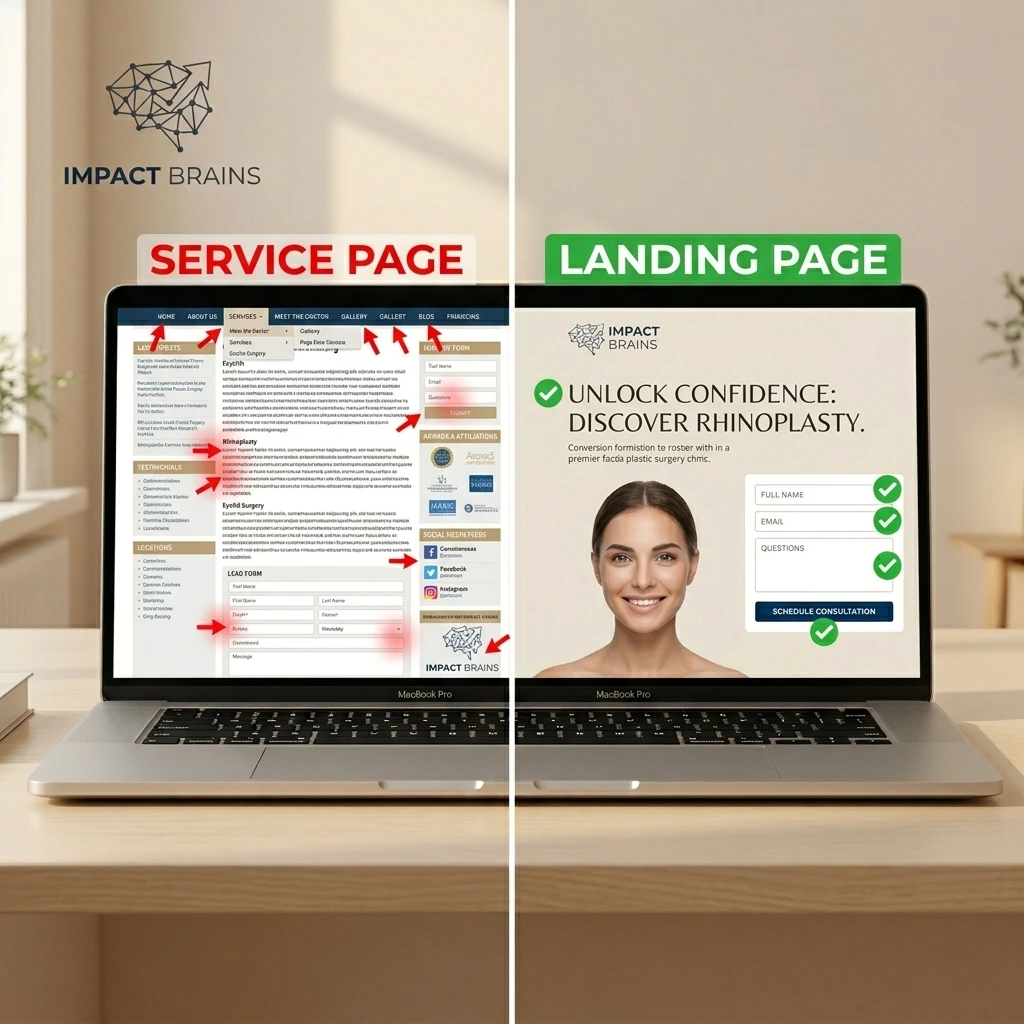
What a High-Converting Facelift Landing Page Actually Looks Like
There’s a winning formula here — not a strict template, but a reliable structure that consistently outshines service pages for plastic surgery Google Ads campaigns.
The Form Goes First (Yes, Really)
One of the biggest blunders we see on plastic surgery landing pages is hiding the contact form at the bottom. Many practices believe, "Patients need to read everything first before they’ll trust us enough to fill out a form."
But the data tells a different story. Patients who click on a facelift ad from Google already have a certain level of interest. They don’t need a lengthy 1,200-word article before they’re ready to share their name and phone number. What they really need is to see that form right away, feel confident that filling it out is safe and straightforward, and know exactly what to expect next.
So, place your consultation request form — with a maximum of three fields — right in the hero section. Above the fold. It should be visible as soon as the page loads.
One Headline. One Promise. One Action.
Your facelift landing page headline should focus on one thing: addressing the emotional outcome your patient desires. Not the procedure itself. The outcome.
Take a look at these examples:
❌ "Facelift Surgery — Our Procedures"
✅ "Look As Young As You Feel — Book Your Private Facelift Consultation Today"
The second option taps into the patient’s aspirations, paints a vivid picture, and clearly tells them what to do next. That’s the essence of your entire landing page captured in a headline.
Trust Signals, Not Just Text
Facelift patients are making a significant financial and physical commitment, and they need reassurance. But that reassurance doesn’t come from a lengthy 800-word explanation of the procedure — it comes from seeing:
- Board certification prominently displayed (ABFPRS, ABOTO, or similar)
- Authentic before-and-after photos with patient consent (in line with advertising guidelines)
- Specific, verifiable patient testimonials — not just generic five-star ratings Media features, awards, or recognitions if applicable
- The surgeon’s face, name, and credentials — not a stock photo
Trust signals need to be front and center—no scrolling required. If a patient has to scroll past your bio to find your credentials, you’ve already lost their interest.
Zero Navigation. Zero Distractions.
Forget about navigation and distractions. This is a must. Your facelift landing page should be free of a main navigation menu. No links to your rhinoplasty page, no footer links to your blog, and definitely no “click here to learn about our team.”
It’s all about one page, one purpose, and one outcome.
If a patient wants to check out your full practice website, they can do that after they’ve submitted the form.
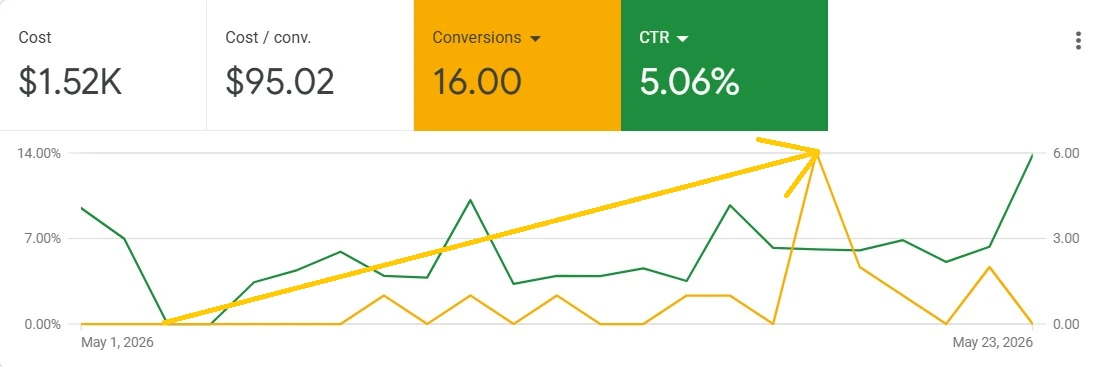
Real Results: How One Facial Plastic Surgery Client Went From 0 Conversions to 16 in Just Two Weeks
We’re here to show you what this looks like in real life—not just in theory. One of our facial plastic surgery clients had been running Google Ads for their facelift services for weeks, directing their ads straight to the facelift service page on their main website. The outcome? Zero conversions. Crickets. To make matters worse, their ads were racking up Google policy violations due to specific clinical language on their service page that didn’t align with Google’s healthcare advertising guidelines.
Here’s what we did:
Step 1: We took a close look at their existing service page and pinpointed the exact language that was causing the policy flags. Certain words and phrases that made clinical outcome claims crossed into Google’s restricted territory for healthcare advertising.
Step 2: We created a dedicated landing page—completely separate from their main website—with a clear headline, a brief trust section, board certification highlights, a simple 3-field consultation form right at the top, real before-and-after images, and no navigation distractions.
Step 3: We updated their Google Ads campaigns to direct traffic to the new landing page instead of the service page.
Step 4: We revamped the ad copy to use compliant language—focusing on outcomes, aspirations, and the patient experience rather than clinical claims.
Check out the results we’re expecting over the next two weeks:
- Conversions: 0 → 16
- CTR: 5.06%
- Cost per conversion: $95.02
- Total spend: $1,520
When you consider that a typical facelift procedure starts at around $8,000 to $15,000 or more, that cost per lead is pretty impressive. Just one successful consultation can cover the entire month’s ad expenses—and then some!
Why Google Ads for Plastic Surgeons Is Different From Every Other Industry
Let’s dive into the Google Ads aspect of this topic — it’s not just about having a great landing page. The advertising strategy for plastic surgeons, especially for procedures like facelifts, rhinoplasties, and blepharoplasties, follows a distinct set of guidelines.
Google Views Cosmetic Surgery as a Sensitive Category
Cosmetic procedures aren’t treated the same way as a restaurant or a law firm. Google puts healthcare and medical services under a microscope — which means your ad copy, landing page, and even your targeting have to meet a higher standard.
When it comes to advertising facelifts, this translates to:
- No promises of guaranteed results ("Get a perfect result" = policy violation)
- No before-and-after images in the ads themselves (only on the landing page with proper consent)
- Targeting must not suggest you’re reaching users based on health-condition data
- The quality of your landing page directly affects your Quality Score — thin pages will be penalized
Many plastic surgeons — or general marketing agencies that don’t specialize in this field — often stumble over these rules. They tend to use the same ad language they would for a luxury product, not realizing that cosmetic surgery ads have their own specific compliance guidelines.
The Keywords That Actually Convert for Plastic Surgery Google Ads
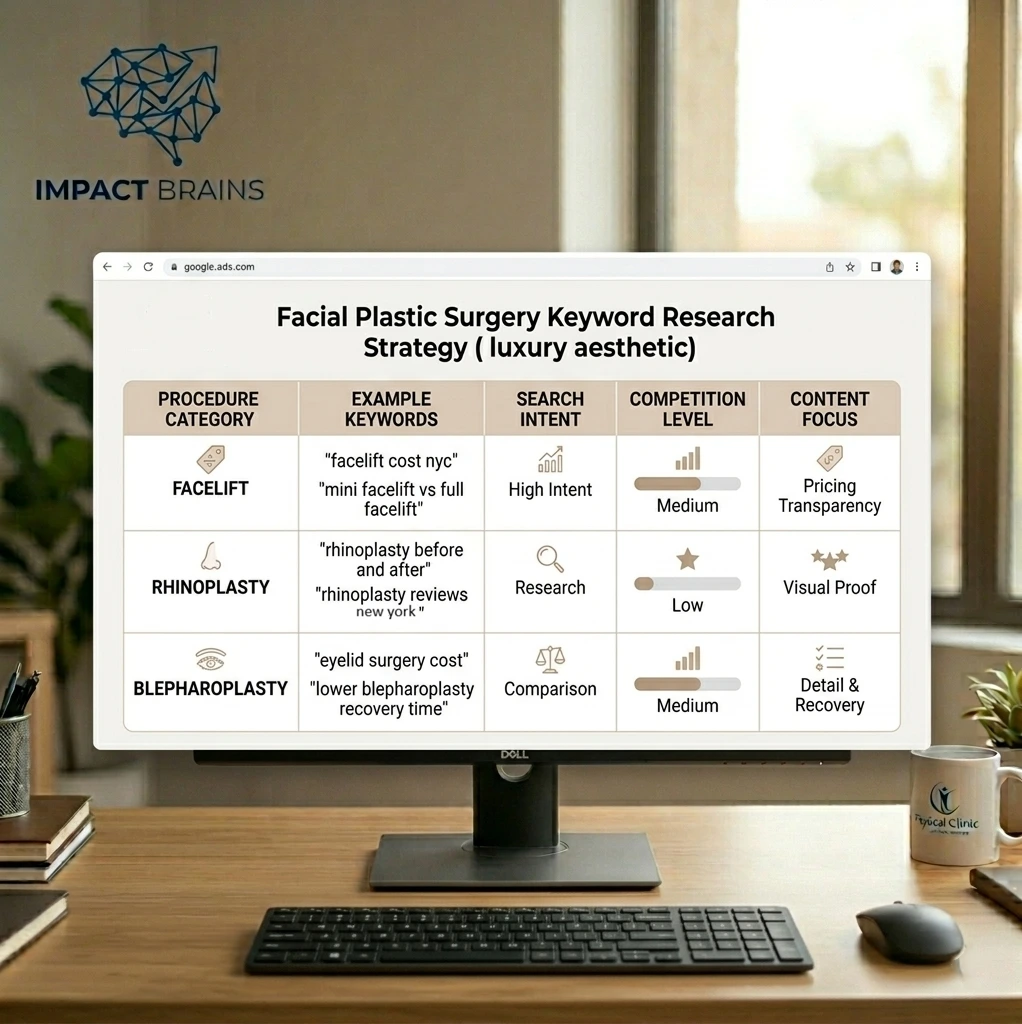
Not all keywords are created equal in this arena. After managing Google Ads for plastic surgeons in various markets, here’s the keyword framework that consistently delivers results:
High-Intent Primary Keywords (Facelift):
- facelift surgeon [city]
- facelift consultation [city]
- best facelift doctor near me
- facial rejuvenation surgery
- facelift cost [city]
High-Intent Primary Keywords (Rhinoplasty):
- rhinoplasty surgeon near me
- nose job consultation [city]
- google ads for rhinoplasty
- rhinoplasty specialist [city]
High-Intent Primary Keywords (Blepharoplasty):
- eyelid surgery near me
- blepharoplasty surgeon [city]
- upper eyelid lift consultation
- google ads for blepharoplasty
Lower Competition, High-Converting Long-Tail Keywords:
- how much does a facelift cost in [city]
- facelift recovery time [city]
- natural looking facelift [city]
- board certified facelift surgeon [city]
- mini facelift vs full facelift [city]
Long-tail keywords, particularly those related to cost and comparisons, usually come with lower competition and tend to attract patients who are further along in their decision-making journey. These individuals are ready to buy, not just casually browsing.
Google Ads Policy Issues Specific to Plastic Surgery Advertising
This is a tricky area that even seasoned marketers can stumble over. Google's rules for advertising cosmetic surgery are quite detailed — and if you step out of line, it’s not just your ads that get disapproved; your entire account could be at risk of suspension due to repeated violations.
Let’s take a look at some of the most common pitfalls for Google Ads campaigns in the plastic surgery field:
Before/After Image Violations
Using before and after photos directly in your display or responsive ads is a no-go. While you can absolutely feature them on your landing page, they’re off-limits in the ad creative itself. Many practices make the mistake of including them in their display campaigns and then find themselves puzzled as to why their accounts keep getting flagged.
Outcome Guarantee Language
Be cautious with phrases like "achieve a younger appearance," "look 10 years younger guaranteed," or "permanent results" — these will definitely raise red flags for your ads. Instead, focus on the experience, the consultation process, and the surgeon's expertise rather than promising specific outcomes.
Website Language Bleeding Into Your Ads' Quality Review
This is exactly what our facelift client encountered. Google doesn’t just stop at reviewing your ad; it also crawls and assesses your landing page (and sometimes even your entire domain). If your main website contains language that goes against healthcare advertising policies, it can impact ads linked to any part of that domain — even if the specific page you’re linking to is compliant. Creating a dedicated landing page on a separate or subdomain can give you a fresh start.
Remarketing to Cosmetic Surgery Audiences
When it comes to remarketing, you need to tread carefully under Google's personalized advertising policy for sensitive health categories. If you’re retargeting visitors to a page titled /facelift-surgery with ads that specifically mention facelift, you could be violating the policy regarding targeting based on health or appearance-related data.

The Complete Guide: Running Google Ads for Facial Plastic Surgery Effectively
Let’s bring everything together into a cohesive strategy. This is the method we recommend for facial plastic surgeons, whether they’re advertising facelifts, promoting rhinoplasty, or marketing full-service cosmetic surgery.
1. Create a Standalone Landing Page
Design a dedicated landing page that isn’t part of your main website’s navigation. It can be on the same domain (as a subdirectory) or a subdomain, but it should be free from any site-wide navigation and laser-focused on one specific procedure and action.
2. Craft Compliant, Conversion-Driven Ad Copy
Highlight the emotional benefits and the surgeon’s expertise. Steer clear of clinical claims, guarantees about outcomes, and any language that might negatively impact body image. Emphasize board certification, experience, personalized care, and encourage the consultation as the next step.
3. Align Keywords with Buying Intent
Organize your ad groups based on different levels of intent. High-intent local keywords (like "facelift surgeon Dallas") should be in one ad group with direct call-to-action copy. Meanwhile, research-focused keywords (such as "facelift recovery time") belong in a separate ad group with educational content that still leads to the consultation call-to-action.
4. Utilize Call Extensions and Lead Form Features
Patients seeking facial plastic surgery often prefer to call rather than fill out a form, especially for something as personal as a facelift. Ensure that call extensions are active and monitored. Google’s lead form features, which allow patients to express interest directly from the search results, can also be effective for this audience.
5. Monitor Everything — Including Call Conversions
One of the biggest oversights in many plastic surgeon advertising setups is that they only track form submissions and completely overlook phone call conversions. By using a HIPAA-compliant call tracking system, you can pinpoint which keywords and ads are generating real consultation requests and optimize your strategy accordingly.
Why Most General Marketing Agencies Get Plastic Surgery Advertising Wrong
Okay, this might stir the pot a bit, but it’s time to get real.
Most digital marketing agencies are jacks-of-all-trades. They might excel at promoting an e-commerce site, a law office, or a local eatery. But when it comes to advertising for plastic surgeons—especially with Google Ads for procedures like facelifts, rhinoplasties, and blepharoplasties—they often lack the specialized knowledge that’s crucial. They might not be familiar with Google’s healthcare-sensitive category policies. They often rely on the same ad copy strategies they’d use for a spa. They direct traffic to generic service pages because that’s their comfort zone.
They don’t grasp the importance of having a HIPAA-compliant form for a cosmetic surgery practice. And they’ve likely never faced a Google account suspension due to healthcare policy violations. As a facial plastic surgeon investing in paid advertising, you’re not just buying clicks. You’re putting money into your reputation, your patient acquisition system, and the growth of your practice.
That kind of investment deserves specialists—people who truly understand the nuances of healthcare marketing compliance, the psychology of high-end patients, and the intricacies of Google Ads strategy.
That’s exactly what we offer.
What to Look For in a Google Ads Agency for Plastic Surgeons
If you’re on the hunt for an agency to handle your plastic surgery advertising, here are some key questions that can help you distinguish the specialists from the generalists:
Start with: “How do you navigate Google’s sensitive category policies for cosmetic surgery advertising?”
If they give you a blank stare or say, “we haven’t had any issues with that,” consider it a warning sign. Anyone actively running plastic surgery ads should be well aware of these policies.
Next, ask: “Where do you direct the traffic from our Google Ads—straight to our website or to a dedicated landing page?”
If they respond with “your website service page,” you’ve just pinpointed why your results might be falling short.
Ask them, "How do you keep track of call conversions along with form submissions?" Patients looking for facelift and rhinoplasty often make a call first.
If your agency isn’t monitoring those calls, you’re making decisions based on incomplete data.
Also, ask them, "Can you share results from other clients in the plastic or cosmetic surgery field?" We want to see real results and genuine conversion data—not just vague claims like "we’ve worked with healthcare clients before."

Frequently Asked Questions
Yes, absolutely. Facelift advertising on Google is permitted, but it falls under healthcare advertising guidelines. Ad copy must avoid guaranteed outcome claims, before/after images cannot be used in the ads themselves, and landing pages need to reflect genuine medical expertise and credentials.
The most common cause is sending paid traffic to a standard website service page rather than a dedicated landing page. Service pages are designed for exploration — they have navigation menus, links to other pages, and extensive information that distracts high-intent visitors from taking one clear action.
This varies significantly by market and targeting, but in major metro areas, a well-optimized campaign with a dedicated landing page can achieve a cost per consultation lead in the $80–$200 range. Given that a single facelift procedure generates $8,000–$20,000+ in revenue, even $200 per lead delivers exceptional ROI.
Yes. Each procedure should have its own dedicated landing page. A patient searching for a blepharoplasty surgeon has a specific intent — landing on a generic "our procedures" page or even a facelift-specific page creates immediate disconnect. One procedure, one page, one CTA.
High-intent local keywords ("rhinoplasty surgeon [city]," "blepharoplasty specialist near me") paired with procedure-specific cost and recovery queries tend to perform best. Long-tail keywords in this space often carry less competition and attract patients who are already in the decision phase.
The three most important steps:
(1) use a dedicated landing page with no clinical outcome guarantees,
(2) avoid before/after images in ad creatives, and
(3) review your main website for language that could trigger Google's healthcare sensitive category policies — since that language can affect your entire domain's ad eligibility.
The Bottom Line
Your facelift patients are actively looking for you right now. They’re searching for those keywords, clicking on ads, and making decisions—often just minutes after landing on a page.
So, the real question isn’t whether Google Ads is effective for plastic surgeons; it absolutely is.
The real question is whether your campaign is designed to attract those patients or if they’ll end up choosing a competitor with a cleaner, clearer, and more focused landing page than yours.
Having a dedicated, high-converting landing page isn’t just a luxury in plastic surgery advertising; it’s essential. After witnessing the transformation from zero conversions to sixteen in just two weeks, it’s clear that this is the minimum standard for any campaign that’s truly worth running.
This blog post is intended for informational and marketing guidance purposes. Google Ads policies are subject to change. Always review current Google advertising policies and consult a qualified healthcare marketing professional before launching campaigns.
Written by Impact Brains — Healthcare & Plastic Surgery Marketing Specialists