Introduction
Businesses today invest heavily into:
- Google Ads
- Meta Ads
- SEO
- landing pages
- content marketing
- email campaigns
But there’s one critical problem many companies overlook before scaling advertising:
Their tracking infrastructure is either incomplete or completely unreliable.
Without proper GA4 and Google Tag Manager (GTM) setup, businesses often:
- optimize campaigns using inaccurate data,
- misread conversion performance,
- feed poor-quality signals into ad platforms,
- and waste thousands in advertising budget.
At Impact Brains, tracking audits consistently reveal broken events, duplicate conversions, missing attribution, and incomplete customer journey data — even in businesses spending significant monthly budgets.
Before you scale advertising, you need clean data.
Because modern advertising platforms depend on accurate tracking to optimize performance effectively.
What Are GA4 & GTM?
Google Analytics 4 (GA4)
GA4 is Google’s modern analytics platform designed to track user behavior, traffic sources, engagement, and conversions across websites and apps.
It helps businesses understand:
- where users come from,
- how they interact with the website,
- what drives conversions,
- and which marketing channels generate actual revenue.
Google Tag Manager (GTM)
Google Tag Manager is a tag management system that allows businesses to deploy tracking scripts, events, and marketing pixels without directly editing website code repeatedly.
GTM acts as the control center for:
- conversion tracking,
- event tracking,
- Meta Pixel implementation,
- remarketing,
- ecommerce tracking,
- analytics integrations,
- and advertising data collection.
Together, GA4 and GTM form the foundation of a modern marketing data system.

Why Accurate Tracking Matters More Than Ever
Advertising platforms today rely heavily on machine learning.
Google Ads and Meta Ads continuously analyze user behavior signals to determine:
- who is likely to convert,
- how bids should be adjusted,
- where ads should appear,
- and which audiences generate the highest ROI.
But machine learning is only as good as the data it receives.
If your tracking setup is inaccurate, platforms optimize toward the wrong outcomes.

This can lead to:
- inflated CPL,
- poor lead quality,
- wasted ad spend,
- inaccurate reporting,
- and unstable campaign performance.
Common Tracking Problems Businesses Don’t Notice
Most businesses assume their tracking is working properly simply because they see “some” conversion data inside advertising platforms.
In reality, many accounts contain serious tracking issues.
Duplicate Conversion Tracking
One of the most common problems is duplicate conversions.
This happens when:
- form submissions fire multiple times,
- events are triggered incorrectly,
- or platforms count the same lead repeatedly.
The result:
Google and Meta believe campaigns are performing better than they actually are.
This distorts optimization and reporting decisions.
Missing Conversion Events
Many businesses fail to track:
- phone calls,
- booked appointments,
- CRM-qualified leads,
- purchases,
- or important user actions.
This creates major blind spots inside reporting systems.
Without complete conversion visibility, platforms cannot optimize accurately.
Broken Attribution
Modern customer journeys involve multiple touchpoints:
- Google search,
- YouTube,
- Meta retargeting,
- email campaigns,
- direct visits,
- organic traffic.
Without proper attribution setup, businesses misidentify which channels are actually driving revenue.
This often causes businesses to scale the wrong campaigns while cutting profitable ones.

No Enhanced Conversions or Conversion API
Privacy changes, browser restrictions, and cookie limitations have significantly reduced traditional tracking accuracy.
Businesses that fail to implement:
- Enhanced Conversions,
- Meta Conversion API,
- or server-side tracking
often lose valuable conversion data.
This weakens platform optimization significantly.
Request a Tracking Consultation →
How Bad Tracking Hurts Advertising Performance
Poor Machine Learning Optimization
Google and Meta rely on conversion signals to optimize campaigns.
If conversion data is inaccurate:
- Smart Bidding becomes unreliable,
- audience targeting weakens,
- and optimization becomes unstable.
Essentially, platforms start learning from incorrect information.
Higher Cost Per Lead
When platforms can’t identify high-quality conversion patterns properly, cost efficiency drops.
Businesses often experience:
- rising CPL,
- inconsistent results,
- poor-quality leads,
- and unstable campaign performance.
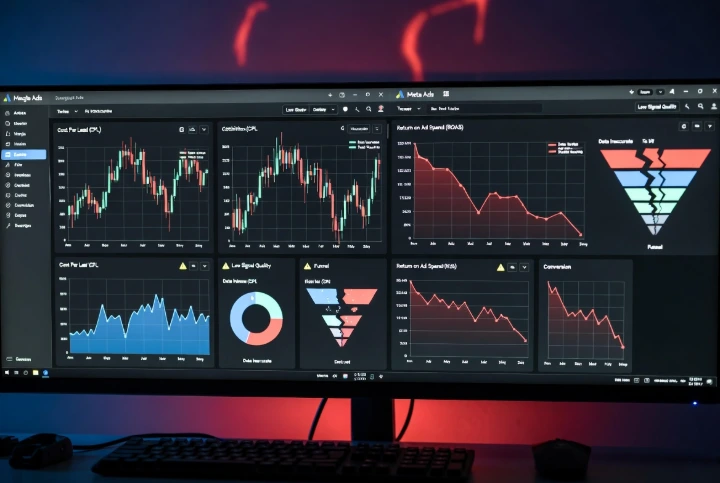
Misleading Reporting
Many businesses believe campaigns are “working” because dashboards show conversions.
But without accurate setup, those numbers may not reflect:
- real purchases,
- qualified leads,
- or actual revenue impact.
This creates dangerous decision-making based on incomplete or inaccurate data.
Why GTM & GA4 Should Be Installed Before Running Ads
Many businesses launch advertising campaigns before setting up proper analytics infrastructure.
This is one of the biggest mistakes in performance marketing.
Before spending heavily on traffic acquisition, businesses should first establish:
- clean event tracking,
- accurate attribution,
- conversion architecture,
- and reliable reporting systems.
A strong tracking foundation allows campaigns to scale more efficiently from the beginning.
What a Proper Tracking Setup Should Include
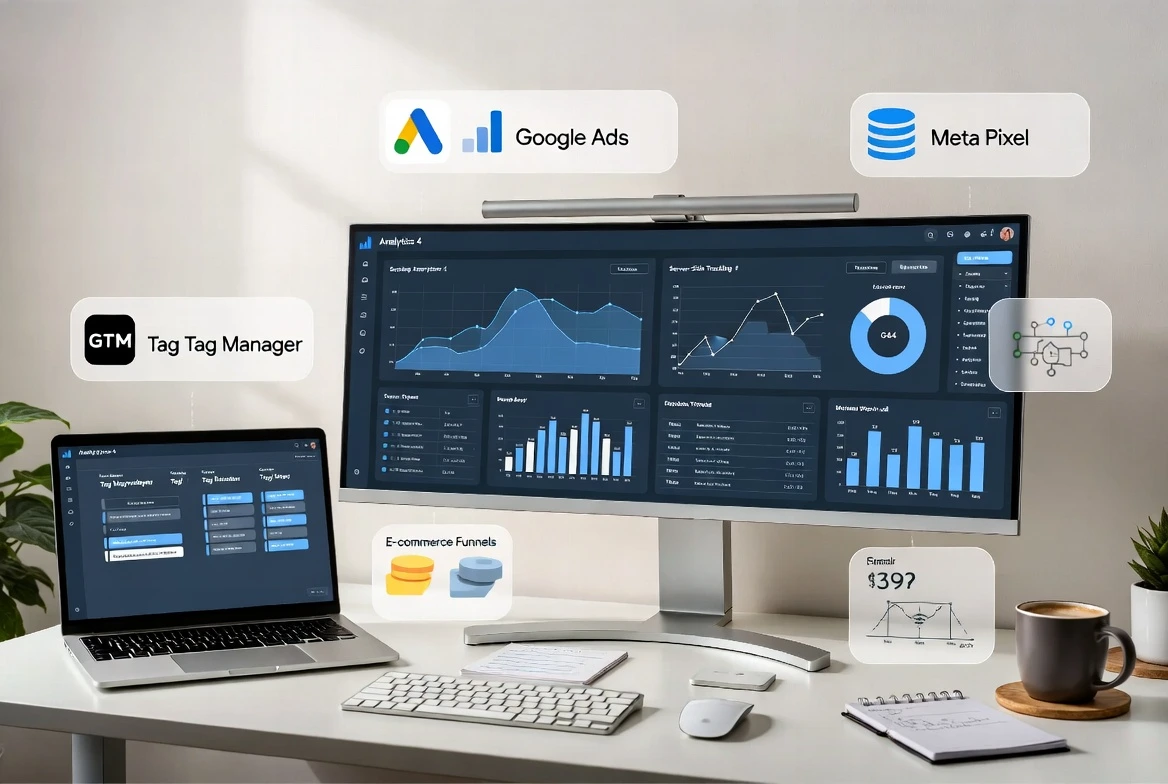
Modern tracking infrastructure typically includes:
Core Analytics Setup
- GA4 configuration
- event tracking
- goal setup
- attribution reporting
GTM Implementation
- centralized tag management
- trigger configuration
- custom event tracking
- marketing integrations
Advertising Tracking
- Google Ads conversion tracking
- Meta Pixel setup
- Enhanced Conversions
- Conversion API implementation
Advanced Tracking Infrastructure
- server-side tracking
- ecommerce tracking
- call tracking
- CRM attribution integration
The Long-Term Business Impact of Proper Tracking
Businesses with strong analytics infrastructure gain:
- cleaner reporting,
- stronger campaign optimization,
- lower acquisition costs,
- better decision-making,
- and more scalable growth systems.
Instead of relying on assumptions, they make decisions using accurate performance data.
That’s where real marketing efficiency comes from.
Final Thoughts
Many businesses believe they have an advertising problem when they actually have a tracking problem.
Without accurate GA4 and GTM implementation, advertising platforms struggle to optimize properly, reporting becomes unreliable, and growth becomes difficult to scale efficiently.
Modern marketing depends on clean data.
Before increasing ad spend, businesses should ensure their analytics and tracking systems are built correctly from the foundation up.
Because better data leads to better optimization — and better optimization leads to stronger ROI.