Why Your Plastic Surgery Practice Is Paying Too Much for Leads — And How to Actually Fix It
June 2026 · 9 min read · Impact Brains
Let's be direct: most plastic surgery practices are overspending on marketing. Not because their surgeons aren't talented. Not because the procedures aren't in demand. But because the systems connecting ad spend to booked consultations are quietly leaking money every single day.
The cosmetic surgery market is massive — global revenue is projected to reach $83.33 billion by 2034 — and demand for procedures has never been higher. Yet the average cost per lead in cosmetic surgery sits at $102–$134 for search ads alone, and many practices are seeing $200–$300+ per consultation when tracking is broken or targeting is broad.
The painful truth? Most of that waste is entirely preventable. And in this article, we're going to show you exactly where it's happening — and what a properly built marketing system actually looks like.
- The Real Cost of a Cosmetic Surgery Lead in 2026
- 5 Reasons Your Consultation Costs Keep Rising
- Why Most Clinics Are Measuring the Wrong Things
- The Patient Acquisition Formula That Changes Everything
- How Better Tracking Directly Lowers Your CPA
- Real-World Results: What Fixing Attribution Actually Looks Like
The Real Cost of a Cosmetic Surgery Lead in 2026
Before we talk about fixing anything, you need to know what the numbers actually look like across channels. These aren't worst-case scenarios — they're industry benchmarks.
Google Search Ads deliver the highest-intent patients — people actively searching "rhinoplasty consultation near me" are ready to book. But with an average CPC for cosmetic surgery now hovering between $8–$15 per click, a low-converting landing page can turn a $5,000 ad budget into a handful of consultations fast.
Meta Ads generate leads at a lower cost, but the qualification gap is real. A Facebook lead who saw your Botox ad while scrolling is not the same as someone who typed "mommy makeover surgeon [city]" into Google at 9pm. They require more nurturing, better follow-up sequences, and longer sales cycles.
Organic SEO, meanwhile, quietly converts at the highest rate of any channel — 18.9% lead-to-consultation according to First Page Sage's 2026 analysis. The catch? It takes 6–12 months to build meaningful traction. That's why your channel mix matters so much.
Not Sure What You're Actually Paying Per Consultation?
We'll audit your current ad accounts, landing pages, and tracking setup — and show you exactly where the budget is going.
Get a Free Marketing Audit5 Reasons Your Consultation Costs Keep Rising
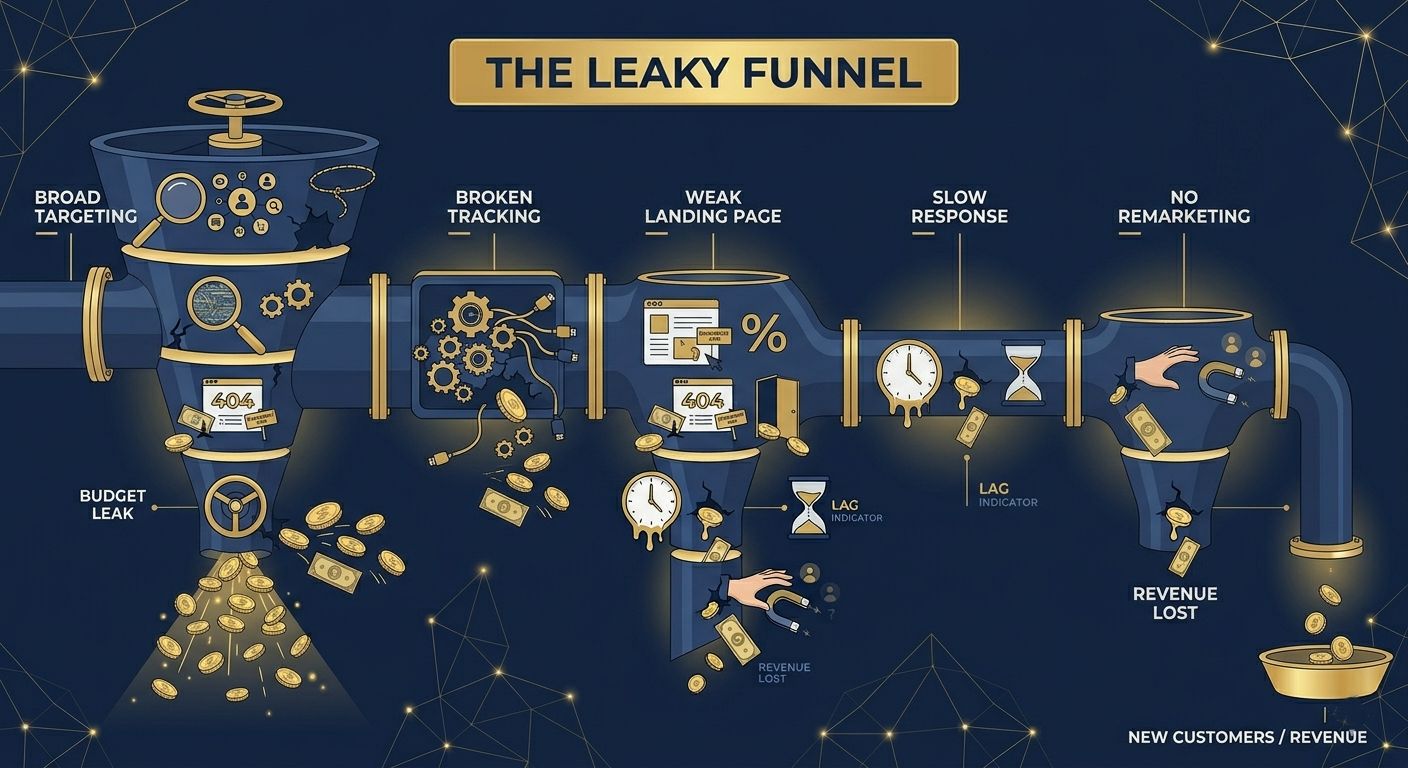
Every dollar wasted on an unbooked lead has a cause. After working with aesthetic practices across different markets, we've seen the same five culprits show up again and again.
If your Google Ads for plastic surgeons campaign can't tell which ads are generating actual consultation requests — not just clicks — Google's algorithm will keep optimizing toward the wrong goal. It'll spend your budget chasing the cheapest clicks, not the most valuable patients. Server-side tracking via GA4 and Google Tag Manager closes this loop completely, and it's one of the highest-leverage fixes we make in client accounts.
Sending paid traffic to your homepage is one of the most expensive mistakes in plastic surgery Google Ads. Your homepage has to serve everyone — existing patients, job seekers, curious browsers. A patient who searched "breast augmentation consultation" needs a page built specifically for that intent: before/after galleries, procedure details, financing options, and a clear consultation form. Procedure-specific landing pages routinely double conversion rates.
Running broad match keywords without a proper negative keyword list means your plastic surgery Google Ads are showing up for "plastic surgery jobs," "plastic surgery recovery foods," and "plastic surgery risks research papers." Real money lost. High-intent targeting means procedure-specific terms combined with a deep negative keyword list that excludes informational, employment, and DIY queries. The quality of clicks matters far more than the quantity.
A patient fills out your consultation form. They're ready, they're interested, they've done their research. But they're also looking at two or three other practices simultaneously. If your team responds within minutes, you win. If you respond 24–48 hours later, you've lost them — and you still paid for that lead. CRM automation with instant email and SMS confirmation, combined with a structured follow-up sequence, directly reduces lead leakage without spending an extra cent on advertising.
The average cosmetic surgery patient researches for 4–12 weeks before booking. They'll visit your site, browse your before/after gallery, and leave without booking. If you're not running remarketing campaigns on Google Display and Meta to stay top-of-mind during that research window, you're letting qualified, warm prospects drift to a competitor who is. Remarketing to existing site visitors costs a fraction of acquiring new traffic and closes the conversion loop beautifully.
Why Most Clinics Are Measuring the Wrong Things
Here's a hard conversation worth having: if your monthly marketing report leads with impressions, clicks, and reach — you're flying blind.
These vanity metrics feel satisfying because the numbers are large. 80,000 impressions! 1,200 clicks! But they tell you nothing about whether your marketing is actually generating revenue. The metrics that matter in a plastic surgery practice are further down the funnel.
| What Most Clinics Track | What Actually Drives Revenue |
|---|---|
| Impressions | Consultation Requests |
| Clicks | Consultation Show-Up Rate |
| Follower Count | Procedure Bookings |
| Website Sessions | Revenue Per Lead Source |
| Email Open Rate | Revenue Per Email Sequence |
The right tracking infrastructure answers one question above all others: "Which ad, keyword, or channel generated a patient who actually had surgery?" Without that answer, every budget decision is a guess.
The Patient Acquisition Formula That Changes Everything
Once your tracking is in place, you can start optimising each stage of the patient journey separately — which is where the real cost reductions happen. Think of it as a sequential funnel where every percentage-point improvement compounds.
Ad Click / Form
Booking Confirmed
Patient Arrives
Surgery Booked
& LTV
Here's why this matters mathematically. Say you're spending $10,000/month and generating 100 leads.
- Scenario A (no optimization): 100 leads → 30% book consultation = 30 consults → 50% show up = 15 patients → 40% proceed = 6 surgeries. Revenue: ~$90,000.
- Scenario B (optimized funnel): Same 100 leads → 50% book = 50 consults → 70% show up = 35 patients → 55% proceed = ~19 surgeries. Revenue: ~$285,000.
- Same ad spend. Three times the revenue. This is what funnel optimization actually delivers.
How Better Tracking Directly Lowers Your CPA

The single highest-leverage technical improvement for most plastic surgery practices we work with isn't a new ad creative or a bigger budget. It's fixing the tracking infrastructure so the data Google and Meta's algorithms receive is actually accurate.
Browser-side pixels miss 20–30% of conversions due to iOS privacy changes and ad blockers. Server-side tracking captures these events reliably, giving your campaigns clean data to optimize against.
Configure GA4 to track micro-conversions (gallery views, financing page visits, phone number clicks) and macro-conversions (form submissions, call bookings). This gives Google Ads better signals for smart bidding.
Connect your CRM to your ad platforms so you can pass back actual consultation and procedure data. When Google knows that patients from "mommy makeover surgeon" keywords convert to $15,000 procedures, it optimises for more of those patients — not just cheaper clicks.
With clean attribution in place, switch from manual CPC or Target CPA bidding to Target ROAS. You're no longer optimising for cost per lead — you're optimising for revenue per dollar spent. Entirely different outcome.
Real-World Results: What Fixing Attribution Actually Delivers
Summit reduces cost per lead by 97.8% in under 90 days
A health & wellness summit was struggling with extremely expensive lead generation on Meta Ads. Through advanced audience targeting, AI-powered optimization, and conversion-focused creative strategy, we transformed campaign performance and scaled registrations profitably.
Ready to Stop Paying Too Much for Consultations?
ImpactBrains specialises in full-funnel marketing for plastic surgery practices — from Google Ads setup and CRO to server-side tracking and CRM automation. Let's find out where your budget is leaking.
Impact Brains is a digital marketing agency specialising in SEO, Google Ads, and CRO for healthcare and aesthetic practices. Questions? Get in touch.
Why Your Plastic Surgery Practice Is Paying Too Much for Leads — And How to Actually Fix It
June 2026 · 9 min read · Impact Brains
Let's be direct: most plastic surgery practices are overspending on marketing. Not because their surgeons aren't talented. Not because the procedures aren't in demand. But because the systems connecting ad spend to booked consultations are quietly leaking money every single day.
The cosmetic surgery market is massive — global revenue is projected to reach $83.33 billion by 2034 — and demand for procedures has never been higher. Yet the average cost per lead in cosmetic surgery sits at $102–$134 for search ads alone, and many practices are seeing $200–$300+ per consultation when tracking is broken or targeting is broad.
The painful truth? Most of that waste is entirely preventable. And in this article, we're going to show you exactly where it's happening — and what a properly built marketing system actually looks like.
- The Real Cost of a Cosmetic Surgery Lead in 2026
- 5 Reasons Your Consultation Costs Keep Rising
- Why Most Clinics Are Measuring the Wrong Things
- The Patient Acquisition Formula That Changes Everything
- How Better Tracking Directly Lowers Your CPA
- Real-World Results: What Fixing Attribution Actually Looks Like
The Real Cost of a Cosmetic Surgery Lead in 2026
Before we talk about fixing anything, you need to know what the numbers actually look like across channels. These aren't worst-case scenarios — they're industry benchmarks.
Google Search Ads deliver the highest-intent patients — people actively searching "rhinoplasty consultation near me" are ready to book. But with an average CPC for cosmetic surgery now hovering between $8–$15 per click, a low-converting landing page can turn a $5,000 ad budget into a handful of consultations fast.
Meta Ads generate leads at a lower cost, but the qualification gap is real. A Facebook lead who saw your Botox ad while scrolling is not the same as someone who typed "mommy makeover surgeon [city]" into Google at 9pm. They require more nurturing, better follow-up sequences, and longer sales cycles.
Organic SEO, meanwhile, quietly converts at the highest rate of any channel — 18.9% lead-to-consultation according to First Page Sage's 2026 analysis. The catch? It takes 6–12 months to build meaningful traction. That's why your channel mix matters so much.
Not Sure What You're Actually Paying Per Consultation?
We'll audit your current ad accounts, landing pages, and tracking setup — and show you exactly where the budget is going.
Get a Free Marketing Audit5 Reasons Your Consultation Costs Keep Rising
Every dollar wasted on an unbooked lead has a cause. After working with aesthetic practices across different markets, we've seen the same five culprits show up again and again.
If your Google Ads for plastic surgeons campaign can't tell which ads are generating actual consultation requests — not just clicks — Google's algorithm will keep optimizing toward the wrong goal. It'll spend your budget chasing the cheapest clicks, not the most valuable patients. Server-side tracking via GA4 and Google Tag Manager closes this loop completely, and it's one of the highest-leverage fixes we make in client accounts.
Sending paid traffic to your homepage is one of the most expensive mistakes in plastic surgery Google Ads. Your homepage has to serve everyone — existing patients, job seekers, curious browsers. A patient who searched "breast augmentation consultation" needs a page built specifically for that intent: before/after galleries, procedure details, financing options, and a clear consultation form. Procedure-specific landing pages routinely double conversion rates.
Running broad match keywords without a proper negative keyword list means your plastic surgery Google Ads are showing up for "plastic surgery jobs," "plastic surgery recovery foods," and "plastic surgery risks research papers." Real money lost. High-intent targeting means procedure-specific terms combined with a deep negative keyword list that excludes informational, employment, and DIY queries. The quality of clicks matters far more than the quantity.
A patient fills out your consultation form. They're ready, they're interested, they've done their research. But they're also looking at two or three other practices simultaneously. If your team responds within minutes, you win. If you respond 24–48 hours later, you've lost them — and you still paid for that lead. CRM automation with instant email and SMS confirmation, combined with a structured follow-up sequence, directly reduces lead leakage without spending an extra cent on advertising.
The average cosmetic surgery patient researches for 4–12 weeks before booking. They'll visit your site, browse your before/after gallery, and leave without booking. If you're not running remarketing campaigns on Google Display and Meta to stay top-of-mind during that research window, you're letting qualified, warm prospects drift to a competitor who is. Remarketing to existing site visitors costs a fraction of acquiring new traffic and closes the conversion loop beautifully.
Why Most Clinics Are Measuring the Wrong Things
Here's a hard conversation worth having: if your monthly marketing report leads with impressions, clicks, and reach — you're flying blind.
These vanity metrics feel satisfying because the numbers are large. 80,000 impressions! 1,200 clicks! But they tell you nothing about whether your marketing is actually generating revenue. The metrics that matter in a plastic surgery practice are further down the funnel.
| What Most Clinics Track | What Actually Drives Revenue |
|---|---|
| Impressions | Consultation Requests |
| Clicks | Consultation Show-Up Rate |
| Follower Count | Procedure Bookings |
| Website Sessions | Revenue Per Lead Source |
| Email Open Rate | Revenue Per Email Sequence |
The right tracking infrastructure answers one question above all others: "Which ad, keyword, or channel generated a patient who actually had surgery?" Without that answer, every budget decision is a guess.
The Patient Acquisition Formula That Changes Everything
Once your tracking is in place, you can start optimising each stage of the patient journey separately — which is where the real cost reductions happen. Think of it as a sequential funnel where every percentage-point improvement compounds.
Ad Click / Form
Booking Confirmed
Patient Arrives
Surgery Booked
& LTV
Here's why this matters mathematically. Say you're spending $10,000/month and generating 100 leads.
- Scenario A (no optimization): 100 leads → 30% book consultation = 30 consults → 50% show up = 15 patients → 40% proceed = 6 surgeries. Revenue: ~$90,000.
- Scenario B (optimized funnel): Same 100 leads → 50% book = 50 consults → 70% show up = 35 patients → 55% proceed = ~19 surgeries. Revenue: ~$285,000.
- Same ad spend. Three times the revenue. This is what funnel optimization actually delivers.
How Better Tracking Directly Lowers Your CPA
The single highest-leverage technical improvement for most plastic surgery practices we work with isn't a new ad creative or a bigger budget. It's fixing the tracking infrastructure so the data Google and Meta's algorithms receive is actually accurate.
Browser-side pixels miss 20–30% of conversions due to iOS privacy changes and ad blockers. Server-side tracking captures these events reliably, giving your campaigns clean data to optimize against.
Configure GA4 to track micro-conversions (gallery views, financing page visits, phone number clicks) and macro-conversions (form submissions, call bookings). This gives Google Ads better signals for smart bidding.
Connect your CRM to your ad platforms so you can pass back actual consultation and procedure data. When Google knows that patients from "mommy makeover surgeon" keywords convert to $15,000 procedures, it optimises for more of those patients — not just cheaper clicks.
With clean attribution in place, switch from manual CPC or Target CPA bidding to Target ROAS. You're no longer optimising for cost per lead — you're optimising for revenue per dollar spent. Entirely different outcome.
Real-World Results: What Fixing Attribution Actually Delivers
Summit reduces cost per lead by 97.8% in under 90 days
A health & wellness summit was struggling with extremely expensive lead generation on Meta Ads. Through advanced audience targeting, AI-powered optimization, and conversion-focused creative strategy, we transformed campaign performance and scaled registrations profitably.
Ready to Stop Paying Too Much for Consultations?
ImpactBrains specialises in full-funnel marketing for plastic surgery practices — from Google Ads setup and CRO to server-side tracking and CRM automation. Let's find out where your budget is leaking.
Impact Brains is a digital marketing agency specialising in SEO, Google Ads, and CRO for healthcare and aesthetic practices. Questions? Get in touch.